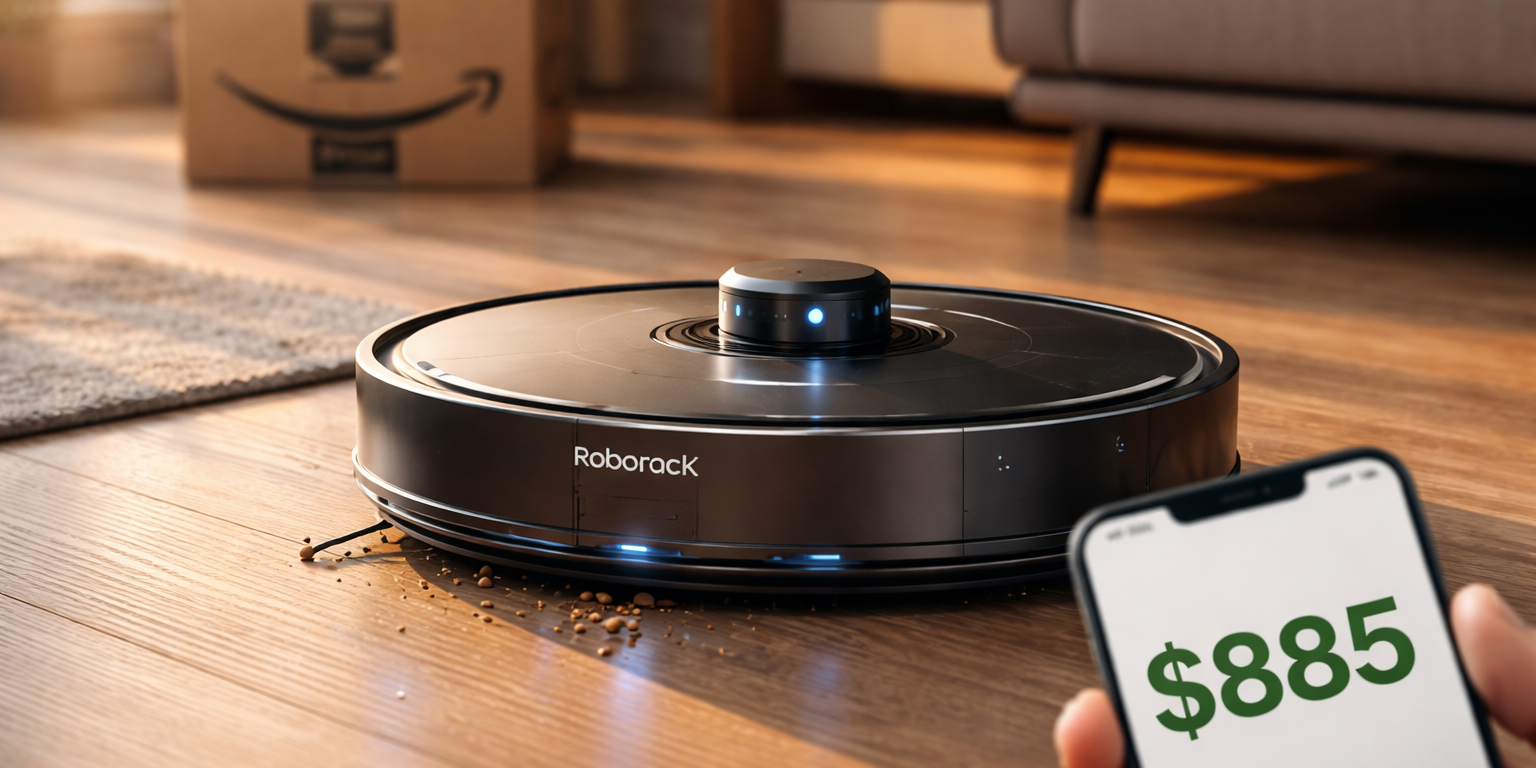
A $715 price drop on Roborock's Saros 10R brings the company's most advanced home cleaning robot to $885, positioning flagship-tier autonomous floor care within reach of a broader consumer segment and signaling intensifying competition in a category where hardware margins have thinned considerably over the past eighteen months. The discount, available through Amazon Prime, applies to a unit that integrates obstacle avoidance, self-emptying waste collection, and a docking station capable of washing and drying mop pads without user intervention. The list price of $1,600 represents the premium end of consumer robotics, a tier historically dominated by iRobot's Roomba Combo j9+ and Ecovacs Dexbot X2, both of which have also seen aggressive promotional pricing in recent quarters as brands struggle to maintain unit volume amid slowing household adoption rates.
Roborock, a Beijing-based subsidiary of Xiaomi that went public on the Shanghai Stock Exchange in 2020, has carved out a reputation for packing industrial-grade sensor arrays into consumer products. The Saros 10R ships with a suite that includes structured light for obstacle detection, LiDAR for mapping, and RGB cameras for object recognition, a combination more commonly found in warehouse automation platforms than devices meant for residential use. The self-emptying base uses cyclonic separation to pull debris from the robot's 350-milliliter onboard bin into a 2.5-liter bag that typically requires replacement every six to eight weeks under normal use. The mop system employs dual rotating pads that lift automatically when the robot transitions from hard flooring to carpet, a feature that earlier-generation hybrids lacked and which led to widespread complaints about cross-contamination and incomplete cleaning cycles. The docking station circulates heated water through the mop pads after each cleaning run, then forces air through them for drying, reducing the bacterial buildup that plagued first-wave mopping robots.
The timing of this discount reflects broader market dynamics reshaping the consumer robotics landscape. Brands that once commanded premium pricing based on early-mover advantage now face competition from manufacturers like Dreame, Narwal, and Eufy, all of which have introduced feature-equivalent models at lower entry prices. Market research from Omdia shows that the average selling price for robot vacuums with mopping capability dropped 22% between mid-2024 and early 2026, compressing margins and forcing established players to choose between protecting price positioning and maintaining market share. Roborock's decision to discount its flagship by nearly half suggests the company has opted for volume over margin, a strategy that mirrors moves by other hardware-centric robotics firms facing commoditization pressure. The shift comes as recurring revenue from consumables, software subscriptions, and extended warranties becomes increasingly central to profitability in consumer robotics, with hardware sales serving more as customer acquisition vehicles than standalone profit centers.
What remains notable about the Saros 10R, even at the discounted price, is the processing architecture underpinning its navigation stack. The robot runs a quad-core ARM processor paired with a dedicated neural processing unit capable of executing object classification models in real time without cloud dependency, an approach that addresses privacy concerns but increases bill-of-materials cost substantially compared to cloud-offload designs. The onboard compute enables the robot to distinguish between obstacles that should be avoided entirely, such as pet waste or charging cables, and objects it can safely push aside, like lightweight floor mats or stray socks. This decision-making happens at the edge with latency under 50 milliseconds, a specification that aligns more closely with industrial autonomous mobile robots than typical consumer appliances. The device also supports over-the-air firmware updates, a capability that extends its functional lifespan and allows Roborock to refine navigation algorithms based on aggregated anonymized usage data from its installed base, which the company reported at 18 million units globally as of Q1 2026.
The promotional pricing on the Saros 10R also highlights a strategic challenge facing consumer robotics companies as they scale: the gap between engineering capability and consumer willingness to pay continues to widen. Roborock has invested heavily in sensor fusion, simultaneous localization and mapping, and autonomous decision-making, technologies that carry significant R&D and component costs. Yet consumer surveys consistently show that price sensitivity in the home cleaning category remains acute, with most buyers unwilling to exceed $500 for a robot vacuum regardless of feature set. The $885 price point, while still elevated compared to mass-market models, represents an attempt to bridge that gap and capture buyers who recognize technical superiority but balk at four-figure price tags. Whether this strategy proves sustainable depends largely on Roborock's ability to drive down manufacturing costs through scale, shift value capture to software and services, or fundamentally rethink the business model around autonomous home care.
What to Watch: Roborock's Q2 2026 earnings report, expected in late July, will reveal whether the steep discounting strategy is moving unit volume enough to offset margin compression. Monitor whether competitors like Ecovacs and iRobot match the Saros 10R pricing or differentiate through software capabilities such as integration with smart home ecosystems. Also track the rollout of Roborock's subscription service for premium mapping features and predictive maintenance, announced in March 2026, as a signal of how aggressively the company intends to monetize its installed base beyond initial hardware sales.