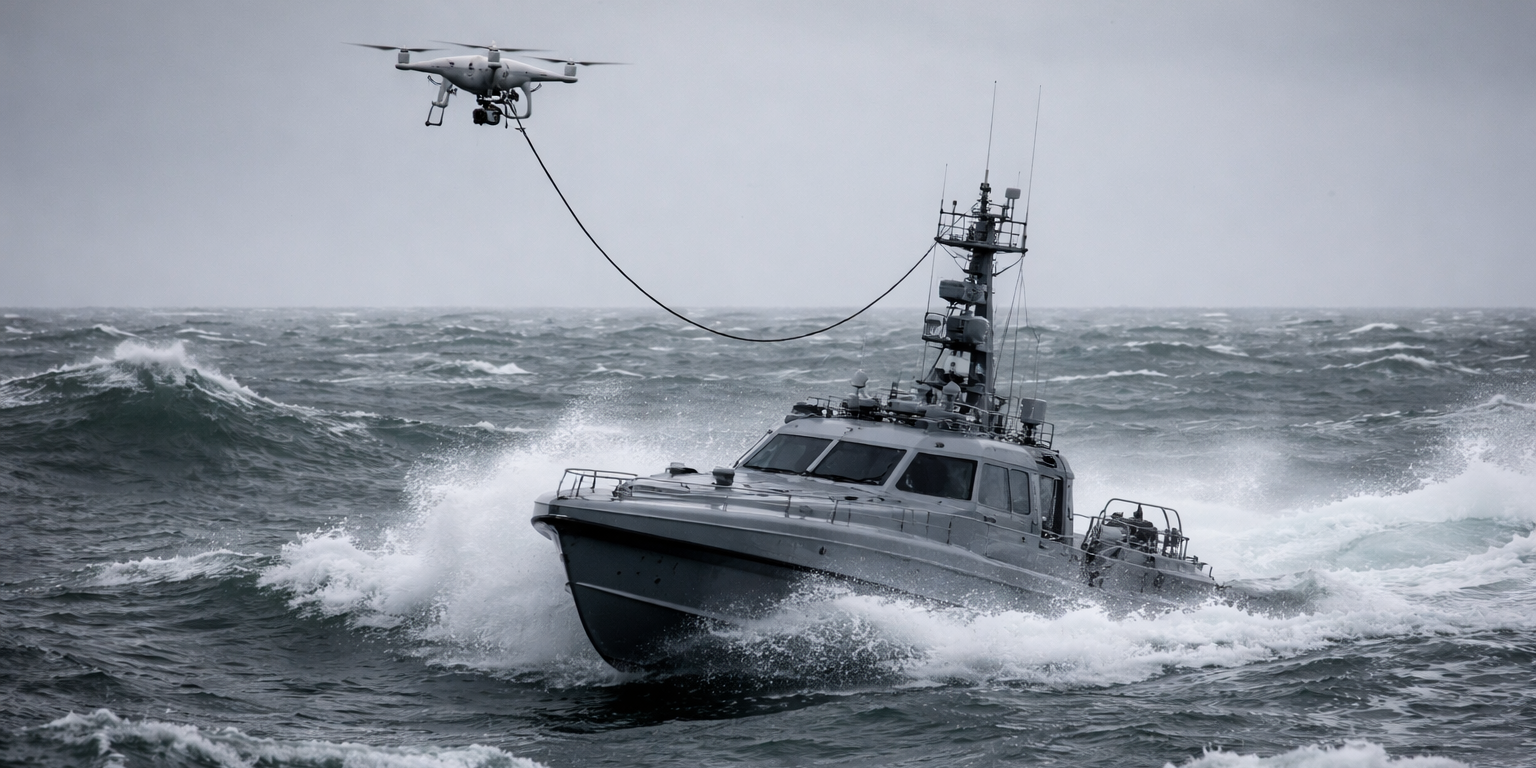
Waves reached 14 feet during recent Royal Navy trials of an autonomous surface vessel that launched, operated, and recovered a tethered aerial drone without crew intervention. The Ministry of Defence conducted the demonstrations in open ocean conditions off the UK coast, testing whether robotic maritime platforms could maintain aerial surveillance even when conditions would ground conventional systems. The persistence factor matters here: the vessel operated continuously for weeks at a stretch, a duration that exceeds most crewed patrol capabilities and approaches the operational threshold defense planners need for area denial and maritime domain awareness missions.
The physical tether connecting drone to vessel solves a problem that has plagued autonomous aerial systems since their inception. Battery endurance vanishes as a constraint when power flows through a cable rather than from onboard cells. The Royal Navy configuration allowed the aerial component to remain aloft indefinitely, transmitting sensor data in real time while the surface vessel provided propulsion, navigation, and power generation. Rough sea states typically force recovery of aerial assets, but the demonstrated system maintained flight operations in conditions that would have scrubbed missions using conventional launch and recovery methods. Defense contractors have pursued tethered drone concepts for land-based applications, but maritime deployment introduces complications from vessel motion, salt spray, and the mechanics of cable management during high sea states.
Autonomous surface vessels represent a growing segment of naval procurement as fleet commanders seek to distribute sensors across wider areas without proportionally increasing crew requirements. The US Navy has invested heavily in similar platforms through its Ghost Fleet Overlord program, while commercial operators including Saildrone and Ocean Infinity have deployed hundreds of uncrewed vessels for ocean mapping and environmental monitoring. The UK demonstration adds aerial capability to the surface autonomy stack, creating what amounts to a persistent mobile sensor tower that can reposition itself across thousands of nautical miles. The Royal Navy has not disclosed which contractors built the vessel or the tethered drone system, though UK defense firms including BAE Systems and QinetiQ have active programs in both autonomous surface vessels and tethered aerial platforms. The Ministry of Defence typically conducts early-stage trials using prototype systems before issuing production contracts, suggesting operational deployment remains several budget cycles away.
Persistent maritime surveillance ranks among the highest priorities for navies operating in congested waterways or contested regions where adversaries employ asymmetric tactics. Crewed vessels require rotation, resupply, and rest periods that create gaps in coverage. Satellite imagery offers global reach but lacks the revisit rate needed for tracking fast-moving surface contacts. Shore-based radar provides continuous monitoring only within a limited range of coastlines. The combination of an autonomous surface vessel with indefinite station-keeping ability and a tethered drone with unlimited flight time addresses each limitation simultaneously. The system can patrol chokepoints, monitor exclusion zones, or trail suspect vessels for extended periods at a fraction of the operational cost of crewed platforms. Defense analysts have projected that autonomous surface vessels could perform 40 to 60 percent of routine patrol missions currently assigned to frigates and corvettes, freeing those high-value assets for missions requiring human judgment or kinetic capability.
What to Watch: Monitor UK Ministry of Defence budget documents through late 2026 for production funding allocated to autonomous surface vessel programs, particularly any line items referencing aerial launch capability. Track patent filings from BAE Systems, QinetiQ, and Thales UK for tethered drone systems adapted to maritime environments, as these often precede contract awards by six to nine months. Watch for follow-on trials involving multiple coordinated autonomous vessels, which would signal progression toward operational deployment rather than technology demonstration.