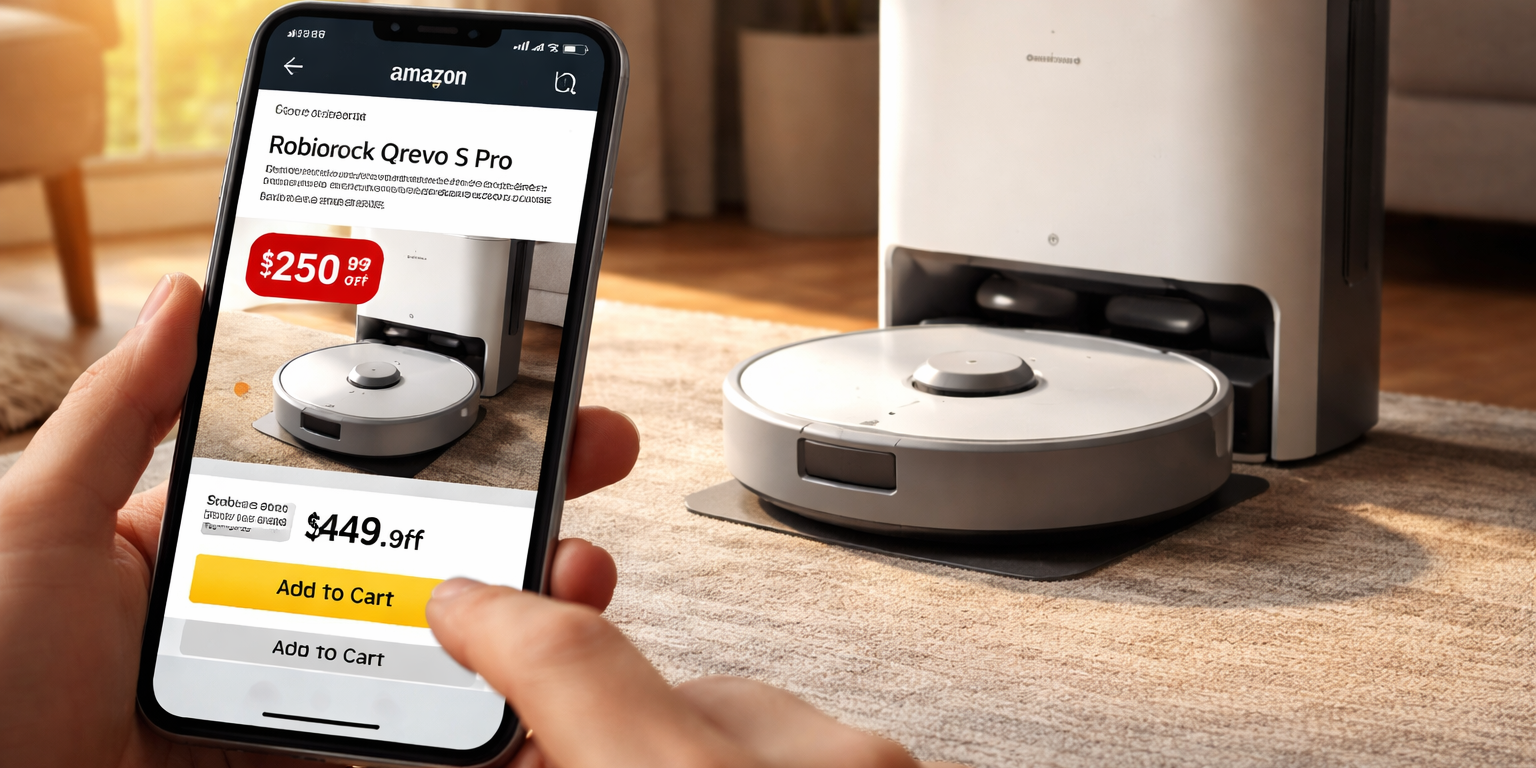
A $250 discount has brought Roborock's Qrevo S Pro—a combination vacuum-mop unit with autonomous dock maintenance—down to $450 for Amazon Prime subscribers, marking one of the steepest price corrections in the consumer floor robotics category this year. The Beijing-based manufacturer launched the model at $700 in early 2025, positioning it as a mid-tier alternative to its flagship Qrevo series. Fourteen months later, the sustained markdown suggests Roborock is defending market share rather than premium pricing, a shift that mirrors broader pressure across the category.
The Qrevo S Pro's feature set illustrates how much hardware has become table stakes in consumer robotics. Auto-empty bins, self-washing mopping pads, and docking stations that handle wastewater disposal once commanded $1,000-plus price tags. Now they appear in units retailing under $500. Roborock integrated simultaneous vacuum and mop operation, a LiDAR navigation stack for room mapping, and a 7,000Pa suction rating—specs that would have anchored a premium product two years ago. The dock handles both dustbin evacuation and mop maintenance autonomously, reducing human intervention to refilling clean water tanks and emptying dirty water every few weeks. For households with hard flooring and pets, the value proposition is straightforward: less manual labor, predictable performance, and a price point that no longer requires executive-level discretionary income.
The competitive landscape explains the pricing better than any feature list. Ecovacs, Dreame Technology, and Narwal have flooded Amazon and Best Buy with similarly equipped models, many priced between $400 and $600. Roborock held a first-mover advantage in LiDAR-based navigation and multi-surface cleaning, but manufacturing scale in Shenzhen has erased that lead. Component costs for solid-state LiDAR modules have dropped roughly 40% since 2024, according to supply chain data from Yole Intelligence, while brushless motor assemblies and lithium battery packs have followed similar trajectories. The result is a consumer robotics market where differentiation increasingly relies on software—app interfaces, room scheduling logic, obstacle avoidance algorithms—rather than hardware specs. Roborock's response has been to lean into aggressive promotions rather than attempt to justify premium pricing on brand alone. The company reported 18% year-over-year revenue growth in its most recent quarterly filing, but operating margins compressed by 3.2 percentage points, a dynamic playing out across the sector.
For robotics engineers and product teams, the Qrevo S Pro's architecture offers a case study in cost-efficient integration. The unit shares a sensor suite and motor platform with Roborock's higher-end models, achieving economies of scale while differentiating through dock features and software lockouts. The mopping system uses twin rotating pads with 200rpm actuation and downward pressure calibration, a mechanical approach that avoids the complexity and cost of ultrasonic vibration systems. The dock itself handles mop cleaning through a spray-and-scrub cycle, then uses heated air drying to prevent bacterial growth—an approach that balances effectiveness with Bill of Materials discipline. Navigation relies on a 2D LiDAR coupled with a front-facing RGB camera for obstacle recognition, a configuration that delivers room-level mapping without the computational overhead of full 3D SLAM. The tradeoffs are deliberate: Roborock sacrificed some low-light obstacle avoidance capability and real-time surface type detection in favor of a sensor stack that could hit a $450 retail price with margin intact.
The pricing pressure extends beyond Roborock. iRobot, now operating under Amazon ownership following its 2024 acquisition, has seen its Roomba Combo line drop below $600 for dock-equipped models, a threshold the company defended vigorously just eighteen months ago. Ecovacs' Deebot X2 series, which includes similar auto-maintenance features, routinely appears at $479 during promotional windows. The floor robotics category is tracking toward commoditization faster than analysts projected in 2024, when the installed base in North American households sat below 12%. Adoption has since climbed past 18%, driven largely by price compression and the maturation of dock-based automation that eliminated the most tedious aspects of robot ownership. What remains to be seen is whether manufacturers can sustain profitability as prices converge around the $400-$500 band, or whether consolidation will thin the competitive field by late 2027.
What to Watch: Monitor whether Roborock maintains the $450 price point past Amazon's summer sales events, or if this represents a temporary inventory clearance ahead of a next-generation Qrevo model. Track Ecovacs' Q3 2026 pricing on the Deebot X2 Combo, expected to launch in August with enhanced AI obstacle recognition—if it undercuts $450, expect broader category repricing. Watch for iRobot's integration moves under Amazon, particularly any bundling strategies with Alexa or Ring that could shift competitive dynamics beyond hardware specs alone.