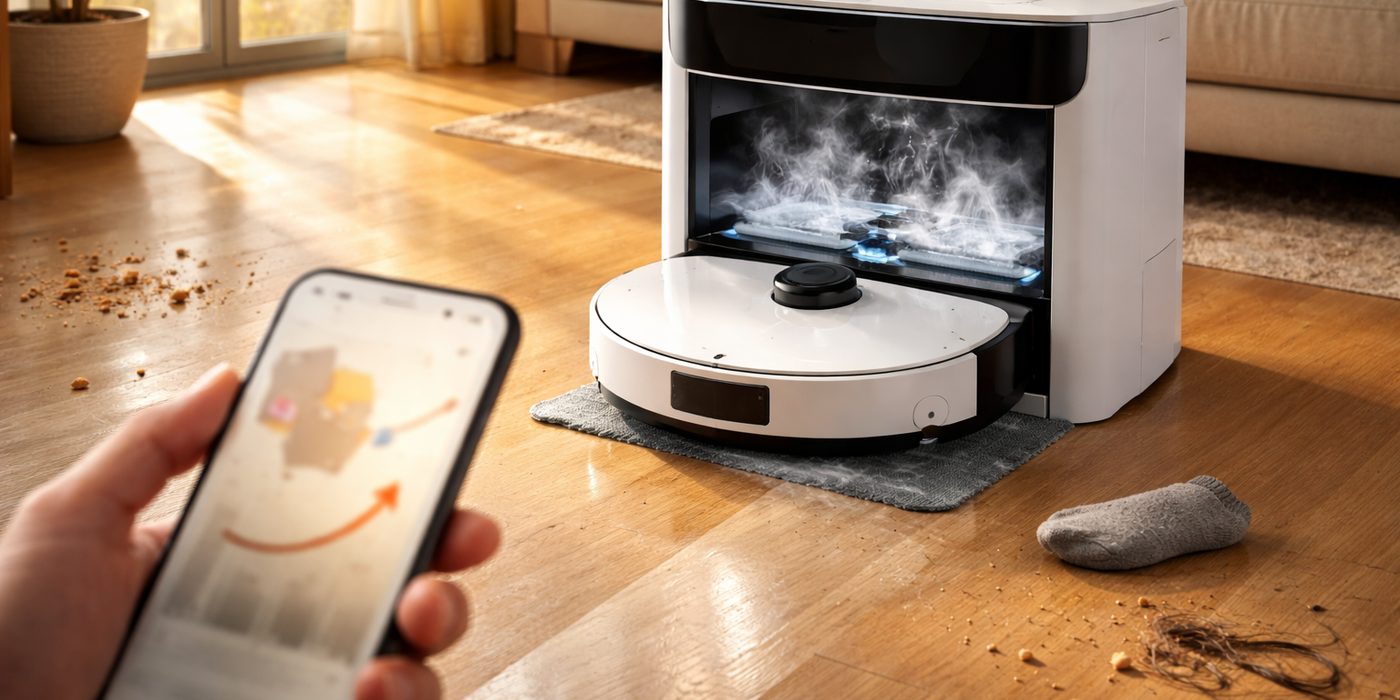
A robot that washes its own mop pads, empties its own dustbin, and navigates a cluttered living room without human rescue now costs less than a mid-range smartphone. That is the practical meaning of Walmart's $355 listing for the Roborock Qrevo QV35A, which sits $295 under its $650 list price, a 45 percent cut, with free shipping attached. Deal-tracking site Dealnews flagged the offer, pitching it at pet owners and anyone who wants vacuuming and mopping handled without pulling the unit apart for cleanup. The pitch is mundane. The price is the story. Features that defined the flagship tier of consumer floor-cleaning robots two product cycles ago are now being cleared at a discount most buyers would call impulse-purchase territory.
The Qrevo line occupies a deliberate middle position in Roborock's catalog. The Beijing-founded company, which listed on Shanghai's STAR Market in 2020 and has spent years jockeying with iRobot, Ecovacs, and Dreame for global share, built the series to bring dock-based automation down from its ultra-premium S-series. The QV35A's draw is the combination of high suction and a dock that scrubs and dries the mop pads between runs. That second feature matters more than it sounds. The chronic failure mode of early mopping robots was the unit itself: a damp, dirty pad dragged across clean floors, then left to breed odor. Automated pad washing converted a chore the owner performed into one the machine performs, and that is the difference between a gadget and an appliance.
Pet households are the segment where this hardware earns its keep, and the reason is mechanical rather than marketing. Hair, tracked-in litter, and the occasional accident stress every subsystem at once: suction, brush design, obstacle avoidance, and mop hygiene. A robot that handles that load without constant intervention has solved the real problem of home robotics, which is not navigation but maintenance burden. Every manual step an owner must perform, whether emptying a bin, rinsing a pad, or untangling a brush, is a point where the robot's autonomy ends and the human's labor resumes. Roborock's dock architecture is an attempt to push that boundary outward, and the QV35A's price now makes that attempt accessible to buyers who would not have considered it at $650.
For engineers and investors, the discount deserves a harder look than the shopper-facing framing invites. A 45 percent markdown at a mass retailer like Walmart can mean several things: inventory clearance ahead of a successor model, promotional pricing timed to the late-November shopping window, or a sign that the street price of this capability tier has permanently reset. The date matters here. With the listing surfacing during the Black Friday run-up, the cut may be partly seasonal. But the broader pattern across the category is consistent: docked mop-and-vacuum units that launched near $600 to $800 routinely settle in the $300 to $400 range within a year or two. That compression squeezes the entire segment, forcing vendors to differentiate on software, obstacle recognition, and service rather than on dock features that rivals can now match at lower cost. It also raises a quiet question about unit economics, since hardware sold at $355 has to cover the dock's pumps, heating elements, and water management, not just the robot body.
The competitive read-through extends beyond Roborock. Chinese manufacturers have driven the category's price curve down aggressively, and Western incumbents have struggled to hold premium positioning against hardware that matches or exceeds their specs at lower cost. When a mid-tier dock robot reaches $355, it pulls the floor under every competitor's entry-level SKU and shortens the window in which a new feature commands a premium. Meanwhile the consumer-robotics learning loop keeps tightening. Every cheap, capable unit sold adds to the installed base of mapped homes, usage telemetry, and trained obstacle models that vendors can use to improve the next generation. Low prices are not just a revenue concession. They are a data acquisition strategy, and the companies that stay in the volume game compound that advantage with each season.
What to Watch
Track whether Roborock's Qrevo pricing holds near $355 after the Black Friday and Cyber Monday window closes; a snap back toward $500 would confirm the cut was seasonal, while a sustained sub-$400 price would signal a permanent reset. Watch for Roborock's next-generation Qrevo or S-series announcements around CES in January 2026's follow-on cycle and early 2027 product teasers, since a successor launch is the usual trigger for deep clearance on the outgoing model. Compare Walmart's listing against Amazon and Roborock's own storefront over the coming weeks to see whether retailers are matching or undercutting each other. Finally, monitor competing dock-robot pricing from Ecovacs and Dreame through the holiday period, which will show whether the $355 tier is becoming the new baseline for self-washing mop robots.