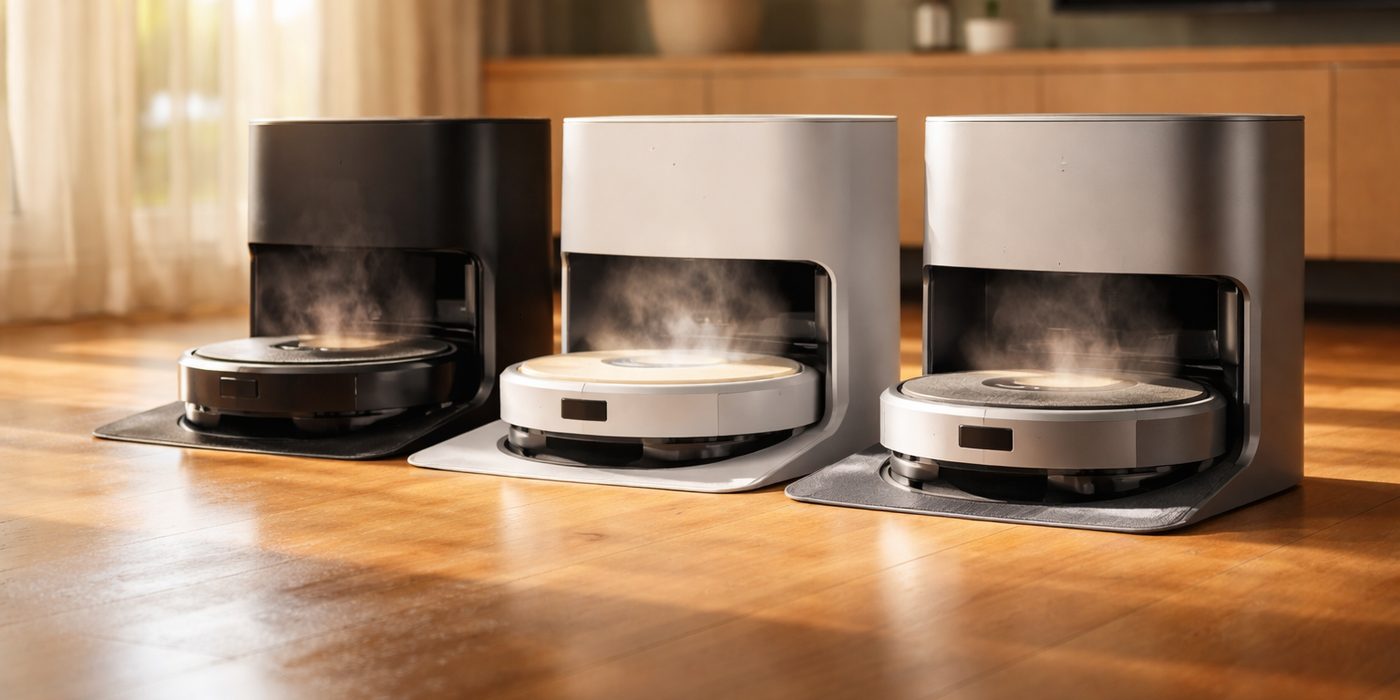
Three of the best-reviewed robot vacuums on the market now do the same thing after every cleaning run: they return to a dock, wash their mop pads, and dry them. That the washing-and-drying cycle is no longer a selling point but a baseline expectation is the quiet story behind a new Gearculture.com roundup of the Roborock Qrevo Edge 2, the Roomba Plus 405 Combo, and the Dreame L40 Ultra Gen 2. All three vacuum and mop. All three handle their own maintenance. What separates them is not capability but philosophy, and that split says a good deal about where consumer robotics competition is heading as 2026 draws to a close.
The feature that once justified a premium price has become table stakes. Self-cleaning mop docks arrived as a flagship luxury around 2022, when a handful of Chinese manufacturers began bundling hot-water pad washing and warm-air drying into stations that cost as much as a mid-range laptop. Four years on, the category has matured to the point where a reviewer can group three competing machines by what they share rather than what they lack. The dock, in effect, has become the product. A robot that cannot empty its own bin, scrub its own pads, and dry them against mildew is now treated as incomplete, which raises the engineering bar for every entrant and compresses margins for anyone who cannot build the station at scale.
Within that shared baseline, each company has staked out a distinct position. Roborock, the Chinese manufacturer that has spent years refining its mapping and obstacle-avoidance stack, pitches the Qrevo Edge 2 as the slim flagship, a machine built to reach under furniture and into tight clearances where thicker rivals stall. iRobot, the American pioneer whose Roomba name remains the category's most recognized brand, takes the opposite tack with the Plus 405 Combo: keep the routine plain, keep the interface simple, and carry the lowest price of the three. Dreame, meanwhile, leans on stamina with the L40 Ultra Gen 2, positioning endurance as its calling card for larger homes where run time and coverage matter more than a slim profile.
For engineers and investors, the interesting signal sits in iRobot's choice. The company that invented the mass-market robot vacuum is now competing on simplicity and price rather than technical leadership, a notable reversal from the era when its navigation and brand carried an automatic premium. That repositioning follows several turbulent years for the firm, including the collapse of its proposed Amazon acquisition in early 2024 and sustained pressure from lower-cost Asian rivals. Roborock and Dreame, by contrast, compete on hardware ambition, with slim chassis design and extended battery performance serving as visible proof points. The result is a three-way market where one player defends a mainstream niche while two push the engineering envelope, and where the dock's washing-and-drying system gives all three a common architecture to refine.
The broader lesson reaches well beyond the living room. Domestic robotics has repeatedly shown that autonomy alone does not sell units; maintenance burden does. The vacuum category found its inflection point only when robots stopped asking owners to rinse filters and wring out mops, and every adjacent segment, from lawn mowers to window cleaners to the humanoid helpers now in early pilots, faces the same test. Whichever machine requires the least human intervention between tasks wins the repeat purchase. The Qrevo Edge 2, Plus 405 Combo, and L40 Ultra Gen 2 are best understood as three answers to that one question, each trading a different variable, whether reach, simplicity, or endurance, to reduce what the owner has to do.
What to Watch
Holiday-season pricing over the next 30 to 60 days will show how aggressively Roborock and Dreame discount their docked flagships against the Roomba Plus 405 Combo, since Black Friday and Cyber Monday promotions typically expose true margin structure. Track whether iRobot's plain-and-cheap strategy holds its unit share in North America or erodes further against the two Chinese challengers. Watch for CES 2027 announcements in early January, where successors to all three platforms, and any new dock-automation features, are likely to surface. Finally, monitor reviewer reports on long-term pad hygiene and dock reliability, the metric that will ultimately decide whether self-drying stations earn their cost.