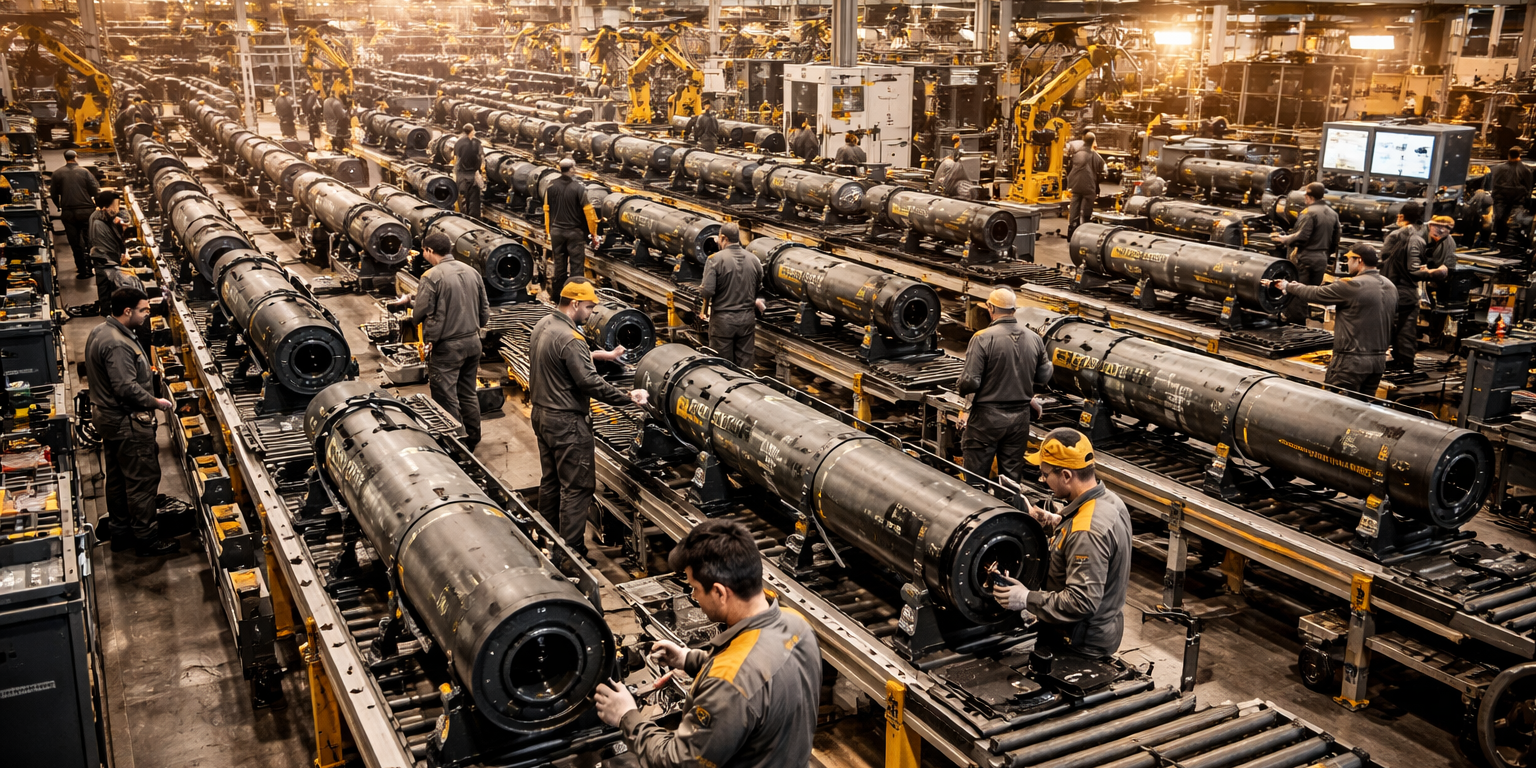
Renault will produce 1,000 Thales Toutatis loitering munitions per month at a converted automotive plant, the companies confirmed last week, establishing the highest-volume production line for remotely operated strike drones in Europe. The arrangement transforms a segment of Renault's existing factory infrastructure into a defense production facility, leveraging automotive manufacturing techniques to scale output of the tube-launched system at speeds defense contractors have struggled to match. Thales developed the Toutatis as a man-portable loitering munition with a reported range of 10 kilometers and a flight endurance of 30 minutes, positioning it as a tactical asset for forward units rather than a strategic platform. The monthly production target of 1,000 units translates to 12,000 systems annually, a figure that dwarfs current European output of comparable systems and signals France's intent to become a primary supplier of expendable drone munitions across allied forces.
The partnership represents a sharp departure from traditional defense manufacturing models, where specialized contractors maintain dedicated facilities with production runs measured in dozens or hundreds of units per month. Renault brings automotive assembly line discipline, supplier networks, and quality control systems honed over decades of producing 2 million vehicles annually across its global footprint. Those capabilities matter for a weapon system designed to be expended in single-use strikes, where unit economics and production velocity determine tactical viability as much as technical performance. Automotive manufacturers have entered defense production before, most notably during World War II mobilization, but modern precedents remain limited. Renault's move follows growing acknowledgment among European defense ministries that traditional contractors lack the manufacturing throughput to meet demand for unmanned systems in high-intensity conflict scenarios. Ukraine's consumption of thousands of small drones monthly has clarified the arithmetic: future conflicts will require industrial-scale production of expendable autonomous platforms, not boutique fabrication.
Thales holds established positions in European defense electronics, radar systems, and avionics, but loitering munitions represent a category where the company faces competition from smaller, more agile firms and a flood of low-cost options from non-European suppliers. The Toutatis uses electric propulsion and incorporates a warhead designed to defeat light armor and fortified positions, according to specifications Thales has disclosed at defense exhibitions. The system's tube-launch format allows infantry squads to deploy it without specialized equipment, and its remote operation architecture keeps human operators in the targeting loop, a design choice aligned with French defense policy on autonomous weapons employment. Pricing details for the Toutatis have not been made public, but comparable systems from European manufacturers typically run between €40,000 and €70,000 per unit depending on sensor packages and warhead options. At 1,000 units monthly, even conservative estimates place the program's monthly output value north of €40 million, establishing the partnership as a material revenue stream for both companies.
France's Ministry of Armed Forces has emphasized domestic production capacity for critical defense systems as a strategic priority, particularly after supply chain disruptions exposed European dependence on external sources for everything from semiconductors to raw materials. The Renault-Thales collaboration fits within that framework, creating a production pipeline insulated from foreign supply constraints and positioned to serve not only French forces but also export customers across Europe and allied nations in other regions. The arrangement also raises questions about dual-use manufacturing, where facilities toggle between civilian and defense production, a model common in Cold War industrial policy but largely abandoned in the post-1991 period. Renault's participation suggests that boundary may be eroding as European governments seek surge capacity that can scale rapidly in response to geopolitical developments. Whether other automotive manufacturers follow Renault's lead will depend partly on regulatory frameworks governments establish to incentivize or mandate defense production commitments from civilian industrial players.
What to Watch: Monitor whether Renault discloses which specific factory will house Toutatis production and whether the company plans to establish separate drone manufacturing subsidiaries or integrate defense output within existing divisions. Track export license approvals for the Toutatis to identify which countries will receive systems and in what volumes, as those orders will determine whether the 1,000-unit monthly target proves sustainable or requires adjustment. Watch for announcements from other European automakers, particularly Stellantis and Volkswagen Group, regarding defense manufacturing partnerships, as Renault's move may pressure competitors to pursue similar arrangements. Pay attention to French Ministry of Armed Forces procurement announcements in Q3 2026, which will clarify whether domestic orders justify the production scale or whether export sales must carry the program.