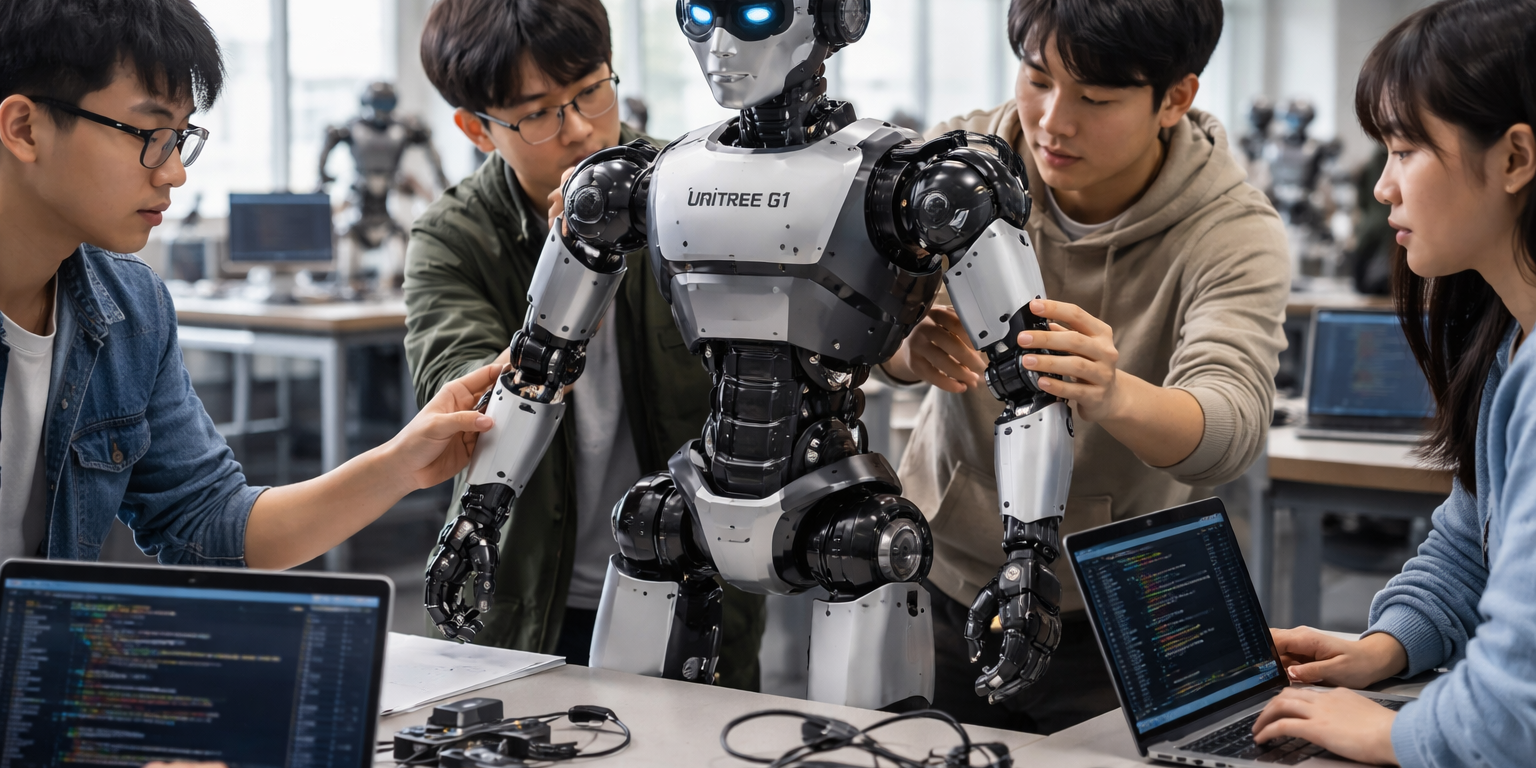
Scientific research and education account for more than 70 percent of Unitree Robotics' humanoid robot revenue, a revenue mix that sets the Chinese manufacturer apart from Western competitors chasing logistics and warehouse deployment. The company has formalized industrial-college partnerships with more than ten universities distributed across Qingdao, Hefei, Suzhou, Wuhan, Guangzhou, and other manufacturing-heavy cities, according to details emerging ahead of its initial public offering. What looks like workforce development is actually customer acquisition at scale. Universities are buying the hardware, training the next generation of roboticists on Unitree platforms, and in the process, cementing the company's position as the default standard for an entire cohort of Chinese engineering graduates who will carry that familiarity into industry.
Unitree has been shipping quadruped robots since 2017 and entered the humanoid market with relatively low-cost platforms that undercut Boston Dynamics and Agility Robotics by wide margins. The G1 humanoid, introduced in mid-2024 at a starting price near $16,000, made headlines for bringing bipedal robotics within reach of university labs that previously could not afford six-figure platforms from Western manufacturers. The company followed with the H1 and subsequent iterations, each priced to move volume into academic settings rather than waiting for commercial deployment to mature. That pricing strategy now appears less about market disruption and more about building an installed base where the next decade of Chinese robotics talent will be trained. Universities are sticky customers. Once a platform is integrated into curriculum, research programs, and lab infrastructure, switching costs are high and replacement cycles are long.
The ten-city footprint spans China's industrial core. Qingdao is home to Haier and a concentration of appliance manufacturers. Hefei has become a hub for electric vehicle and battery production. Suzhou and Guangzhou anchor electronics and consumer goods manufacturing. Wuhan combines automotive production with a growing semiconductor sector. These are not randomly selected markets. Each city represents a manufacturing cluster where robotics talent will be absorbed directly into local industry, and where Unitree's presence in university labs translates into familiarity among the engineers who will specify automation platforms in three to five years. The partnerships reportedly include joint research programs, shared lab facilities, and curriculum development, but the structure also ensures a steady flow of hardware purchases as universities expand programs and refresh equipment. Unitree's revenue model resembles enterprise software more than industrial equipment, with recurring engagement through education rather than one-time capital expenditure.
The IPO timing remains unspecified, but the move to formalize university partnerships ahead of a public offering suggests Unitree is building a narrative around predictable revenue and strategic positioning rather than speculative deployment milestones. Investors in robotics companies have grown wary of timelines that promise commercial scale in logistics, healthcare, or manufacturing within 18 months. Unitree's pitch appears different: revenue is already flowing, customers are institutions with multi-year budget cycles, and the company is embedding itself in the talent pipeline that will define China's automation workforce through the end of the decade. The risk is that education revenue does not scale at the rate of venture-backed competitors racing toward enterprise contracts, but the counterargument is that Unitree is playing a longer game. By the time humanoid robots are genuinely viable in factory settings at scale, potentially in the late 2020s, an entire generation of Chinese engineers will have trained on Unitree hardware. That installed base has strategic value that pure deployment metrics do not capture.
What to Watch: Unitree's IPO prospectus, once filed, will reveal the breakdown between education and commercial revenue, gross margins by customer segment, and whether university contracts include multi-year commitments or are renewed annually. Monitor whether competing Chinese humanoid manufacturers, including Fourier Intelligence and UBTech, adopt similar education-first strategies or continue targeting enterprise pilots. Also track which universities outside the initial ten cities sign partnerships in the second half of 2026, as geographic expansion will signal whether this model is scalable nationally or limited to established manufacturing hubs. Finally, watch for announcements of joint research outputs or patents emerging from these partnerships, which would indicate whether the collaborations are producing defensible IP or are purely transactional hardware sales.