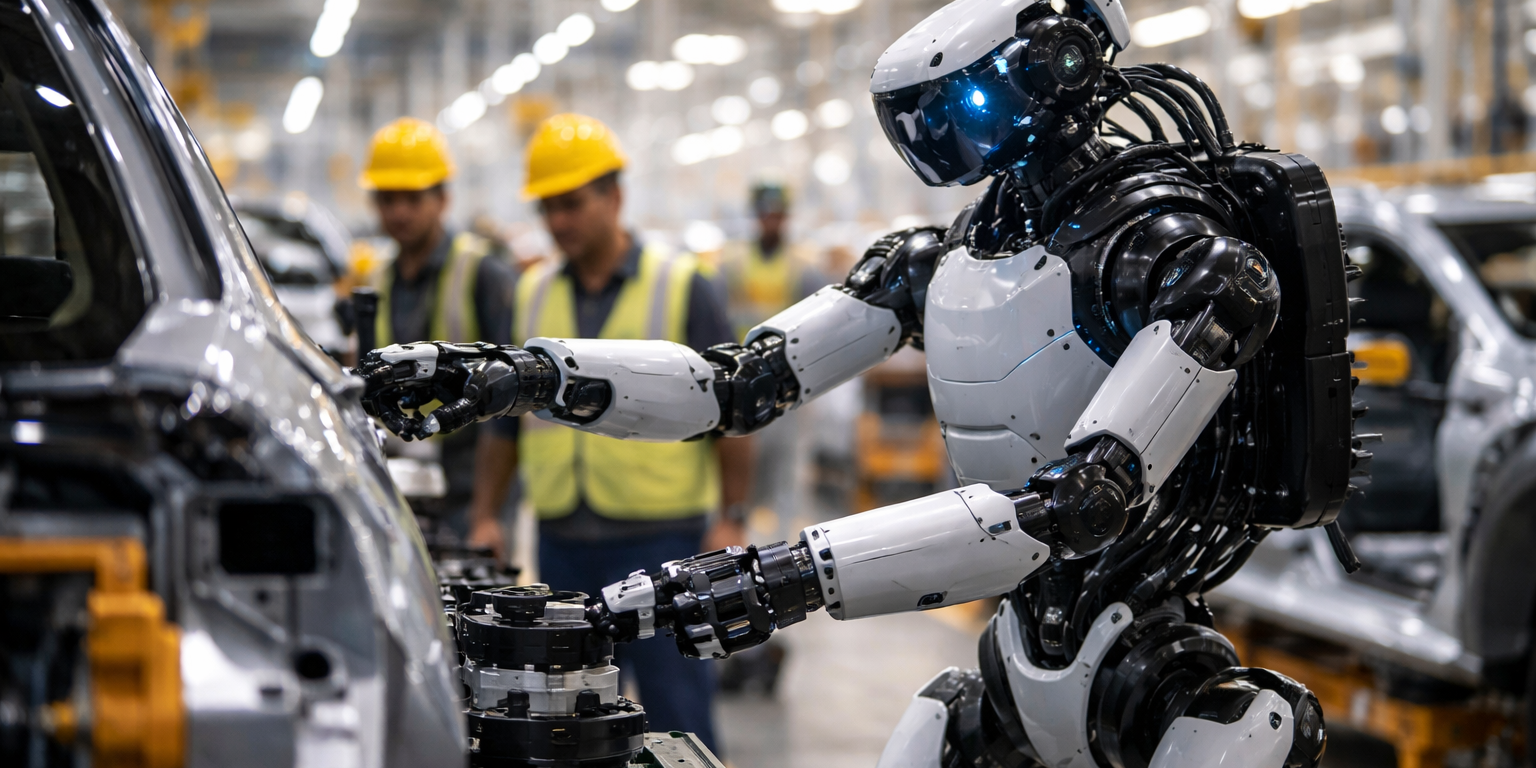

A tenfold market expansion rarely happens by accident. Physical AI—the category encompassing robots and autonomous systems capable of perceiving, reasoning about, and acting within unstructured real-world environments—is projected to balloon from $1.50 billion in 2026 to $15.24 billion by 2032. That 47.2% compound annual growth rate substantially exceeds forecasts for traditional industrial robotics, which typically track in the mid-teens. The divergence matters because it confirms what industry observers have suspected for eighteen months: AI integration, not mechanical innovation, now determines which robotics platforms win commercial traction. The forecast, released through industry channels this week, identifies defense modernization programs and healthcare system automation as the two dominant demand drivers, with manufacturing and logistics transitioning from experimental deployments to fleet-scale operations.
Defense organizations worldwide are reshaping procurement priorities around autonomous systems that can operate in contested or hazardous environments without continuous human oversight. These platforms span reconnaissance drones with real-time obstacle avoidance, autonomous ground vehicles for logistics convoys, and mobile manipulation systems for ordnance handling. Unlike previous generations of military robotics that required dedicated operators for each unit, physical AI systems employ onboard perception and decision-making that allows small teams to supervise multiple platforms simultaneously. This operational leverage explains why defense spending on autonomous systems has accelerated even as overall procurement budgets face pressure. Healthcare presents a different equation but similar economics. Hospital systems confronting persistent staffing shortages are deploying AI-enabled mobile robots for medication delivery, specimen transport, and environmental services—tasks that free clinical staff for patient-facing work. More advanced applications include surgical assistance robots with autonomous instrument tracking and patient monitoring systems that combine computer vision with predictive analytics.
Digital twin technology is emerging as critical infrastructure within this expansion, though it receives less attention than the physical robots themselves. These virtual replicas—complete physics simulations of robotic systems and their operating environments—allow developers to test navigation algorithms, manipulation strategies, and failure modes across millions of scenarios before hardware deployment. Boston Dynamics, Figure AI, and several defense contractors now maintain digital twin environments that mirror factory floors, hospital corridors, and outdoor terrain with centimeter-level precision. The technology reduces development timelines by identifying edge cases and software bugs in simulation rather than through expensive physical testing. It also enables continuous improvement after deployment, as operators upload performance data from field robots to refine the digital models, then push updated algorithms back to the fleet. This closed-loop optimization, impossible with conventional robotics, helps explain why physical AI platforms improve faster than their predecessors and why organizations that have deployed them report accelerating return on investment.
The 47.2% growth rate carries implications beyond robotics suppliers and their customers. Component manufacturers supplying LiDAR sensors, depth cameras, GPU accelerators, and electric actuators are seeing demand shift from prototype quantities to production volumes that require supply chain reconfiguration. Universities and technical institutes are struggling to produce enough robotics engineers and AI specialists to support commercial deployment schedules, creating wage pressure and talent competition that favors organizations with established training programs. Insurance and legal frameworks are adapting more slowly, with autonomous robot liability remaining contested territory in most jurisdictions. Investment patterns show venture capital flowing toward companies with deployed systems and revenue rather than concept-stage platforms, a shift that typically signals market maturation. Several major industrial automation providers that built businesses around conventional programmable robots now face strategic decisions about whether to develop physical AI capabilities internally, acquire specialist firms, or risk irrelevance as customers prioritize autonomous systems. The market consolidation expected over the next eighteen months will likely determine which robotics brands remain independent and which become acquisition targets for automotive, aerospace, or technology conglomerates seeking positions in the physical AI supply chain.
What to Watch: Track procurement announcements from the U.S. Department of Defense and European defense agencies through Q2 2025, particularly for autonomous ground vehicle programs that specify real-time decision-making capabilities rather than remote operation. Monitor healthcare systems in labor-constrained markets—Japan, Germany, and U.S. regions with nursing shortages—for expansion of existing robot deployments beyond pilot wards to facility-wide operations. Follow hiring patterns at physical AI developers; companies scaling engineering teams by 50% or more are likely preparing for production contracts already in negotiation.