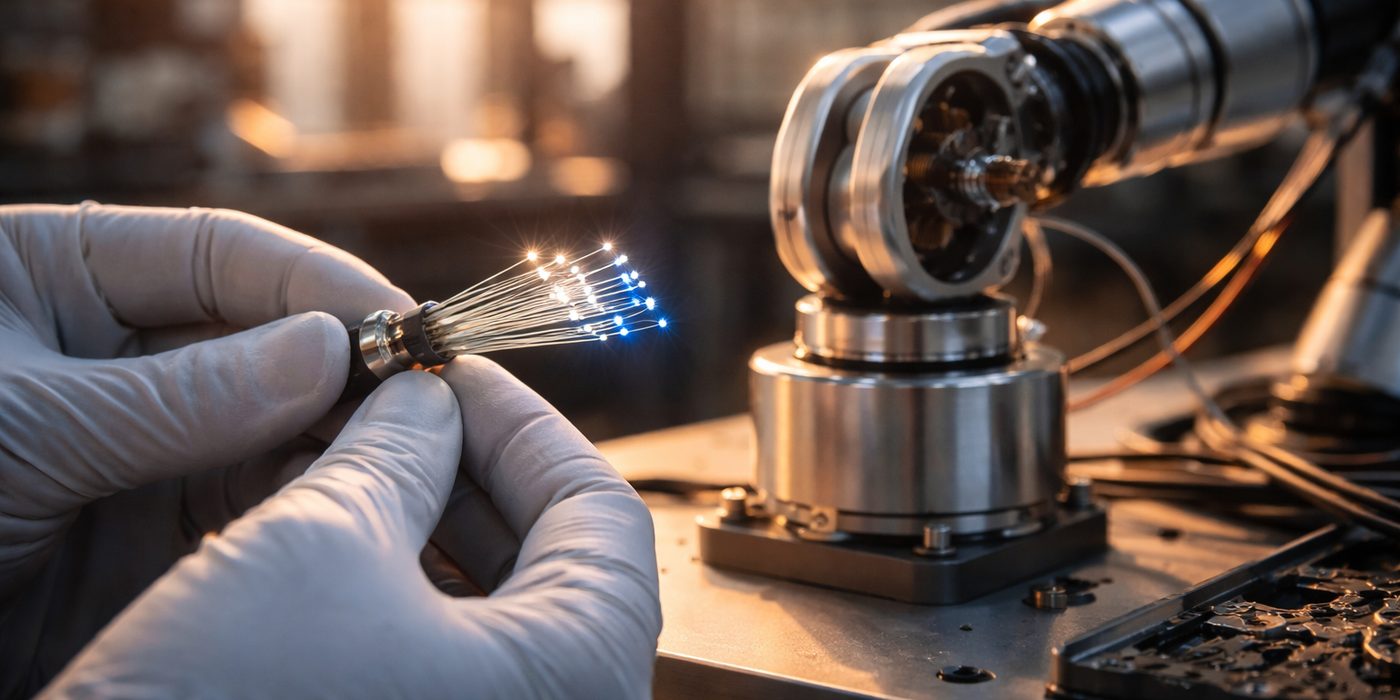
Third quarter of 2027 is when Pan-International Industrial Corp. plans to put motors built for humanoid robots on the market, according to a Digitimes report, and it will get there by way of a very different product. The Taiwan-based manufacturer is aiming to begin shipping high-density MMC optical-fiber connectors in the first quarter of 2027, six months before the motor launch. The two lines have almost nothing in common technically. One moves light through AI server racks. The other moves limbs. But both draw on the same underlying competence: precision manufacturing of small, tightly toleranced parts at volume, which is the unglamorous skill that decides who profits when a hardware category scales.
Pan-International is hardly a household name outside Taiwan's electronics supply chain, and that is part of the story. The company has long made connectors, cables, and related interconnect components, the passive hardware that sits between the chips and boards that attract attention and investor money. MMC connectors address a specific bottleneck in AI infrastructure. As GPU clusters grow, the number of optical fibers that have to be terminated in each rack climbs sharply, and traditional connectors consume too much faceplate space. Higher-density formats pack more fiber channels into the same footprint, which is why connector makers across Asia have been racing to qualify products with hyperscalers and the server builders that supply them. A first-quarter 2027 shipment target puts Pan-International in that queue behind established players, so qualification cycles and customer wins will matter more than the launch date itself.
The humanoid motor program is the more speculative of the two, and the more interesting for readers of this publication. Humanoid developers have spent the last two years discovering that actuators, not AI models, are the stubborn constraint on cost and reliability. A full-size humanoid needs somewhere between two and three dozen joints, each requiring a motor, a reducer, sensing, and a driver, and the torque density and thermal behavior of those assemblies drive both the price and the failure modes. Most of the volume today flows to a small group of Chinese suppliers who have scaled alongside Unitree, UBTech, and AgiBot. Taiwanese component makers are now trying to carve out a position as an alternative source, one that Western and Japanese humanoid builders wary of single-country dependence might prefer. Pan-International's pitch, as reported, is to extend its precision-manufacturing base into motors rather than to invent a new actuator architecture.
Here is the sharper observation. A third-quarter 2027 launch date means Pan-International will not have production motors in customer hands until roughly a year from now, and humanoid platforms are being locked in much earlier than that. Design wins for hardware that ships in volume in 2028 and 2029 are being decided in 2026 and early 2027, when engineering teams freeze their joint architectures and pick suppliers for validation builds. A motor that launches in the third quarter of 2027 risks arriving after the sourcing decisions for the next generation of humanoids have already been made. Unless Pan-International is sampling to customers well ahead of commercial launch, it may be competing for the generation after next. The company has not publicly named customers or published torque and efficiency specifications, and without them the market cannot yet judge whether the product is competitive.
The pairing of optical connectors and humanoid motors also reflects a broader pattern among Asian electronics manufacturers: use the cash flow from the AI data-center boom to fund entry into physical-AI hardware. Connector and interconnect demand tied to server buildouts is real and current, while humanoid volumes remain measured in the thousands of units per year across the industry. A supplier that can finance motor development from data-center margins can afford to wait for the humanoid market to mature, a luxury that pure-play actuator startups do not have. That asymmetry favors diversified component houses over specialists in a prolonged ramp. It also means the connector business will likely determine how much capital and engineering attention the motor program receives if humanoid demand arrives slower than forecasts suggest. For investors, the signal to read is capital allocation, not the launch dates: how much capacity Pan-International commits, and whether it secures an anchor customer before building it.
What to Watch Track whether Pan-International names a humanoid OEM or Tier 1 partner for its motors before the end of the first quarter of 2027, since an announced sampling relationship would be the clearest evidence the program is real. Watch the company's upcoming earnings calls for capital expenditure guidance tied to motor production lines and for any mention of MMC connector qualification with hyperscalers or server ODMs ahead of the first-quarter shipment target. Compare its eventual torque-density and efficiency figures against actuator offerings from established Chinese suppliers and from Taiwanese rivals entering the same space. Finally, monitor humanoid platform announcements from Unitree, UBTech, and Western developers through early 2027 for sourcing shifts that would indicate whether non-Chinese actuator suppliers are gaining traction.