
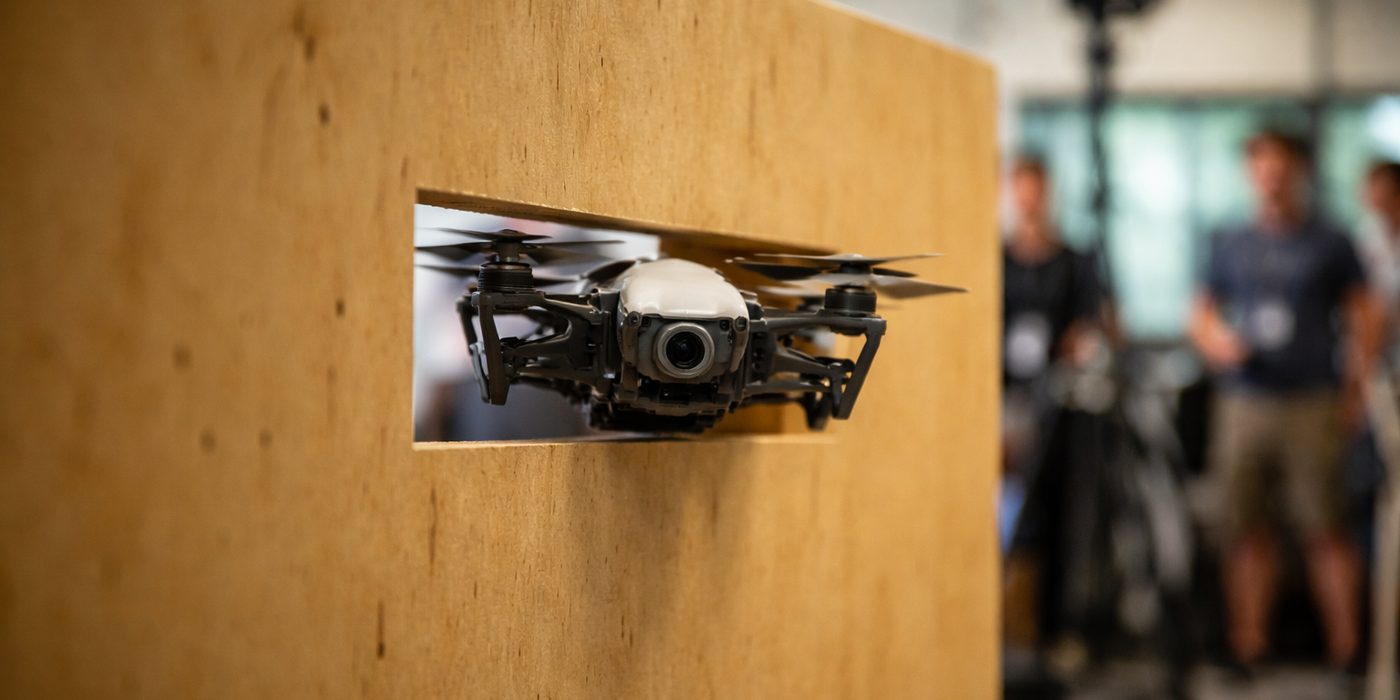
A quadrotor that cannot fit through a gap should, by conventional logic, go around. A research team has built one that goes through anyway, folding its two side arms inward mid-flight to pass openings narrower than its own body. The work, featured in IEEE Spectrum's weekly Video Friday roundup, rests on a design method that optimizes the aircraft's geometry and the arm-folding trajectory together, rather than bolting a morphing mechanism onto a finished airframe and hoping the controller sorts it out. The distinction matters. Most morphing-drone prototypes treat shape change as an afterthought to a fixed design.
The underlying problem is old and stubborn. Quadrotors are efficient because their rotors sit at the corners of a rigid, symmetric frame, and that same frame makes them wide. Wide aircraft get stuck in doorways, ductwork, collapsed-building rubble, and the dense steel of industrial plants. Engineers have attacked the problem from several directions: shrinking the vehicle, adding protective cages that inflate its footprint, or planning aggressive tilted flight paths that slip a rigid body through at an angle. Each carries a cost. Smaller drones carry less payload and fly shorter. Cages add mass and drag. Tilted flight demands precise state estimation and leaves almost no margin for error when the gap is tight.
Folding arms offer a different trade. Instead of adapting the path to the body, the body adapts to the path, and the researchers' contribution is in how they decide what that body should look like. By jointly optimizing the frame's dimensions and the choreography of the two side arms, the method searches for geometries that remain flyable through the transition, not just at the endpoints. That is the hard part. A folded configuration shifts the center of mass, changes the thrust distribution across the rotors, and alters the inertia the flight controller has to manage, all while the vehicle is moving. A design tuned only for its unfolded state can become uncontrollable halfway through a squeeze.
For the industry, the interesting question is less whether the stunt works than where it transfers. Search-and-rescue teams have long wanted aerial platforms that can enter structures through breaches no larger than a manhole. Inspection operators working inside boilers, tanks, and wind-turbine blades face the same constraint, as do warehouse operators weighing drones for inventory scans between tightly packed racking. A platform that stays large and stable in open air, then contracts to clear an obstruction, offers a payload-and-endurance profile that a permanently small drone cannot match. The caveat is mechanical: every actuated joint is a failure point, a weight penalty, and a certification headache, and the economics only favor folding when the missions genuinely demand both open-air range and confined-space access.
The work also lands at an awkward moment of convergence between aerial robotics and the humanoid and legged platforms that dominate investor attention in 2026. The common thread is co-design, the practice of optimizing hardware and control as one system instead of handing a finished chassis to a software team. Legged and humanoid developers have embraced it for actuator selection and limb proportions. Aerial morphing has lagged, partly because flight leaves so little margin for a poorly matched body. If joint optimization of geometry and motion proves repeatable across vehicle classes, it becomes a general methodology rather than a one-off demonstration. That is the observation worth sitting with: the headline stunt is a squeeze through a narrow gap, but the durable idea is that the airframe itself becomes a variable the optimizer is allowed to change.
The Video Friday format that surfaced this work is itself a useful signal. IEEE Spectrum's weekly collection, which also maintains a running calendar of upcoming robotics events, tends to capture research a few months before it reaches commercial roadmaps, and the same edition lists Humanoids 2026, scheduled for 6-9 December 2026 in Santa Clara, California. Academic demonstrations like this one rarely carry price tags or production timelines, and none has been disclosed here. What they offer instead is an early look at which design assumptions are about to be questioned. Fixed-frame quadrotors have dominated for fifteen years largely because nobody had a clean way to design a frame that changes shape without sacrificing flight authority. A credible method for doing so, even in a research setting, reopens a design space that most commercial vendors had treated as closed.
What to Watch
The first signal is publication detail: look for the full paper and any open-sourced design code, since reproducibility will determine whether other labs and aerial-robotics startups adopt the joint-optimization approach. Second, track Humanoids 2026 in Santa Clara on 6-9 December 2026 for adjacent co-design work that could cross-pollinate with aerial morphing. Third, watch for follow-on results that move from controlled gap tests to unstructured environments, and for any reported figures on flight endurance and payload penalties for the folding mechanism, which will decide commercial viability. Finally, monitor inspection and rescue-drone vendors for morphing-frame product announcements through early 2027.