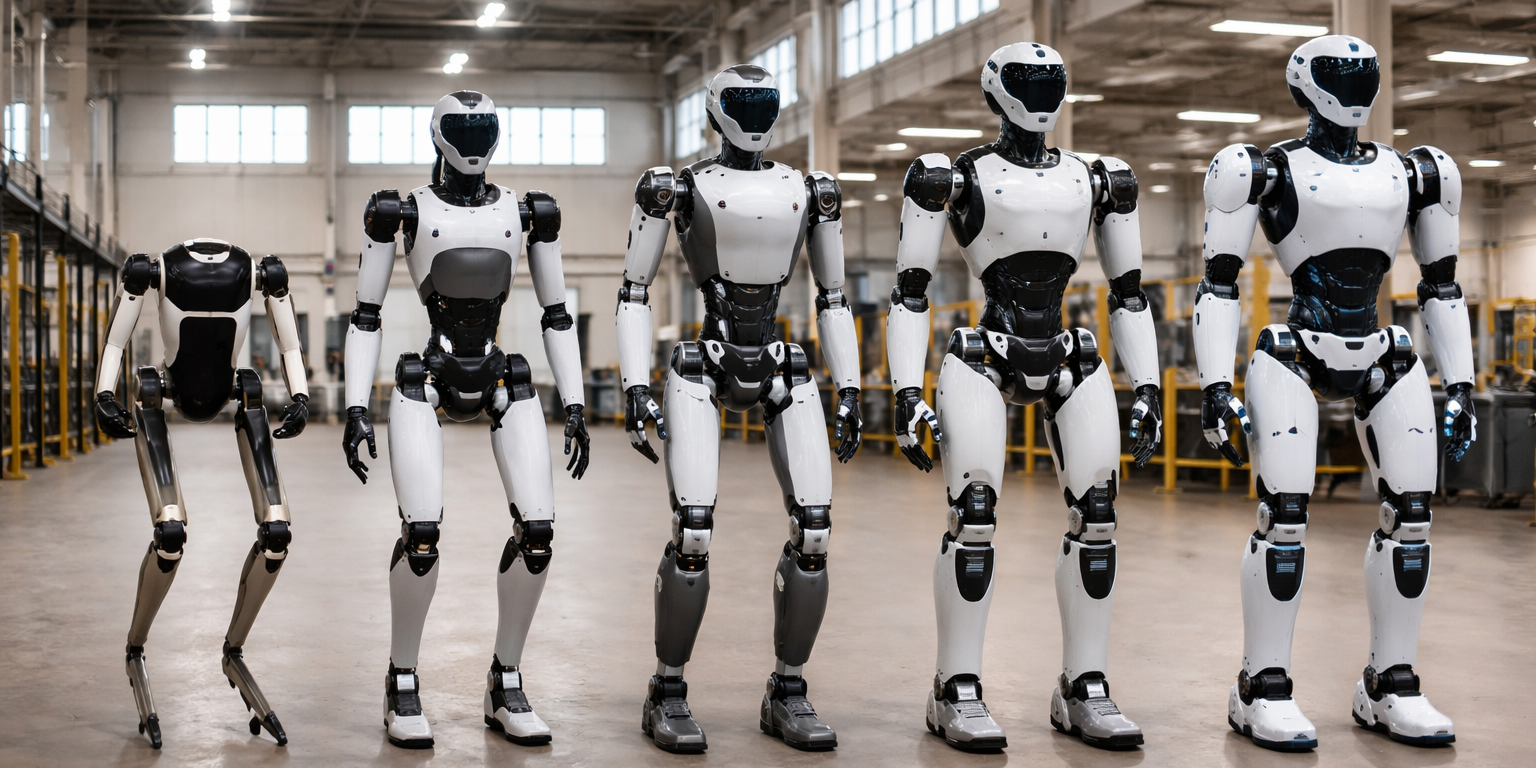

NVIDIA spent $12.9 billion to acquire a company that had previously purchased Pollen Robotics, the Paris-based maker of open-source humanoid robot platforms, according to details revealed in IEEE Spectrum's weekly Video Friday roundup. The transaction represents NVIDIA's most significant move into direct robotics hardware ownership and gives the chipmaker end-to-end control over humanoid development stacks from silicon through mechanical reference designs.
Pollen Robotics built its reputation on Reachy, a modular torso robot with expressive antennas and open-source software that allowed researchers and developers to experiment with humanoid manipulation without enterprise-scale budgets. The company shipped developer kits starting at roughly $15,000 and emphasized accessibility over industrial hardening. Pollen's approach attracted academic labs and smaller robotics groups who needed capable arms and vision systems but couldn't justify six-figure platforms. The French startup raised approximately €5 million across seed and Series A rounds before its acquisition by the unnamed parent company that NVIDIA has now absorbed. Pollen CEO Matthieu Lapeyre had previously worked on the Poppy Project, an open-source humanoid initiative that emerged from INRIA, France's national research institute for digital sciences.
NVIDIA has been steadily assembling the pieces for a vertically integrated robotics business. The company announced its Jetson Thor system-on-chip for humanoid robots at GTC 2024, providing dedicated neural network accelerators and real-time motor control on a single board. Project GR00T, unveiled alongside Thor, offered foundation models pretrained on humanoid locomotion and manipulation tasks. Those software tools required reference hardware for validation, which NVIDIA initially sourced through partnerships with companies including Agility Robotics, Apptronik, and Fourier Intelligence. Acquiring Pollen gives NVIDIA its own mechanical platform to bundle with chips and software, creating a complete turnkey solution for companies entering the humanoid market without in-house mechanical engineering depth. The $12.9 billion price tag suggests NVIDIA acquired significantly more than Pollen alone. Industry observers note the figure implies a larger robotics conglomerate or a company with adjacent AI infrastructure assets that included Pollen as one division among several.
The timing aligns with a broader consolidation wave in humanoid robotics. Figure AI raised $675 million at a $3.2 billion valuation in February 2024, with backing from Microsoft, OpenAI, and NVIDIA itself. Boston Dynamics sold to Hyundai Motor Group for $1.1 billion in 2021, then announced plans to commercialize Atlas, its hydraulic humanoid, by retrofitting it with electric actuators and partnerships with automotive manufacturers. Apptronik secured partnerships with NASA and Mercedes-Benz to deploy Apollo humanoids in vehicle manufacturing and logistics. Sanctuary AI demonstrated Phoenix robots folding laundry and assembling components at speeds approaching human workers. The common thread across these developments has been the collision of capable AI models with improving hardware economics. Humanoid robots no longer require entirely bespoke components. Brushless motors, harmonic drives, and embedded compute boards have commoditized to the point where a functional torso costs tens of thousands instead of hundreds of thousands. NVIDIA's acquisition accelerates that commoditization by offering validated designs alongside the silicon and training infrastructure needed to make them useful.
What to Watch: NVIDIA's roadmap for integrating Pollen's mechanical designs with Jetson Thor should emerge at GTC 2027 in March, where the company typically unveils robotics partnerships and reference platforms. Track whether NVIDIA licenses Pollen's designs to third parties or reserves them exclusively for Jetson customers, which would signal how aggressively the company intends to compete with humanoid OEMs versus enabling them. Monitor whether other chipmakers, particularly Qualcomm and AMD, respond with their own mechanical reference designs or deepen partnerships with independent humanoid manufacturers. The Humanoids Summit in Seoul on September 22-23, 2026, and IROS 2026 in Pittsburgh from September 27 to October 1 will likely feature the first public demonstrations of NVIDIA-Pollen integrated systems.