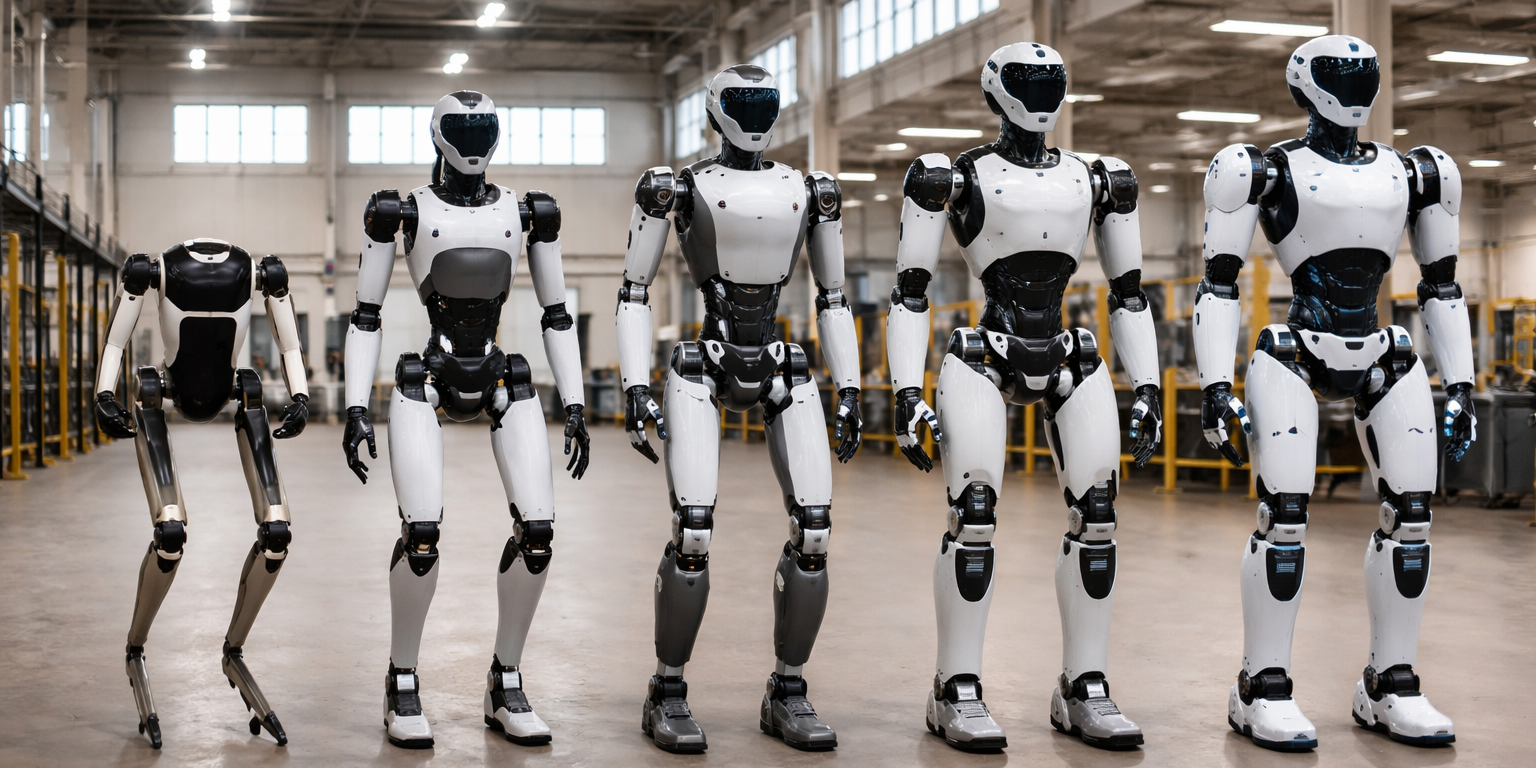
Five hardware revisions in three years would strain most robotics startups. Agility Robotics shipped them all while building a 70,000-square-foot factory in Salem, Oregon, and deploying robots in active warehouse operations. The progression from Cassie, a two-legged research platform that emerged from Oregon State University in 2017, to the latest Digit 5 represents one of the most accelerated development cycles in commercial humanoid robotics. Each version addressed specific shortcomings discovered during real-world deployments, a feedback loop that compressed the typical hardware development timeline. Where competitors have announced humanoid robots with delivery dates years away, Agility moved from research concept to production line in less than a decade.
Cassie never had arms, torso, or any pretense of warehouse utility. The bird-like biped existed to prove dynamic locomotion on two legs could work outside laboratory settings. Researchers at Oregon State, led by Jonathan Hurst, focused exclusively on the hardest problem: keeping a robot upright and moving across uneven terrain. That narrow focus paid dividends. By 2020, Agility had spun out as a commercial entity with functional leg hardware and control systems that actually worked. The first Digit prototype arrived that same year, adding a torso, arms, and enough payload capacity to handle lightweight totes. Digit 1 could walk and carry objects, but it could not work a full warehouse shift. Battery life lasted roughly two hours under load. The robot required constant human supervision and frequent intervention when it encountered obstacles or positioning errors. Still, it represented the first bipedal robot purpose-built for logistics rather than research or demonstration.
Digit 2 and 3 arrived in quick succession through 2021 and 2022, each focused on durability and autonomy rather than radical redesign. Battery packs grew larger. Sensors proliferated to improve obstacle detection and navigation. The robot's hands, initially simple grippers, evolved into more capable end effectors that could handle a wider variety of tote sizes and packaging materials. Agility deployed these versions with early customers including logistics providers and automotive manufacturers testing humanoid robots in controlled environments. The company learned what broke first: joints under repetitive stress, software failures during edge cases, battery degradation after thousands of charge cycles. By Digit 4, which entered production in late 2023, the robot had achieved the reliability metrics required for multi-shift warehouse operations. Mean time between failures stretched into hundreds of operating hours. The control software incorporated machine learning models that adapted to different facilities without extensive reprogramming. Digit 4 represented the first version Agility considered truly production-ready, and the company began manufacturing in Salem at commercial scale.
Digit 5, announced in early 2026, incorporates three years of operational data from deployed fleets. The changes appear incremental but prove significant in practice. Reinforced actuators extend service life. Improved vision systems allow the robot to operate in lower light conditions and handle more varied packaging types. The head design changed to accommodate additional sensors without compromising the robot's center of gravity. Runtime per charge now exceeds eight hours under typical warehouse loads, enough for a full shift with margin for variability. Agility has not disclosed pricing for Digit 5, but industry analysts estimate the robot costs between $150,000 and $250,000 per unit depending on configuration and support contracts. That positions Digit below the cost of fully automated sorting systems but well above conventional industrial arms or mobile robots. The economics work in facilities where floor space commands premium costs and where human workers face ergonomic risks from repetitive lifting. Span Global Logistics, one of Agility's anchor customers, now operates dozens of Digit robots across multiple distribution centers. Amazon tested earlier versions and announced plans to expand deployment in 2027, though the company has not specified unit volumes.
The competitive landscape shifted dramatically while Agility iterated through five hardware versions. Figure AI raised $675 million in early 2024 and deployed its first humanoids with BMW later that year. Tesla demonstrated Optimus prototypes performing factory tasks. Apptronik partnered with Mercedes-Benz. Sanctuary AI secured partnerships in retail. None have yet matched Agility's deployment scale or operational track record, but all are well-funded and moving quickly. Digit's advantage lies in those three years of field data and the manufacturing infrastructure already producing robots at commercial volume. Every competitor must solve the same problems Agility encountered with Digit 2 and 3: reliability, battery life, autonomous navigation in dynamic environments, graceful failure modes when things go wrong. Agility already learned those lessons. Whether that head start translates to sustained market leadership depends on how quickly competitors close the gap and whether Agility can maintain its iteration pace as the robots grow more complex and the customer base more demanding. The company has not announced plans for Digit 6, but given the three-year development arc from Cassie to Digit 5, another major revision likely looms within eighteen months.
What to Watch: Track Agility's 2027 production targets from the Salem facility, which the company has stated can manufacture thousands of units annually at full capacity. Monitor Amazon's deployment timeline and unit volumes, as the e-commerce giant's adoption would validate humanoid economics at massive scale. Watch for Figure AI and Tesla to publish comparable operational data from their humanoid deployments, particularly mean time between failures and cost per task completed. Competitor pricing announcements in Q4 2026 will reveal whether Agility's manufacturing head start translates to cost advantages or whether well-capitalized rivals can undercut on price while matching capability.