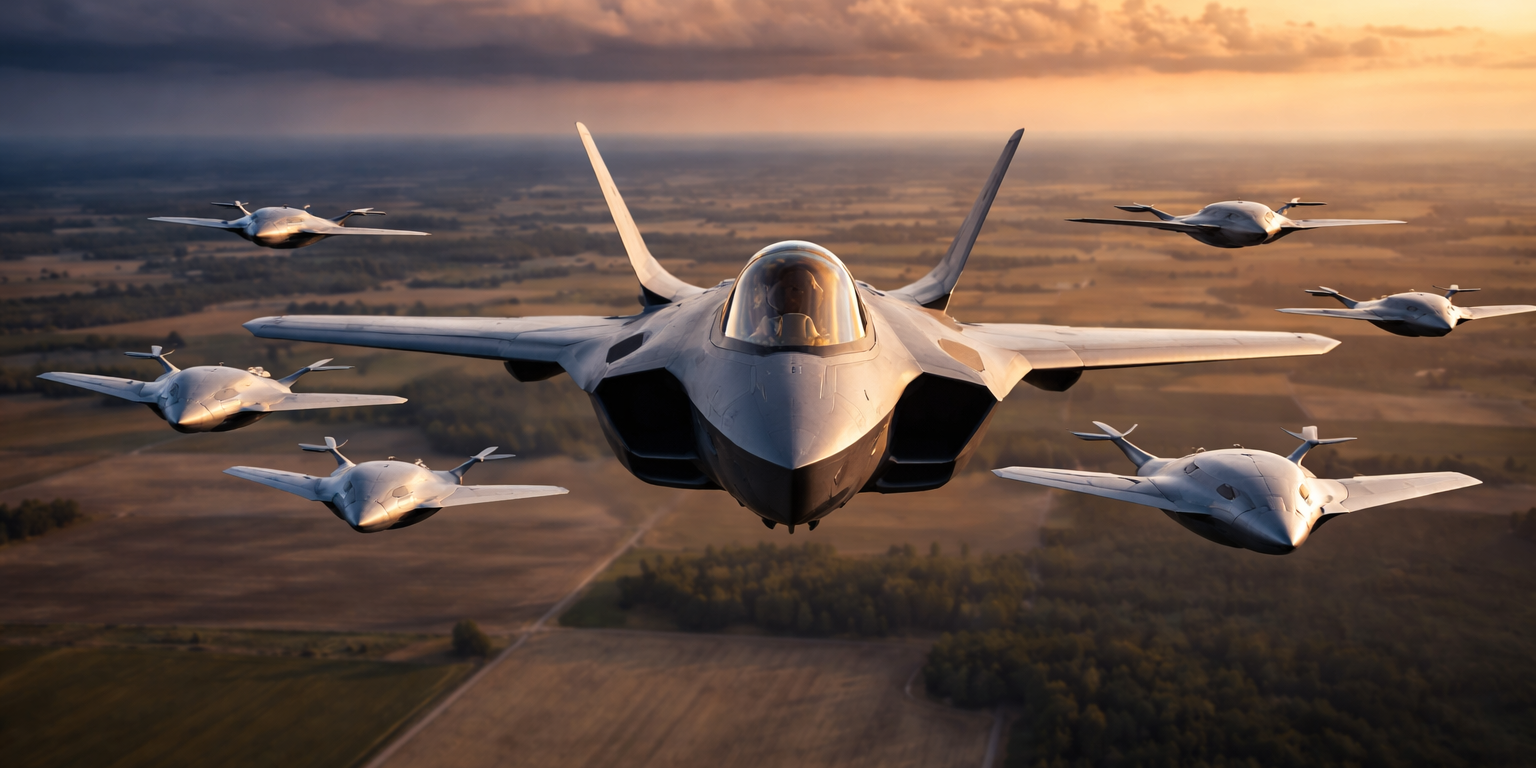
Defense budgets for autonomous drones jumped 18 percent year-over-year in 2026 across the top fifteen military spending nations, according to procurement data compiled by Jane's Defense Weekly. The United States led with $8.3 billion allocated to AI-driven unmanned aerial vehicle programs, followed by China at an estimated $5.1 billion and the United Kingdom at $1.2 billion. The figures represent not just incremental growth but a categorical reallocation of resources, with autonomous platforms now claiming budget share historically reserved for fighter jets, transport aircraft, and helicopter fleets. Several NATO members, including Poland and Romania, redirected funds from planned F-35 purchases into high-endurance reconnaissance drones capable of operating independently for 72 hours or longer.
The spending surge follows two years of field data showing that autonomous drones reduced the cost per intelligence-gathering mission by 60 to 75 percent compared to crewed alternatives, while increasing mission frequency by a factor of four. U.S. Air Force trials conducted between September 2024 and March 2025 at Nellis Air Force Base demonstrated that AI-piloted MQ-9 Reaper variants could execute complex surveillance patterns with 94 percent of the effectiveness of human-piloted sorties, but at one-fifth the operational cost when factoring in crew training, life support, and rest requirements. The European Defence Agency ran parallel evaluations with smaller tactical drones across Estonia, finding similar cost advantages in border monitoring and rapid-response reconnaissance. Those results convinced finance ministries, not just generals, that autonomous systems deliver measurable return on investment in an era of constrained budgets and expanding threat perimeters.
Three companies have emerged as dominant suppliers in this accelerated procurement cycle. General Atomics, which builds the MQ-9 family, reported a $4.7 billion backlog in autonomous drone contracts as of March 2026, more than double its 2024 figure. Northrop Grumman's RQ-4 Global Hawk and its newer RQ-180 stealth reconnaissance platform captured $3.2 billion in new orders from U.S. and allied forces. Turkish manufacturer Baykar, producer of the Bayraktar TB2 and the newer TB3 carrier-capable variant, signed contracts worth $2.1 billion with eight countries, including Saudi Arabia, Indonesia, and Pakistan. All three manufacturers have invested heavily in onboard AI that enables the aircraft to adjust flight paths, prioritize targets, and coordinate with other unmanned units without continuous ground-station input. The technical leap from remotely piloted to genuinely autonomous operation reduces bandwidth requirements, minimizes latency vulnerabilities, and allows a single operator to oversee multiple aircraft simultaneously. U.S. Central Command now routinely runs four-drone formations managed by one controller, a ratio that was considered experimental as recently as 2023.
The military appetite for autonomous drones is also reshaping the commercial robotics sector. Venture capital flowing into dual-use drone startups hit $1.8 billion in the first half of 2026, according to PitchBook, with investors betting that technologies proven in defense will eventually scale into logistics, agriculture, and infrastructure inspection. Shield AI, a San Diego-based company specializing in AI pilots for fixed-wing and quadcopter drones, raised a $200 million Series F in April at a $2.3 billion valuation. Anduril Industries, which produces the Lattice AI operating system used across multiple drone platforms, secured $1.5 billion in Series E funding in February and is now valued at $14 billion. Both companies are hiring robotics engineers at a pace that has tightened the labor market for autonomous systems talent, with senior perception engineers commanding salaries above $350,000 in some cases. Traditional defense primes are responding by acquiring smaller AI-focused firms. Lockheed Martin purchased AI navigation startup Terran Orbital in January for $800 million, while Boeing took a majority stake in autonomous flight software company Near Earth Autonomy in March.
What to Watch: Track the U.S. Department of Defense's Replicator initiative, which aims to field thousands of autonomous drones by late 2027 and will likely announce its first production contracts in August or September 2026. Monitor export license approvals for advanced autonomous drones to Taiwan and South Korea, expected in Q3 2026, which will signal whether the U.S. is willing to transfer high-end AI capabilities to front-line allies. Watch for the European Union's joint procurement framework for member-state drone acquisitions, scheduled for a vote in the European Parliament in October 2026, which could consolidate billions in scattered national programs into a unified buying mechanism that favors European manufacturers.