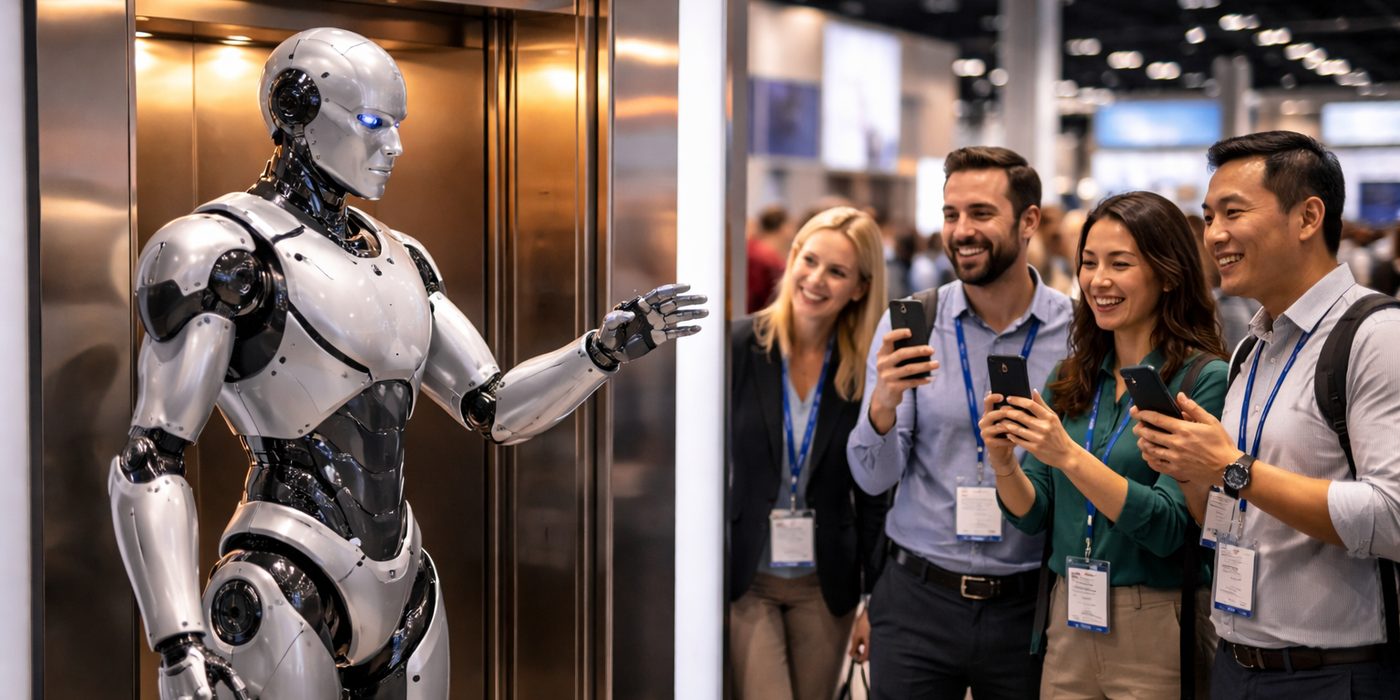
A humanoid robot spent this week doing something most of its peers have not: working a sales booth for a customer that is not a robotics company. SKYE, the full-size humanoid built by Chicago-area firm Metropolis Robotics, was stationed in the Adams Elevator exhibit at NAEC 2026, held at McCormick Place. According to the October 21 announcement distributed through PRNewswire, the machine drew crowds of attendees from the vertical transportation industry, the trade that designs, installs, and services elevators and escalators. The pairing is deliberate. Adams Elevator wanted foot traffic on a crowded show floor, and Metropolis wanted a public venue where SKYE could operate in front of thousands of people who have no particular stake in robotics.
The setup reflects a pattern that has quietly taken hold across the humanoid sector. Trade show floors, hotel lobbies, and retail spaces have become proving grounds for machines that are not yet ready for sustained factory or warehouse work. Engagement is a forgiving metric. A robot that greets visitors, answers questions, and poses for photos does not need to lift 20 kilograms for a full shift or recover gracefully from a dropped tote. It needs to stay upright, stay on script, and avoid embarrassing its host. Metropolis, an Illinois company, is betting that this kind of customer-facing role can generate revenue and operating data while heavier-duty capabilities mature.
The choice of partner matters more than it first appears. Elevator companies sell a product that is, by design, invisible. Nobody thinks about vertical transportation until it fails, which makes differentiation at a trade show a genuine problem. A seven-foot-class humanoid gives a mid-sized firm like Adams Elevator a reason for attendees to stop walking, and that is a concrete, measurable benefit the booth manager can take back to a marketing budget meeting. For Metropolis, the arrangement converts a demonstration into a service engagement, with a third party carrying the exhibit cost and the brand association. That inverts the usual humanoid sales motion, in which the robot maker funds the demo and hopes a customer materializes.
For engineers and investors, the signal is in the operating conditions rather than the crowd size. McCormick Place is among the most demanding public environments in North America for a mobile robot: dense foot traffic, hostile radio-frequency conditions from thousands of competing devices, loud ambient noise that degrades speech recognition, and constantly shifting obstacles. Keeping a bipedal platform functional there for multiple show days tests battery management, thermal behavior, fall recovery, and human-robot interaction software in ways a lab never will. The press materials emphasize attendee engagement and do not disclose uptime figures, battery swap schedules, or whether SKYE walked autonomously or operated within a controlled area. Those missing details are precisely what technical buyers will want. A larger point follows from this. As humanoid hardware converges in capability across vendors, the winners in near-term commercial deployments may be decided less by gait or payload than by who builds the most repeatable service model around the machine, and event-based work is where that model gets rehearsed.
What to Watch
Over the next 30 to 90 days, watch whether Metropolis Robotics publishes operating data from the NAEC 2026 deployment, particularly uptime across the show days and any interventions required, since that would move SKYE from spectacle to credible service platform. Track whether other exhibitors at McCormick Place or at the fall and winter trade shows follow Adams Elevator in renting or co-branding humanoids, which would confirm events as a repeatable revenue line. Also monitor whether Metropolis announces a second host partner outside the vertical transportation sector, and whether it discloses pricing or lease terms for SKYE, the number that would let investors compare its unit economics against better-funded rivals.