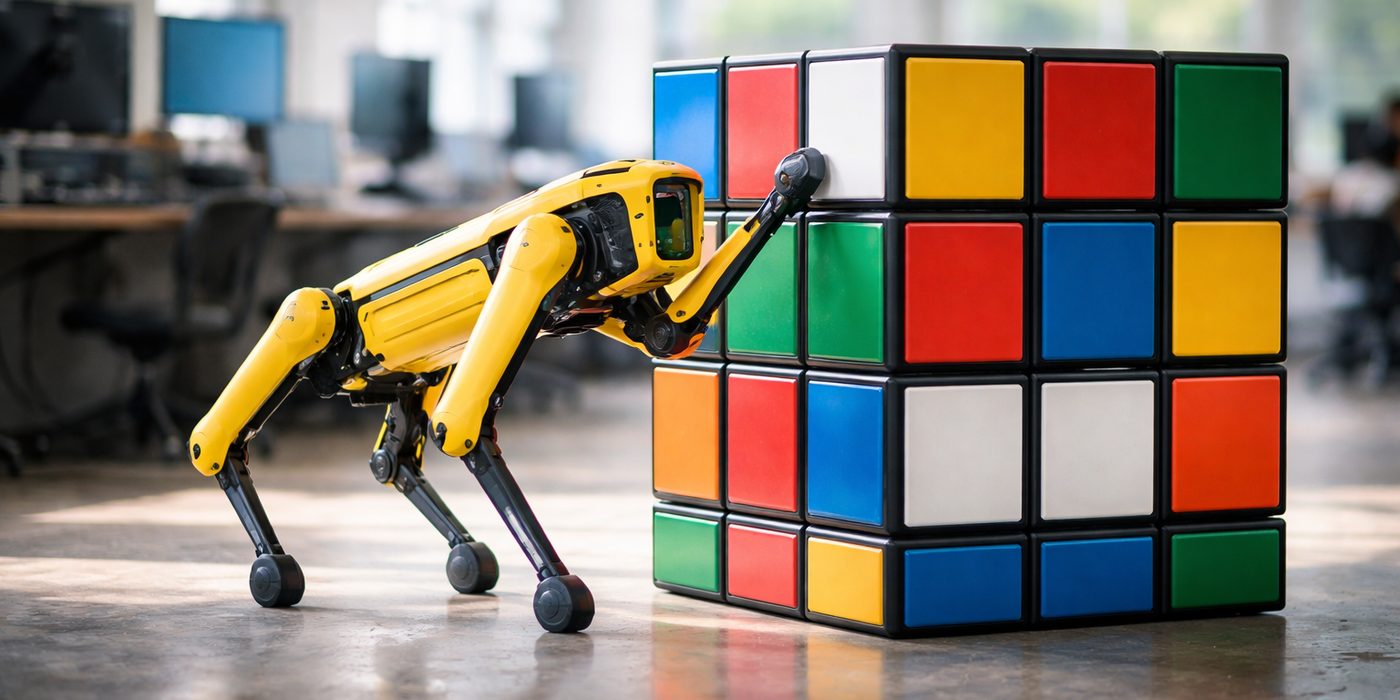
The robot does not have hands. That is the point, and also the problem it had to solve. In a video highlighted this week in IEEE Spectrum's Video Friday roundup, a quadruped from ETH Zurich's Robotics Systems Lab autonomously solves a giant Rubik's Cube using only its feet, rotating faces and re-orienting the puzzle without any dedicated manipulator bolted to its body. There is no teleoperator in the loop. The machine perceives the cube's state, plans a solution, and executes the physical moves itself, standing on three legs while the fourth does the work of a finger.
The Robotics Systems Lab, led by Marco Hutter, has spent the better part of a decade building the research lineage that makes a demonstration like this plausible. Its ANYmal platform became one of the most widely used legged research robots in academia and industry inspection, and the group has repeatedly pushed the machine past pure locomotion. Earlier ETH work put arms on legged bases for door opening and object retrieval, and the lab has published extensively on reinforcement-learning-based whole-body control. Using a limb as a manipulator is a different proposition from adding an arm. It collapses two hardware functions into one, and it forces the control stack to treat balance and contact as a single, continuous problem rather than two coordinated ones.
The engineering challenge is harder than the novelty framing suggests. A foot is a poor end effector. It lacks fingertips, tactile sensing is limited, and the contact geometry is blunt. A giant cube helps, since larger faces tolerate coarser positioning, but the robot must still apply enough torque through a rounded contact patch to turn a face without slipping or toppling its own base. Every push on the cube is also a push back on the robot. Holding a stable stance while one leg exerts deliberate force on an external object demands tight coordination between the planner, the contact estimator, and the stance legs, all running against the unpredictable friction of a plastic puzzle.
What a senior engineer should take from this is less the cube and more the architecture. Legged platforms have largely been sold as mobility stacks with optional payloads, and the dominant commercial approach to manipulation has been to mount a separate arm, adding mass, cost, a second power draw, and another failure surface. A control framework that lets existing limbs perform useful manipulation points toward leaner configurations, or at least toward redundancy, where a robot with a damaged or absent arm can still complete a task. That has implications for inspection robots working in industrial sites, where payload budgets are tight and every added actuator is a maintenance liability.
The demonstration also lands at a moment when the industry's attention is fixed on humanoids, which are expensive precisely because they carry the most actuators and the most dexterous end effectors. Quadrupeds are comparatively mature, cheaper to build, and already deployed at scale in energy, mining, and security applications. Work showing that a four-legged body can exhibit manipulation-adjacent skill complicates the assumption that general-purpose capability requires a human form factor. Investors weighing legged versus bipedal bets should read the video as evidence that the cheaper form factor still has unexplored headroom, even if it will not replace a humanoid's hands for fine assembly work.
There are limits worth stating plainly. This is a research video, not a product, and ETH has not framed it as a commercial capability. A giant cube is a controlled, purpose-chosen object, and success on it does not transfer automatically to arbitrary tools or cluttered environments. Cycle time, success rate across repeated trials, and robustness to lighting and cube wear are the metrics that would determine whether the approach generalizes, and none of those are visible in a short clip. Still, learned whole-body policies that blend contact-rich manipulation with balance are exactly the capability class that commercial legged vendors are racing to productize, and academic proofs of concept tend to precede industrial adoption by a few years.
The Video Friday listing also doubles as a calendar of where this research will surface next. CoRL 2026 runs 9-12 November in Austin, and Humanoids 2026 follows 6-9 December in Santa Clara, California. Both venues are where legged manipulation results typically get formal treatment, with peer-reviewed methods, ablations, and failure analysis that a demo video omits.
What to Watch
Watch the CoRL 2026 program in Austin, 9-12 November, for any ETH Zurich Robotics Systems Lab paper detailing the foot-manipulation method, including success rates and the learning-versus-model-based split in the controller. Track Humanoids 2026 in Santa Clara, 6-9 December, to see whether other groups present competing legged-manipulation results. Follow ANYbotics, the ETH spin-out commercializing the ANYmal line, for any signal that limb-based manipulation migrates into product firmware. And note whether quadruped makers such as Boston Dynamics and Unitree respond with their own limb-as-tool demonstrations before year-end.