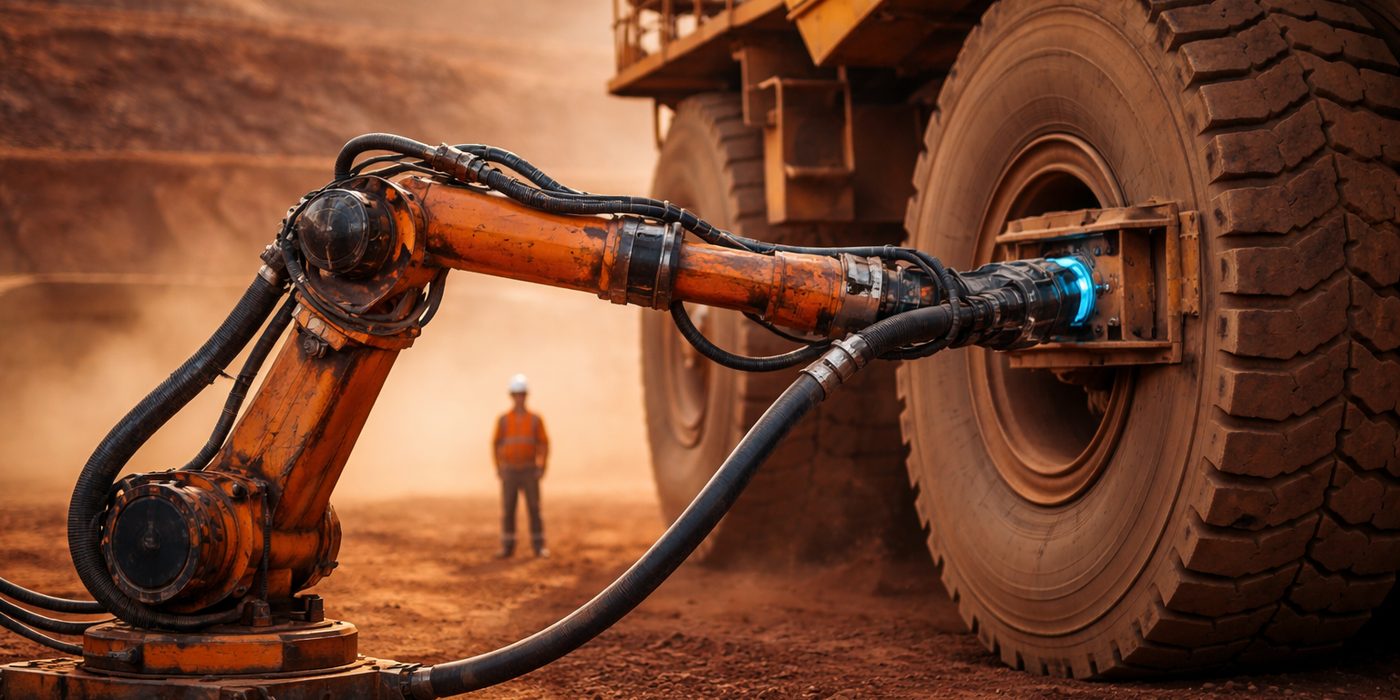
A 6-megawatt charging cable is not something a person lifts casually, and it is certainly not something a humanoid robot can plug in. Fortescue, the Perth-based iron ore producer, has concluded as much and turned to a machine that has spent decades in car factories: the KUKA industrial arm, originally built for welding and assembly lines and now modified to connect charging cables to 240-tonne electric haul trucks in the Pilbara. According to Electrek's reporting, humanoid robots simply aren't ready for the job. The cables are heavy, the currents are enormous, and the environment is among the harshest on any working industrial site.
The decision cuts against a narrative that has dominated robotics coverage for two years. Humanoid developers have pitched general-purpose bipeds as the eventual answer to labor-intensive tasks in logistics, manufacturing, and heavy industry. Charging a mining truck looks, on paper, like exactly the sort of dull, repetitive, hazardous chore a humanoid might absorb. Fortescue's engineers appear to have looked at the physics and chosen differently. A fixed-base industrial manipulator offers payload capacity, rigidity, and repeatability that bipedal platforms cannot match when the task involves dragging a high-voltage cable the diameter of a forearm into a socket on a vehicle weighing as much as a small cargo ship.
The backdrop is Fortescue's aggressive decarbonization target. Andrew Forrest's company has pledged to eliminate fossil fuel use from its Australian iron ore operations, which means replacing a diesel fleet of enormous haul trucks with battery-electric equivalents. That swap is brutally demanding. Trucks in this class run near-continuous shifts, so charging has to be fast, reliable, and ideally automatic, because every minute a haul truck sits idle costs real money. Delivering power at the 6 MW scale means cables and connectors built to carry currents that would be lethal and punishing on equipment. Automating the plug-in step removes people from proximity to that hardware, a safety argument as much as an efficiency one, and it lets charging happen on a predictable cycle rather than whenever an operator is available.
For the robotics industry, the lesson is about matching machine to task rather than chasing form factor. KUKA's arms are mature, well understood, and backed by a global service network, which matters enormously in a remote region where a failed robot can strand a multimillion-dollar vehicle. Modifying proven automotive hardware also shortens the path from concept to site. Dust, heat, vibration, and fine iron ore particulate are the Pilbara's standard conditions, and industrial arms have a long record of surviving factory floors that are rough in their own way. Humanoids, by contrast, carry unresolved questions around battery life, actuator durability, and sealing against abrasive environments. Investors weighing where autonomy dollars will flow in resources and energy should notice that the first scaled answer here came from the installed base of conventional automation, not the newest entrant.
There is a broader implication for how mining and heavy-equipment operators will source robotics as electrification spreads. Charging infrastructure for large electric fleets is becoming a robotics market in its own right, spanning cable handling, connector alignment, thermal management, and fleet scheduling software. Companies that sell sensing, vision-guided alignment, and force-controlled manipulation stand to benefit as much as the arm makers themselves, since plugging a rigid connector into a moving, slightly misaligned truck at 6 MW demands precision that raw payload cannot provide. Fortescue's willingness to pay for custom modification signals demand for application-specific integration work, a segment where integrators and system builders often capture more margin than the hardware vendors whose robots they deploy.
What to Watch
Track whether Fortescue publishes throughput or uptime figures from the Pilbara charging deployment during the fourth quarter of 2026, since reliability data would be the first hard evidence of how well modified automotive arms hold up under mining conditions. Watch KUKA's industrial and energy announcements for any productized version of this cable-handling configuration, and monitor rival arm makers such as FANUC, ABB, and Yaskawa for competing heavy-charging offerings. Pay attention to humanoid developers' mining and energy pilots over the next 90 days, as any claim of heavy-cable handling would need to clear the payload and ruggedization bar that Fortescue just set. Finally, follow Fortescue's electric haul truck fleet expansion updates for signs the charging approach scales beyond a single site.