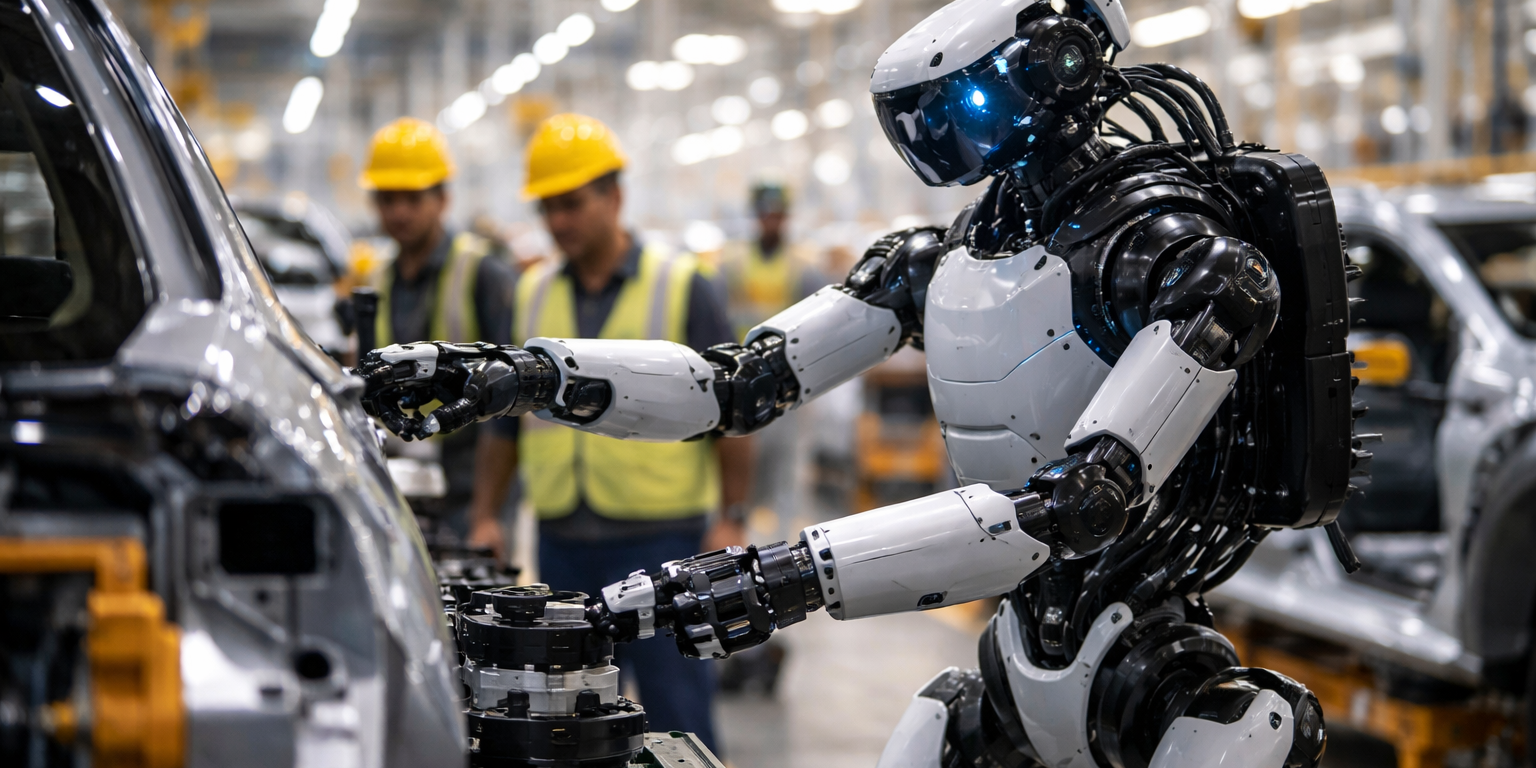
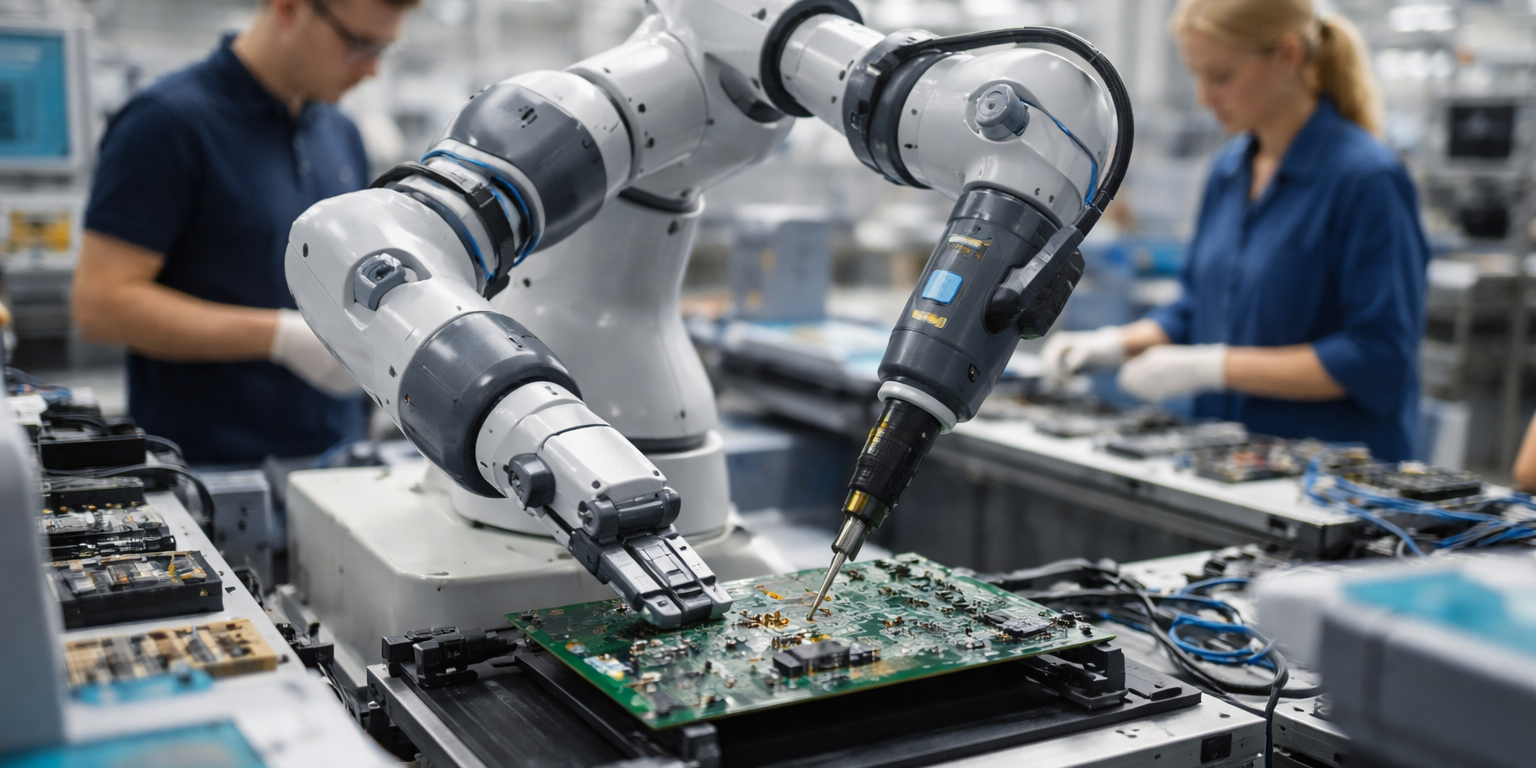
A dual-arm robot that works alongside humans without safety barriers entered the market this month from Mantis Robotics, marking another push by a newer entrant to challenge the fixed-cell automation model that still dominates factory floors. The system allows manufacturers to reconfigure production lines without the capital expenditure and floor space demands of traditional robotic cells, according to the company. That matters in industries like electronics assembly and automotive components, where product variants multiply and production runs shorten every quarter.
Mantis designed the robot to handle tasks requiring bimanual coordination, such as assembling components that need stabilization while fastening or manipulating flexible materials that one arm cannot manage alone. The architecture departs from single-arm collaborative robots, which have gained traction since Universal Robots popularized the category nearly fifteen years ago but remain limited in task complexity. Dual-arm systems promise greater dexterity but introduce synchronization challenges and higher price points, which explains why penetration remains modest outside research labs and automotive final assembly. Mantis claims its control software resolves the coordination problem through real-time path planning that treats both arms as a unified kinematic chain rather than independent manipulators. That approach reduces the programming burden, though field validation will determine whether it holds up across diverse applications.
The fenceless operation relies on torque-limited joints, compliant actuators, and perception systems that monitor the workspace for human presence. These features align with ISO/TS 15066 guidance on collaborative robotics, which permits direct human contact if forces stay below injury thresholds. Several vendors now offer similar safety architectures, but Mantis emphasizes configuration flexibility: users can mount the system on mobile bases, benchtops, or overhead gantries without recertifying safety protocols for each setup. That modularity appeals to contract manufacturers and job shops that shift between projects weekly, environments where fixed automation generates insufficient return on investment. Traditional industrial robots require safety assessments whenever their work envelope changes, a process that can take weeks and cost tens of thousands in engineering time. If Mantis has genuinely streamlined that process, it removes a significant adoption barrier.
The company has not disclosed pricing, payload capacity, reach specifications, or initial customer names, details that would clarify where this system fits within the collaborative robotics spectrum. Competitors range from Doosan Robotics and Techman Robot on the cost-sensitive end to ABB's YuMi and Kawasaki's duAro in higher-performance tiers. Payload capacity typically determines addressable applications: systems rated below five kilograms per arm suit light assembly and inspection, while ten-kilogram-plus payloads open machine tending and material handling. Reach also matters, since dual-arm robots occupy more floor space than single-arm equivalents, making them less viable in cramped production cells. Mantis has positioned the launch around flexibility rather than raw specifications, a marketing choice that suggests the company targets users frustrated by traditional automation's rigidity more than those seeking maximum throughput. Whether that message resonates depends on how many manufacturers prioritize reconfigurability over cycle time, a calculation that varies widely by sector.
Broader industry dynamics favor collaborative approaches, at least in certain niches. Labor shortages persist in manufacturing regions across North America, Europe, and parts of Asia, pushing wages higher and making automation economically viable for tasks that were marginal cases five years ago. At the same time, product life cycles continue compressing, especially in consumer electronics and electric vehicle components, where design iterations occur quarterly rather than annually. Fixed automation struggles in that environment because retooling costs often exceed the revenue potential of short production runs. Collaborative robots, particularly dual-arm variants, promise adaptability, but adoption has lagged projections made earlier this decade. Integration complexity, limited vendor support, and uncertainty about return on investment have slowed deployment outside large manufacturers with dedicated robotics engineering teams. Mantis enters a market where the value proposition is clear but execution remains challenging. Success will depend less on the robot's technical capabilities than on the company's ability to deliver turnkey integration support and demonstrate quantifiable payback periods in real-world installations.
What to Watch: Customer announcements from Mantis Robotics in Q3 2026 will reveal which industries find the dual-arm system compelling and at what price point. Integration partnerships with systems integrators or end-of-arm tooling vendors would signal a go-to-market strategy beyond direct sales. Monitor whether established collaborative robot vendors respond with dual-arm offerings of their own, particularly Universal Robots and Fanuc, whose product portfolios currently emphasize single-arm architectures. Comparative payload and reach specifications, once disclosed, will clarify whether Mantis competes on performance or purely on flexibility.