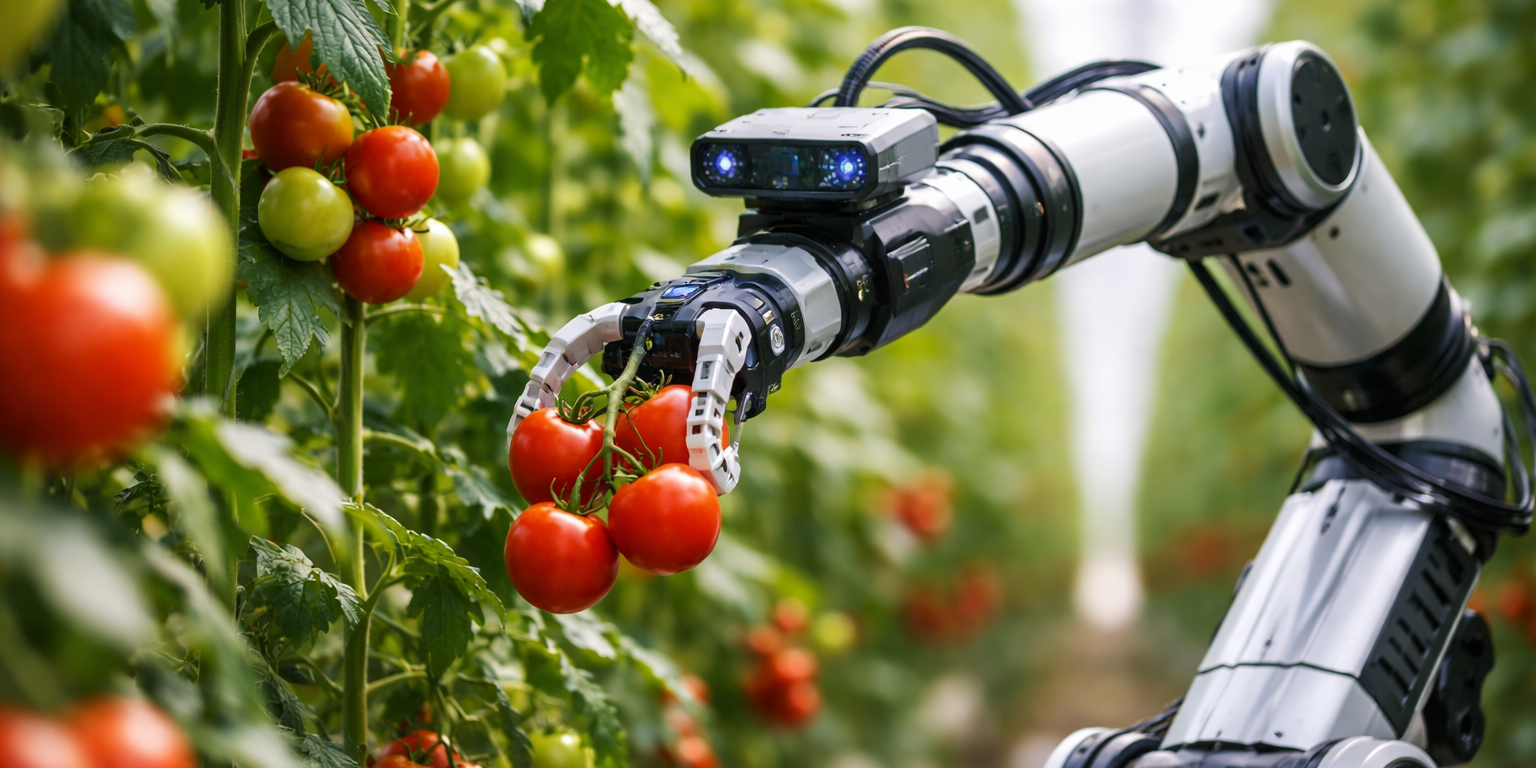
A consortium of Canadian greenhouse operators has installed vision-guided robotic harvesters across twelve production facilities, moving orchard automation out of the pilot phase and into daily commercial use. The systems, developed through partnerships between growers and machine vision specialists, use depth-sensing cameras and machine learning models trained on thousands of hours of canopy imagery to locate, assess ripeness, and detach fruit without bruising. Operators at facilities in Leamington, Ontario and Delta, British Columbia report the robots now handle between 18% and 31% of total tomato harvest volume, with plans to expand coverage as additional units arrive through 2027. The shift reflects growing pressure on labor economics in Canadian horticulture, where wage inflation and seasonal worker shortages have pushed operational costs up 22% since 2023 according to the Ontario Greenhouse Vegetable Growers association. One operator noted that a single robotic harvester running two shifts can pick the equivalent of three full-time workers, with lower rates of stem damage and fewer discarded clusters.
The technical challenge in greenhouse robotics lies not in the gripper design but in perception. Tomatoes, peppers, and cucumbers grow in dense, overlapping layers where lighting changes by the hour and stems obstruct sightlines. Early systems failed because they relied on simple color detection, which couldn't distinguish ripe fruit from adjacent foliage or handle shadows cast by structural beams. The current generation uses stereo vision paired with convolutional neural networks that map canopy geometry in three dimensions, building a spatial model that updates in real time as the robot moves down the row. Training data came from growers who mounted cameras on mobile carts and recorded thousands of passes through their greenhouses, capturing variations in plant density, trellising styles, and fruit orientation. Engineers then labeled the footage frame by frame, teaching the models to recognize picking points even when only 40% of a cluster is visible. The result is a system that can navigate variability that would stall a purely rule-based approach. Cycle time averages 7.8 seconds per cluster in tomato applications and 11.2 seconds for bell peppers, which require more precise stem cuts to avoid tearing the calyx.
Three companies dominate the Canadian deployment landscape. MetoMotion, an Israeli firm with a Vancouver engineering office, supplies the vision software and sells complete turnkey systems under a robotics-as-a-service model priced at roughly $4,200 per month per unit. Harvest CROO Robotics, based in Florida but operating a pilot line in Abbotsford, British Columbia, focuses on strawberry harvesting but has adapted its platform for greenhouse tomatoes under contract with a major Leamington grower. A third player, a Toronto startup called Ripe Robotics, emerged from University of Waterloo research and has secured partnerships with two mid-sized greenhouse operations, deploying prototypes that use a different gripper design involving soft pneumatic actuators rather than rigid mechanical fingers. Ripe's founders claim their approach reduces fruit bruising to under 6%, compared to industry averages near 12%, though independent verification of those figures has not been published. All three companies face the same constraint: Canadian greenhouses operate on thin margins, and capital equipment must pay for itself within 24 months or operators won't commit. That forces vendors to prioritize reliability and uptime over feature expansion, leading to conservative engineering choices that favor proven components even when newer options might offer better performance.
The broader implication extends beyond tomatoes. If vision-guided manipulation works in the chaotic environment of a greenhouse canopy, it becomes plausible in orchards, vineyards, and field crops where conditions are even less controlled. Several of the engineers involved in the Canadian greenhouse rollout previously worked on apple-picking robots that failed in commercial trials because they couldn't handle variability in tree architecture. Greenhouses offered a middle ground: less structured than a factory floor, but more predictable than an open orchard. Success here provides a reference architecture that outdoor systems can adapt, particularly the sensor fusion methods that combine depth cameras, thermal imaging, and inertial measurement units to maintain spatial awareness in environments where GPS is unavailable or unreliable. The Ontario deployments have already attracted attention from berry growers in Washington and cherry producers in Michigan, both looking to solve similar labor shortages. One robotics investor based in Kitchener noted that greenhouse automation is becoming a proving ground for perception algorithms that will eventually migrate to mobile platforms in less forgiving settings. The question is whether the economics scale. Greenhouses generate revenue year-round, which improves ROI on expensive robots. Orchards operate seasonally, meaning equipment sits idle for months. That changes the financial model and may require different deployment strategies, such as robots that move between regions following harvest cycles.
What to Watch: Monitor MetoMotion's planned expansion into pepper harvesting, expected to begin trials in Q3 2026 at a facility near Kingsville, Ontario. Ripe Robotics is reportedly negotiating a Series A funding round that would close in August 2026, which could accelerate deployment timelines. The Ontario Greenhouse Vegetable Growers will release updated labor cost data in October 2026, providing the first full-year comparison of robotic versus human harvesting costs under commercial conditions. Finally, watch for Harvest CROO's decision on whether to establish a permanent Canadian manufacturing hub, a move that would signal confidence in long-term demand north of the border.