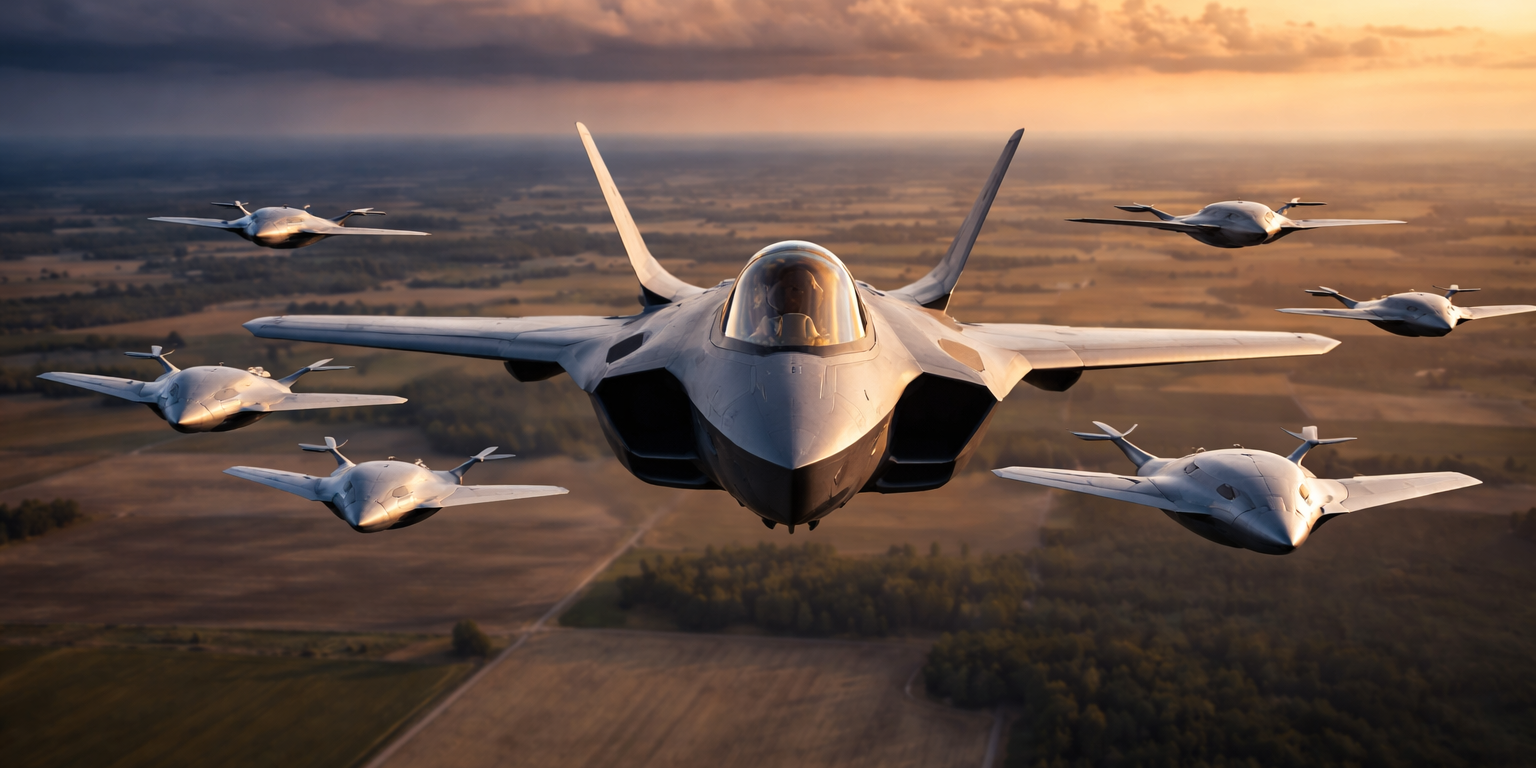
General Atomics and Anduril will build the first operational autonomous wingman drones for the U.S. Air Force under the Collaborative Combat Aircraft program, the service announced, launching what officials describe as the most ambitious effort yet to field AI-controlled aircraft in combat. The contract awards position both companies to deliver CCA prototypes within the next three years, flying alongside crewed F-35s and Next Generation Air Dominance fighters in coordinated strike packages. Anduril brings its Fury unmanned combat aerial vehicle platform to the effort, while General Atomics leverages decades of experience building the Reaper and other remotely piloted systems. The autonomy layer, critical to enabling these aircraft to make tactical decisions without constant human input, will be developed by a trio including Anduril, Shield AI, and Collins Aerospace, who were tapped separately to create the software brains that distinguish CCA from traditional drones.
The Air Force structured CCA as an incremental program with multiple planned awards rather than a single winner-take-all competition, a deliberate strategy to maintain industrial capacity and accelerate fielding timelines. Air Force officials have stated publicly they expect to buy at least 1,000 CCA aircraft across multiple increments, with the first operational units reaching squadrons in the late 2020s. This first increment focuses on demonstrating core autonomy capabilities including formation flight, sensor fusion, and coordinated weapons employment while maintaining human authorization for kinetic effects. The service plans subsequent increments to expand mission sets and incorporate advancing AI capabilities as the technology matures. Boeing and Lockheed Martin, traditional defense primes, competed but did not receive awards in this round, a notable shift that reflects the Pentagon's push to integrate non-traditional vendors with software-native development approaches. General Atomics has flown CCA demonstrators at Edwards Air Force Base, testing collaborative behaviors between unmanned and crewed aircraft in realistic combat scenarios.
Shield AI's selection for the autonomy system represents a significant validation of the company's Hivemind technology, which has flown combat missions in Ukraine and logged operational hours on V-BAT vertical takeoff drones with the U.S. military. The San Diego-based company built its reputation on autonomous flight in GPS-denied environments, a capability essential for CCA operations in contested electromagnetic spectrum against near-peer adversaries. Collins Aerospace, a Raytheon Technologies subsidiary with deep experience in avionics and flight controls, brings systems integration expertise and relationships across the Air Force fighter enterprise. Anduril contributes not only its Fury airframe but also its Lattice battle management system, which ties together sensors, platforms, and effects across distributed forces. The three-way autonomy development split suggests the Air Force wants interoperable software that can run across different airframes and evolve independently of platform design, avoiding the vendor lock-in that has plagued previous aircraft programs. Flight tests beginning in 2025 will demonstrate whether these autonomy systems can handle dynamic air combat maneuvering, threat reaction, and weapons coordination without latency or brittleness.
The awards arrive as China rapidly expands its own unmanned combat aircraft development, with the Feihong-97A and other loyal wingman concepts appearing at air shows and reportedly entering flight testing. Pentagon officials have acknowledged publicly that adversary progress in autonomous systems influenced the decision to accelerate CCA timelines, compressing what might traditionally be a decade-long development into a five-year sprint to operational capability. CCA aircraft are expected to cost a fraction of crewed fighters, potentially between $20 million and $30 million per unit at scale, enabling the Air Force to absorb attrition in high-threat environments without losing pilots or incurring the political costs of downed aircrew. The drones will carry sensors and weapons into contested zones, extending the reach of crewed aircraft while preserving those higher-value assets at safer standoff ranges. This operational concept, sometimes called manned-unmanned teaming, has been tested in simulation and limited flight demonstrations but never fielded at scale in a peer conflict scenario. General Atomics and Anduril now face the challenge of translating years of experimental work into production-ready aircraft that can survive not just flight tests but the bureaucratic gauntlet of operational testing, certification, and squadron integration.
What to Watch: General Atomics and Anduril will begin critical design reviews in mid-2025, with first flights of production-representative aircraft expected by late 2026. Shield AI's Hivemind autonomy will undergo Air Force evaluation flights at Edwards Air Force Base throughout 2025, testing collaborative tactics with F-35 and F-22 squadrons. The second CCA increment competition will launch in 2025, with awards expected in 2026 for more advanced mission sets including suppression of enemy air defenses and deep strike. Boeing and Lockheed Martin are expected to compete again with revised offerings incorporating lessons from the first round.