
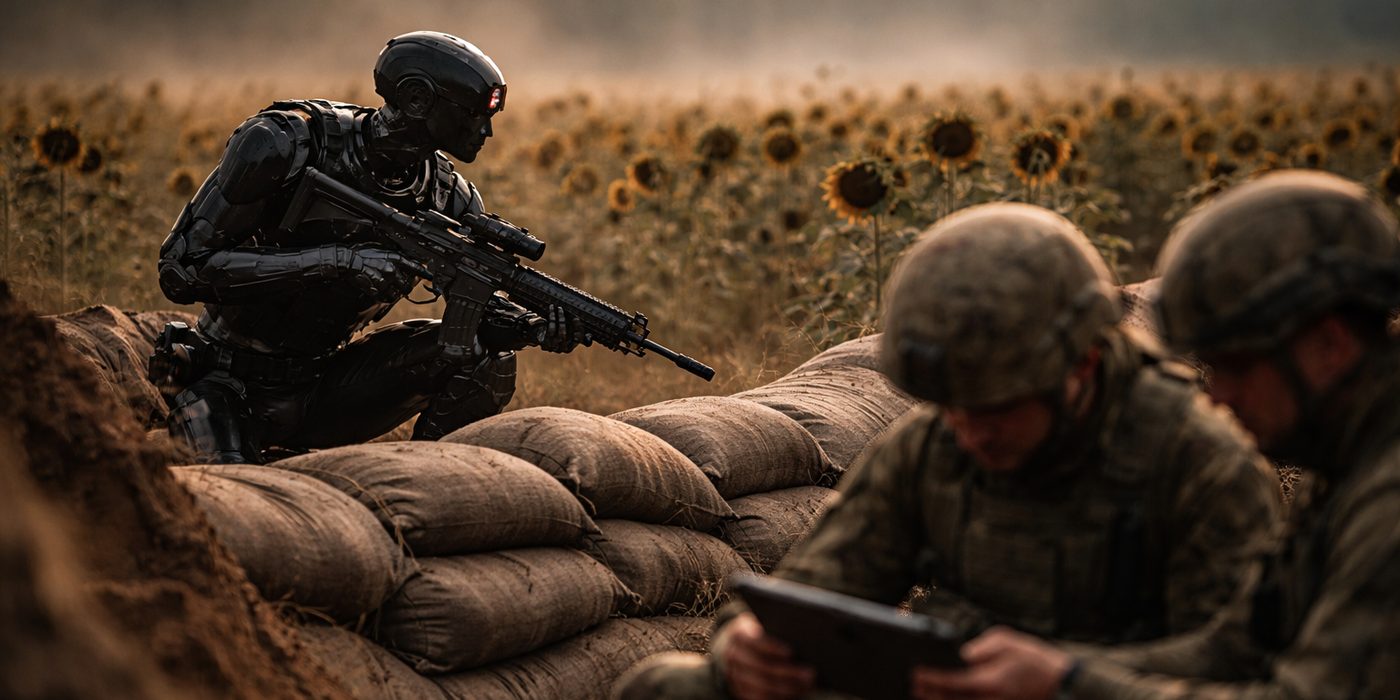
Machine guns are not the first thing most humanoid makers mention when they pitch a general-purpose robot. Foundation Future Robotics mentions them early. Co-founder Mike LeBlanc told Fox News that the company's Phantom MK 2 humanoid is ready to engage enemy forces in Ukraine, and that units are headed into the combat zone. Fox News published the account without independent verification of deployment numbers, locations, or operational status, and the specifics matter here. A robot that has been shipped, a robot that has been fielded, and a robot that has fired a weapon under fire are three different milestones, and LeBlanc's public framing blurs all three. Still, the stated intent alone sets Foundation apart from competitors who keep their defense work behind classified doors.
The company's path to this point is unusual even by humanoid-sector standards. Foundation, based in San Francisco, built its public profile on a pitch that sounded more like industrial automation than infantry support: bipedal robots to take over dangerous, repetitive labor. Eric Trump's involvement as a partner brought political visibility and a distinctly American-industrial-policy gloss to the brand. The Phantom line was always designed with a military customer in mind, LeBlanc has indicated, and the MK 2 is the iteration where that design intent turned into hardware aimed at a specific war. Ukraine has become the proving ground for nearly every category of unmanned system, from first-person-view drones to ground vehicles that haul casualties and ammunition. Humanoids are the newest entrants, and the most skeptically received.
The skepticism is technical, not rhetorical. Legged robots face a brutal set of constraints on a modern battlefield: mud, rubble, trenches, electronic warfare that scrambles radio links, and an adversary whose drones hunt anything that moves with a thermal signature or an emitting antenna. Wheeled and tracked unmanned ground vehicles have a decade of lessons behind them in Ukraine, and several have been lost in large numbers. A bipedal platform adds balance, fall recovery, and joint wear to an already punishing problem. Then there is the weapons question. Mounting a gun on a stable tracked chassis is a solved engineering problem. Having a humanoid carry, aim, and fire one while walking is not, because recoil, targeting latency, and the robot's own center of mass all interact. Whether Foundation has solved that or is demonstrating an early capability under controlled conditions is the central unanswered technical question.
For the wider industry, the business logic is easier to read than the engineering. Humanoid makers have raised billions on the promise of factory and warehouse labor, but commercial orders at scale remain thin, and unit economics for a bipedal robot still struggle against purpose-built automation. Defense budgets do not ask for a payback period in the same way. A government customer will pay a premium for a capability that reduces casualties, and a wartime customer will pay faster. That is the calculation pulling humanoid firms toward military work, even those that publicly emphasize civilian uses. Foundation is simply the first to say so loudly. If its units demonstrably perform in Ukraine, rivals including Figure, Agility, and Chinese manufacturers such as Unitree will face pressure from investors and defense ministries to show their own battlefield credentials.
The regulatory and supply-chain consequences deserve as much attention as the hardware. Any humanoid built with Chinese-sourced actuators, batteries, or compute faces export-control and procurement scrutiny the moment it enters a defense context, and Foundation has leaned on its American manufacturing story to differentiate itself. Allied governments are watching, too. NATO members are drafting rules for autonomous and remotely operated systems, and a commercially backed humanoid operating in an active war will be cited in those debates whether the company wants the attention or not. LeBlanc's decision to address 'Terminator' comparisons directly suggests the company knows the framing risk. How it defines human control over any weapon-carrying unit, remote operation versus onboard autonomy, will shape which customers can legally buy it.
What to Watch Watch for independent confirmation of how many Phantom MK 2 units are actually operating in Ukraine and in what role, since the current account rests largely on company statements. Track whether Foundation discloses a defense contract, a funding round, or a named government customer before the end of 2026, any of which would turn a marketing claim into a verifiable business. Monitor competitor announcements from Figure, Agility Robotics, and Unitree over the next 60 days for matching defense pivots or public distancing from them. Finally, follow NATO and U.S. Department of Defense policy statements on human-in-the-loop requirements for weapon-bearing ground robots, which will determine how commercially viable armed humanoids can become.