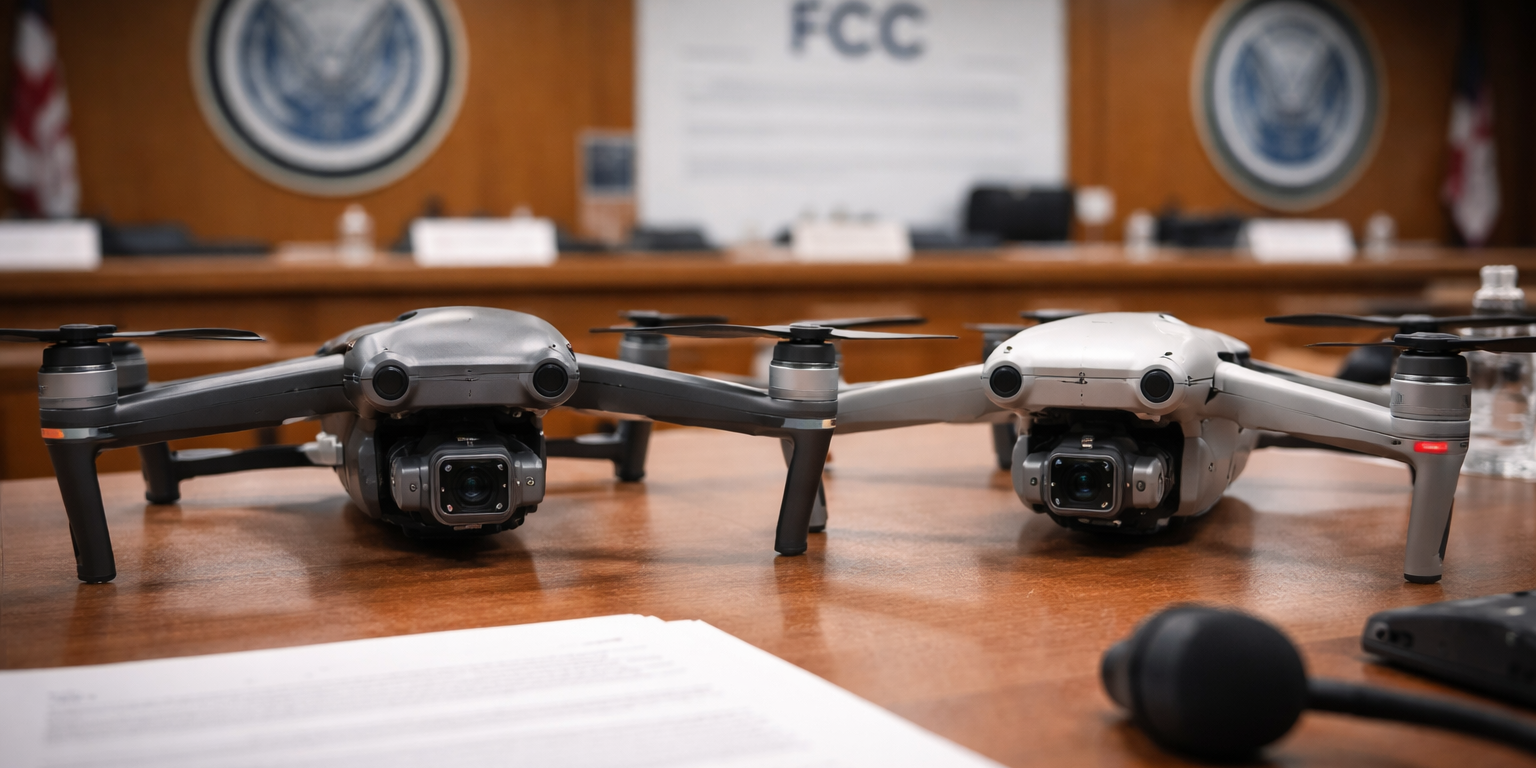
The Federal Communications Commission has published notice of its intent to ban equipment from Anzu Robotics, claiming the Austin-based company functions primarily as a licensing front for DJI rather than an independent manufacturer. The agency's Public Safety and Homeland Security Bureau revealed the proposed action in documentation dated August 2026, naming Anzu alongside previously targeted entities as covered companies under the Secure Equipment Act. Equipment authorization would be revoked retroactively, pulling Anzu drones already deployed in commercial operations off the market unless operators can prove compliance through alternative means. The FCC characterized the licensing relationship between Anzu and DJI as insufficiently arm's-length to qualify Anzu as a distinct entity for regulatory purposes.
Anzu launched in 2024 marketing itself as an American alternative to DJI, with aircraft that bore unmistakable resemblance to popular DJI models including the Mavic 3 and Mini series. The company's pitch centered on domestic assembly and support infrastructure, but relied on licensed intellectual property and core components from DJI. That arrangement appeared initially to satisfy customers seeking to avoid Chinese-manufactured equipment amid growing federal scrutiny of supply chain security. Municipal police departments, infrastructure inspection contractors, and agricultural operators bought Anzu systems specifically to sidestep procurement restrictions on DJI hardware while retaining access to what were functionally equivalent aircraft. Anzu reported selling several thousand units across commercial and public safety channels before the FCC review began. The company maintained operations in Texas with customer service and warranty support handled domestically, a structure it argued demonstrated genuine operational independence from DJI's Shenzhen headquarters.
The FCC's investigation focused on the financial and operational relationship between the two companies. According to sources familiar with the inquiry, regulators examined licensing agreements, component sourcing contracts, and software development records to determine whether Anzu exercised meaningful control over product design and manufacturing. The conclusion, reflected in the proposed ban, found that DJI retained effective control over core technologies including flight controllers, vision systems, and communications protocols. Anzu's role amounted to final assembly, localization, and distribution rather than substantive engineering or manufacturing. This mirrors the FCC's treatment of Autel Robotics' EVO Nano series, which faced similar scrutiny over its relationship with parent companies subject to U.S. trade restrictions. The Anzu case differs in that the company actively marketed its separation from DJI as a selling point, making the FCC's determination particularly consequential for how licensing arrangements are evaluated under equipment authorization rules.
The broader implications extend beyond one company's market access. Drone manufacturers have explored licensing as a viable path to serving U.S. customers while leveraging established Chinese technology platforms. Skydio, the largest U.S.-based drone manufacturer, competes on fully domestic development and production but faces cost and feature gaps against DJI's ecosystem. Anzu-style licensing offered a middle path that preserved DJI's technical advantages while satisfying surface-level domestic sourcing requirements. The FCC's position effectively forecloses that option, forcing customers to choose between Chinese-made hardware and genuinely independent alternatives that may cost more or deliver fewer capabilities. Public safety agencies in particular face budget pressures that made Anzu attractive compared to Skydio's higher-priced offerings. Infrastructure inspection contractors told industry analysts throughout 2025 and early 2026 that Anzu provided the best compromise between regulatory compliance and operational performance. That calculus now collapses if the FCC proceeds with the ban.
What to Watch: The FCC will accept public comments on the Anzu ban through September 2026, with particular attention to input from municipalities and commercial operators currently using the equipment. Watch whether Anzu attempts to restructure its relationship with DJI to satisfy the FCC's concerns, or exits the market entirely. Skydio's pricing and production capacity will face immediate scrutiny as the primary beneficiary if thousands of Anzu drones require replacement. Track whether other licensing-based manufacturers including certain thermal imaging and payload specialists face similar reviews, as the FCC's reasoning could apply beyond complete aircraft to component suppliers.