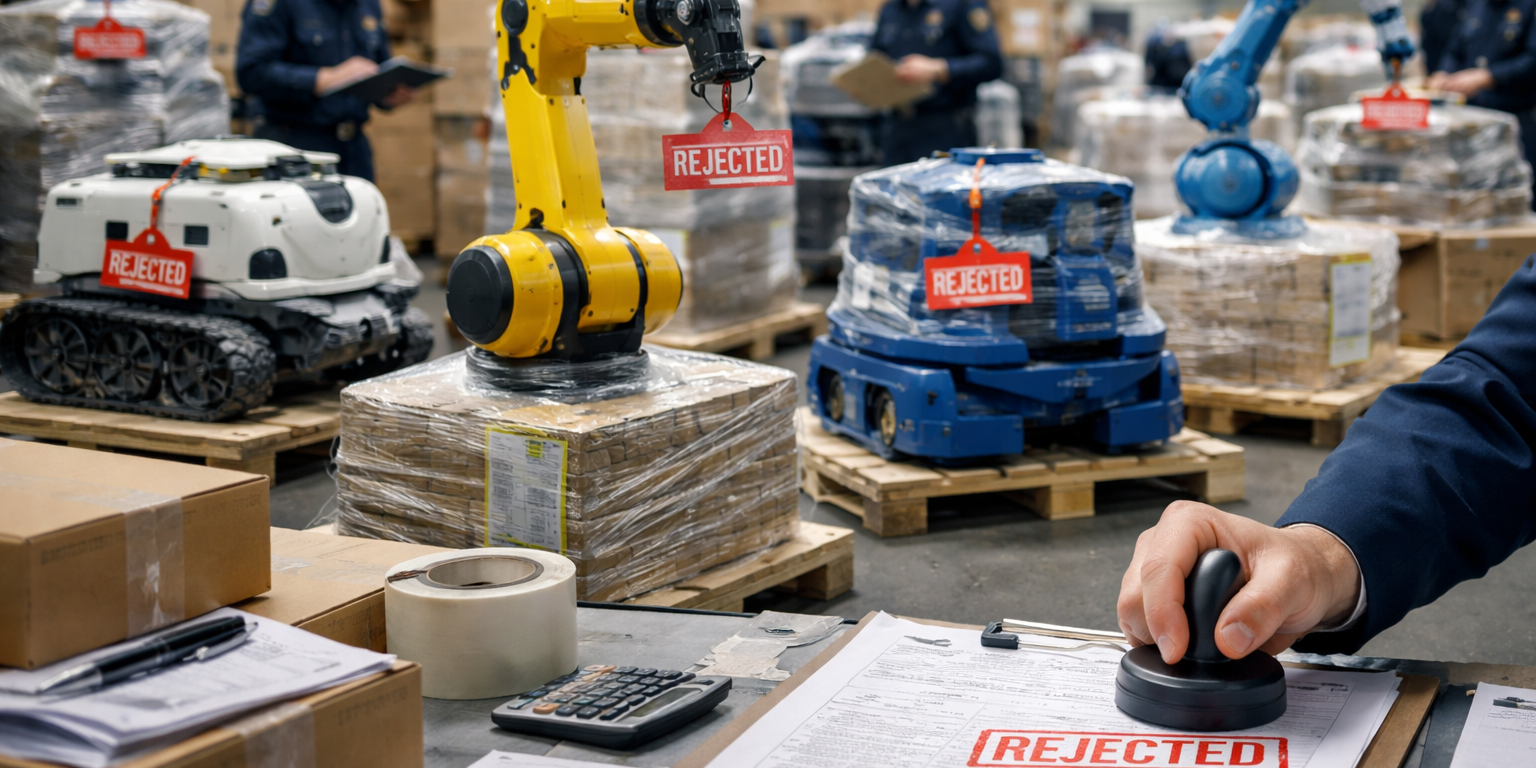
Mobile robots capable of wireless communication and weighing more than 2 kilograms can no longer enter the United States as new products, following a July 28 decision by the Federal Communications Commission to add the category to its Covered List of equipment deemed threats to national security. The threshold captures nearly every commercial and industrial robot on the market, from warehouse automation units to agricultural systems, creating what industry executives describe as an immediate supply chain crisis for companies dependent on foreign manufacturing partners.
The Covered List originated in 2021 as a mechanism to identify specific communications equipment and services that posed security risks, initially targeting Chinese telecommunications giants like Huawei and ZTE. The latest expansion, driven by the Department of Defense rather than the FCC itself, represents a categorical approach that differs fundamentally from the original list's targeted methodology. Unlike earlier additions that named specific manufacturers or product lines, the new rule applies to any robot meeting the weight and communication criteria, regardless of country of origin. This means a collaborative robot manufactured in Germany or a logistics platform built in Japan faces the same import restrictions as products from China, though the policy's practical impact falls heaviest on Chinese suppliers who dominate global robotics production. The FCC simultaneously added power inverters commonly used in solar installations, signaling a broader DOD concern about foreign-manufactured components in critical infrastructure.
Robotics companies operating in the United States now confront asymmetric competitive pressures. Chinese manufacturers can continue selling their products domestically and in most international markets, while U.S. companies face restricted access to the same supply base that has driven down component costs and accelerated development cycles over the past decade. A warehouse automation startup that previously sourced chassis and motor controllers from Shenzhen now must either find domestic suppliers charging premium prices or redesign systems around available components, extending development timelines by months or years. The 2-kilogram threshold appears calculated to exclude consumer drones and small hobby robots while capturing industrial-grade equipment, but robotics engineers note the cutoff lacks technical justification related to actual security vulnerabilities. A 3-kilogram delivery robot poses no inherently different communications risk than a 1.5-kilogram unit, yet only the former faces import prohibition. Industry representatives interviewed by IEEE Spectrum expressed frustration with what they characterize as policy-making untethered from engineering reality, though none agreed to attribution given the charged political environment surrounding China trade restrictions.
The timing compounds challenges for companies already navigating tariff uncertainties and export control expansions. Several robotics firms had structured supply chains around modular designs incorporating standardized components from multiple countries, a strategy that distributed risk while maintaining cost efficiency. Those architectures now require fundamental revision. One agricultural robotics company discovered that its lightweight field scouting robot, which weighed 1.8 kilograms, would cross the threshold once equipped with the cellular modem required for remote operation, forcing a choice between removing connectivity features or domesticating production. Meanwhile, established players with existing FCC authorizations for foreign-manufactured products can continue importing those specific models, creating an incumbency advantage that entrenches current market leaders and raises barriers for new entrants. The rule does not retroactively revoke authorizations already granted, meaning a warehouse robot approved in early July can still ship, but any hardware revision requiring new certification falls under the ban. This grandfathering mechanism introduces version-lock dynamics where minor improvements trigger major compliance obstacles.
What to Watch: Monitor whether the FCC issues clarifications on the "any foreign country" language following industry pushback about allied nation products. Track Q4 2026 earnings calls from warehouse automation companies for quantified impacts on product roadmaps and margin pressure from supply chain restructuring. Watch for potential legal challenges arguing the categorical ban exceeds the FCC's statutory authority under communications law. Several robotics industry groups are reportedly coordinating a formal petition for rulemaking that would replace the blanket restriction with manufacturer-specific or component-level risk assessments, expected to file before the end of September 2026.