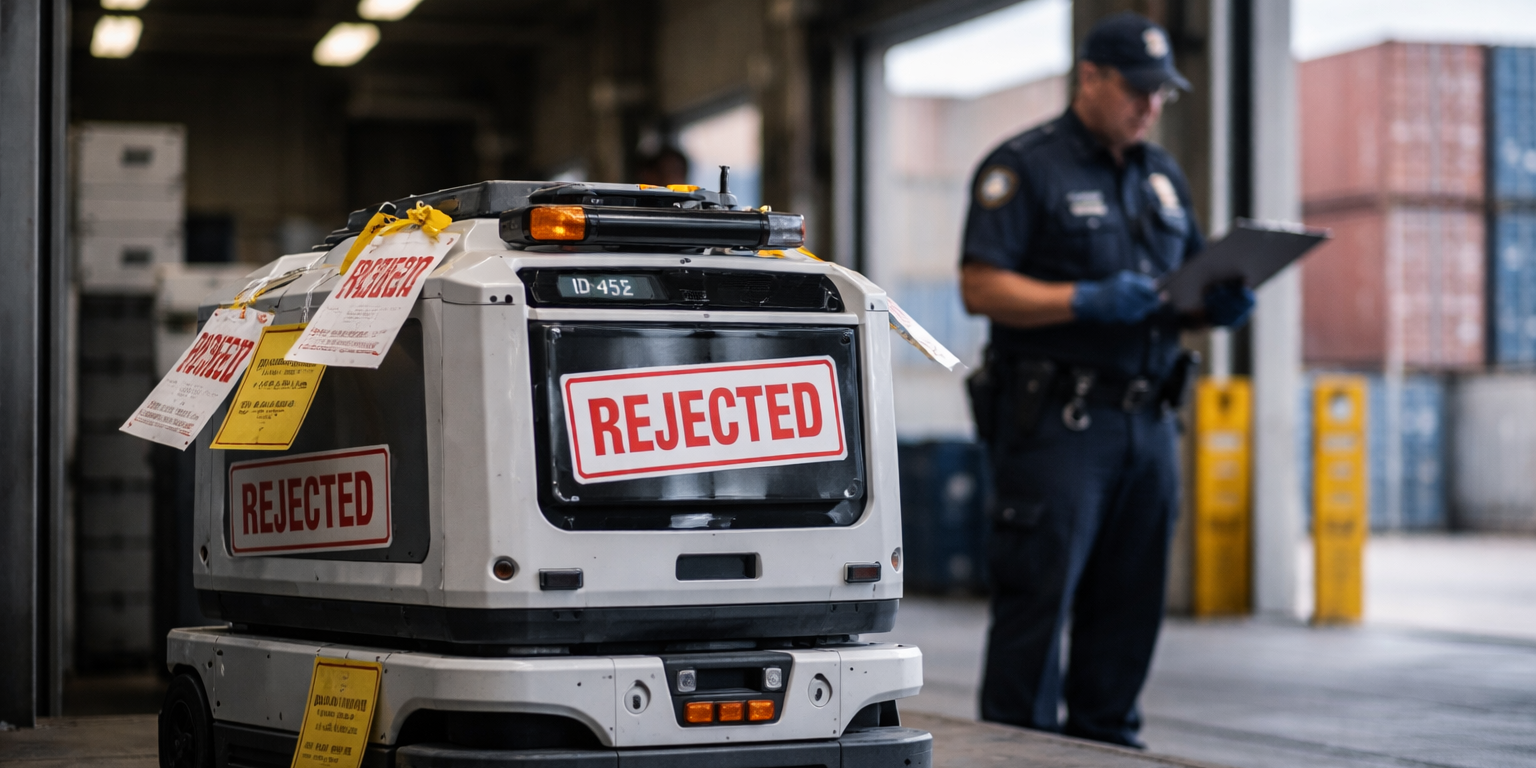
Robots weighing more than 2 kilograms that communicate wirelessly can no longer enter the United States as new imports, following a July 28 update to the Federal Communications Commission's Covered List. The agency's national security blacklist, first published in 2021 to restrict telecommunications equipment from Chinese manufacturers, now extends to mobile robots and power inverters used in solar installations. The expansion, pushed by the Department of Defense, marks the first time the FCC has applied blanket import restrictions to an entire robotics product category based solely on country of origin, without naming specific manufacturers.
The 2-kilogram threshold captures nearly every commercial mobile robot currently deployed in warehouses, factories, and last-mile delivery operations. Boston Dynamics' Spot weighs 32.5 kilograms. The smallest AMRs from companies like MiR and Locus Robotics typically start around 60 kilograms unladen. Even lightweight collaborative arms mounted on mobile bases exceed the cutoff. The FCC provided no technical justification for the weight limit in its public announcement, leaving manufacturers and systems integrators scrambling to interpret whether the rule applies to individual robot components, complete systems, or both. Legal experts interviewed by trade publications noted the regulation's language suggests any single integrated device meeting both the weight and communication criteria falls under the ban, regardless of how it ships. That interpretation would exclude modular robotics kits assembled domestically but capture turnkey platforms imported ready to deploy.
Chinese manufacturers dominate the sub-$50,000 AMR segment, where the majority of warehouse automation purchases happen. Shenzhen-based SEER Robotics, which shipped more than 8,000 units globally in 2025, sells navigation-capable tugger robots starting at $18,000. Geek+ has deployed over 30,000 picking robots worldwide, with heavy concentrations in North American e-commerce facilities operated by third-party logistics providers. Both companies rely on Wi-Fi and cellular connectivity for fleet management, putting their entire product lines squarely in the FCC's crosshairs. The ban does not affect robots already installed and operating in the United States, but it blocks replacement units, expansion orders, and any new model introductions. For integrators who have built service contracts and spare parts networks around Chinese platforms, the ruling creates immediate business continuity problems. One Atlanta-based warehousing consultant, speaking on condition of anonymity, said three clients are now evaluating whether to continue expansion of Chinese-made AMR fleets already numbering in the hundreds of units, or absorb the cost of switching to domestic or allied-nation suppliers mid-deployment.
The inverter designation adds a parallel disruption for robotics companies developing solar-powered outdoor platforms. Agricultural robots, perimeter security units, and delivery droids increasingly use photovoltaic panels to extend operational range. Chinese manufacturers supply roughly 80 percent of inverters sold in North America, according to Solar Energy Industries Association data. Domestic inverter production exists but operates at significantly higher cost, and lead times stretched past six months even before the FCC announcement. The dual restrictions on robots and inverters suggest Defense Department planners see vulnerability in autonomous systems that communicate over commercial networks and draw power from grid-independent sources. Neither the FCC nor the Pentagon has released threat assessments or incident reports justifying the expansion, though the July 28 order cites ongoing reviews of supply chain risks in critical infrastructure.
Manufacturers based in allied nations stand to gain share. Japan's Rapyuta Robotics, Denmark's Mobile Industrial Robots, and Germany's Fraunhofer IPA spinoffs all produce AMRs in the affected weight class with domestic or European manufacturing. Their pricing runs 40 to 60 percent higher than comparable Chinese units, a gap that narrows when factoring in tariffs and compliance costs but still presents a barrier for price-sensitive logistics buyers. Some integrators are exploring split architectures, where foreign-made robots operate without wireless connectivity, controlled instead by wired field networks that terminate at U.S.-manufactured gateways. Whether such designs satisfy FCC requirements remains untested. The agency has not published technical guidance on permissible communication topologies or clarified whether Bluetooth, Zigbee, or other short-range protocols fall under the ban alongside Wi-Fi and cellular. Industry groups including the Association for Advancing Automation and the Robotic Industries Association have requested formal comment periods and technical workshops, but the FCC has not committed to either.
What to Watch: The FCC is expected to release detailed technical specifications by late September 2026, clarifying which communication protocols trigger the ban and whether domestically assembled robots using foreign-made radios qualify for exemptions. Watch for lobbying efforts from the Robotic Industries Association and major integrators seeking carve-outs for installed base expansions. Several Chinese robotics firms are reportedly exploring manufacturing partnerships in Mexico and Vietnam to route around the origin-based restrictions. Litigation challenging the FCC's authority to regulate robotics absent spectrum allocation issues could land in federal court before year-end.