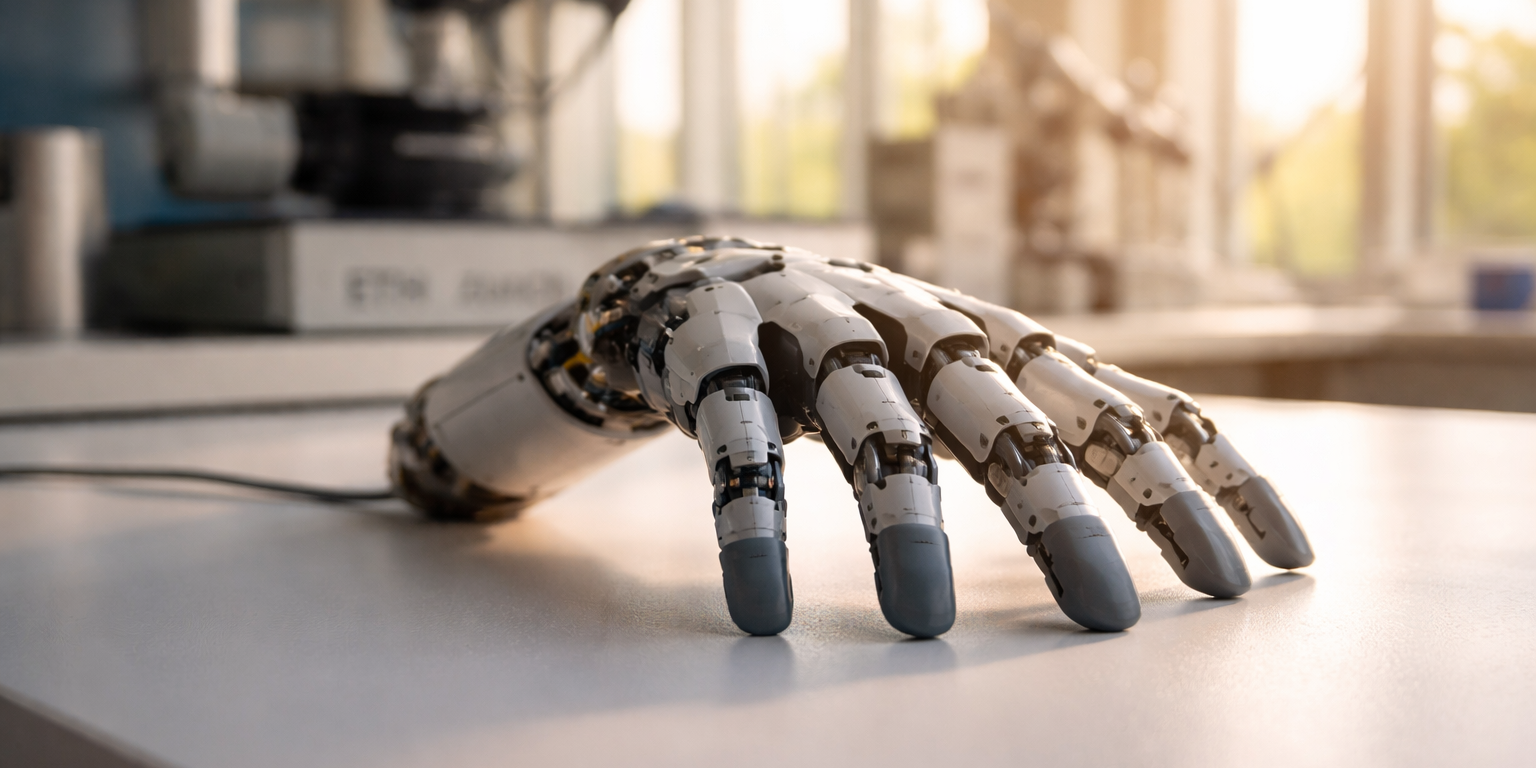
A disembodied robotic hand crawls across a laboratory table at ETH Zurich, fingers undulating in deliberate sequence to pull itself forward. The device operates without a robotic arm, torso, or any other body structure—just five articulated fingers, a palm, and the embedded actuators that make autonomous locomotion possible. Robert Katzschmann's team at the Soft Robotics Lab designed the system to challenge a fundamental assumption in humanoid robotics: that manipulation requires a stable base and articulated limbs to position the end effector.
The project originated from a straightforward observation about inefficiency. Traditional robotic arms carry significant weight, consume substantial power, and occupy considerable workspace—all to move a gripper or hand to a task location. For applications where the manipulation point is known and stationary, that entire kinematic chain becomes overhead. Katzschmann's group asked whether the hand itself could travel to the worksite, eliminating the need for supporting hardware. The answer required solving a problem that doesn't exist in conventional robotics: how do you create a hand that's simultaneously a locomotion platform? The ETH Zurich team embedded soft pneumatic actuators into each finger, allowing the hand to execute a gait cycle that alternates between anchoring and reaching. Two fingers grip the surface while three extend forward, then the roles reverse in a coordinated sequence that resembles inchworm locomotion translated into five-digit mechanics.
The technical challenge extended beyond simple crawling. A functional robotic hand must maintain sufficient grip strength for manipulation tasks while remaining light and flexible enough for efficient movement. The team's design uses chambers within each finger that inflate and deflate in programmed patterns, creating both the gripping force needed to secure objects and the controlled compliance required for adaptive locomotion across uneven surfaces. The system weighs considerably less than equivalent traditional configurations—a critical factor for mobile applications where every gram affects battery life and movement efficiency. Testing demonstrated the hand's ability to traverse horizontal surfaces, climb moderate inclines, and navigate around obstacles using tactile feedback from pressure sensors embedded in the fingertips. The crawling speed remains modest compared to wheeled or legged robots, but the design prioritizes access over velocity. The hand can squeeze through gaps and reach into confined spaces that would exclude larger robotic platforms entirely.
The implications reach beyond novelty. Manufacturing environments increasingly deploy collaborative robots for assembly tasks, but workspace constraints often limit where these systems can operate. A crawling manipulator could access machinery interiors, perform inspections inside narrow channels, or execute maintenance tasks in spaces designed for human hands rather than robotic arms. Defense applications present another use case—remote inspection and manipulation in hazardous environments where a small, expendable unit offers advantages over expensive multi-limb platforms. Search and rescue operations could benefit from devices capable of navigating rubble and confined voids where traditional robots cannot reach. The medical field represents perhaps the most immediate commercial opportunity. Minimally invasive surgical tools already employ snake-like articulation to reach internal anatomy through small incisions. A soft robotic hand that crawls through the body cavity could position itself for procedures, then relocate autonomously as the operation progresses, reducing the need for multiple insertion points.
The ETH Zurich work joins a broader shift in robotics research away from monolithic humanoid designs toward specialized morphologies optimized for specific tasks. Boston Dynamics demonstrated that quadruped robots outperform bipedal designs for many industrial applications. Similarly, the crawling hand suggests that manipulation doesn't require replicating the full human form—just the relevant subsystem. This approach could accelerate deployment timelines and reduce costs by allowing engineers to match robot complexity precisely to task requirements rather than building general-purpose platforms that remain expensive and difficult to commercialize. The project also highlights ongoing advances in soft robotics, where compliant materials and pneumatic actuation replace rigid links and electric motors. These systems offer inherent safety advantages in human-collaborative environments and adaptability across varied tasks, though challenges remain in achieving the precision and speed of conventional designs. Katzschmann's team continues developing the hand's autonomy, working to integrate computer vision and machine learning algorithms that would allow the device to identify manipulation targets and plan its own approach paths without human teleoperation.
What to Watch: Monitor publication from the ETH Zurich Soft Robotics Lab detailing the hand's control architecture and sensor integration, likely appearing in IEEE Robotics and Automation Letters or Soft Robotics journal before year-end 2026. Track whether medical device companies or surgical robotics firms including Intuitive Surgical or CMR Surgical engage with ETH Zurich for licensing discussions around minimally invasive applications. Watch for follow-on DARPA or European Defence Agency funding if military interest materializes in confined-space manipulation for EOD or reconnaissance missions.