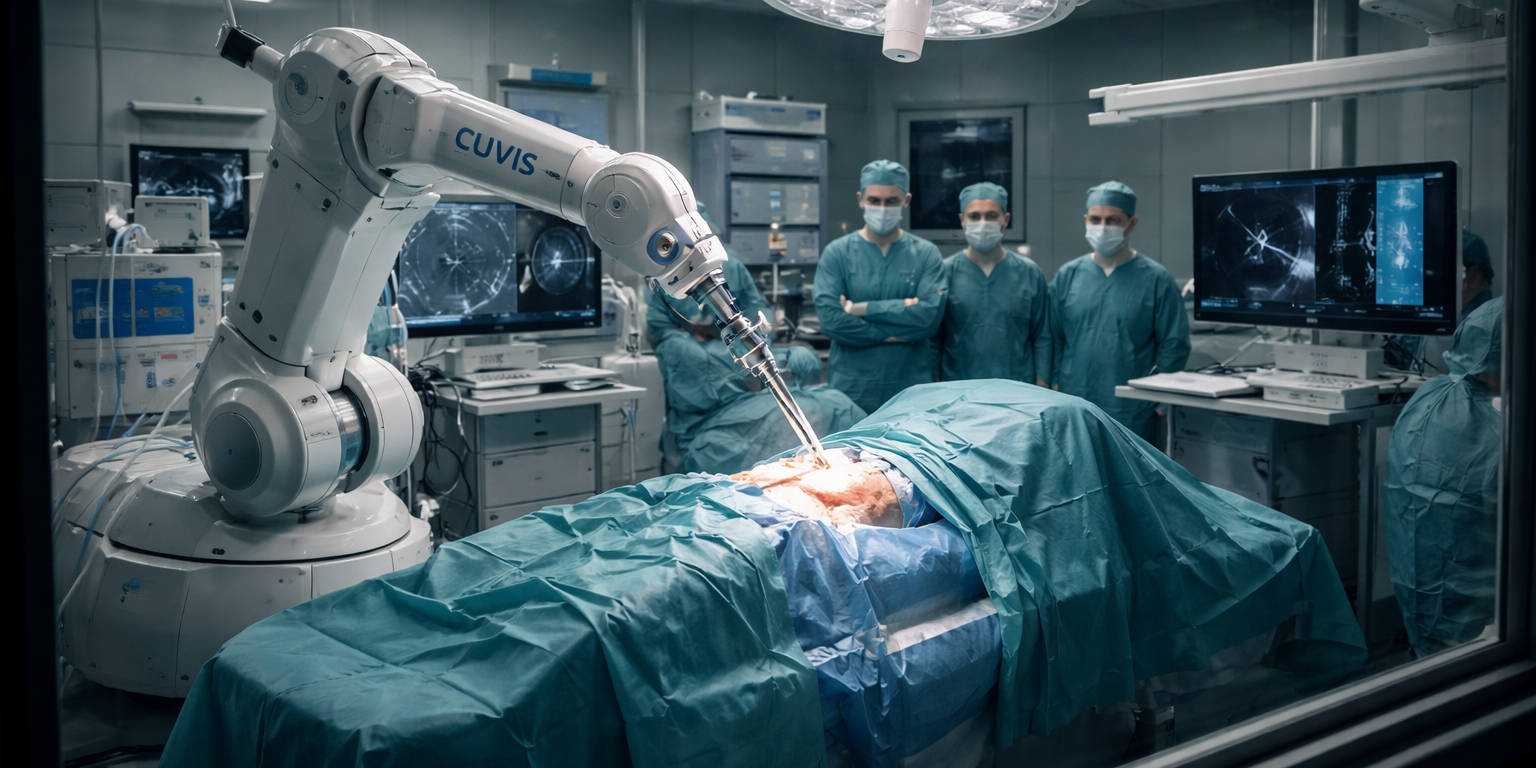
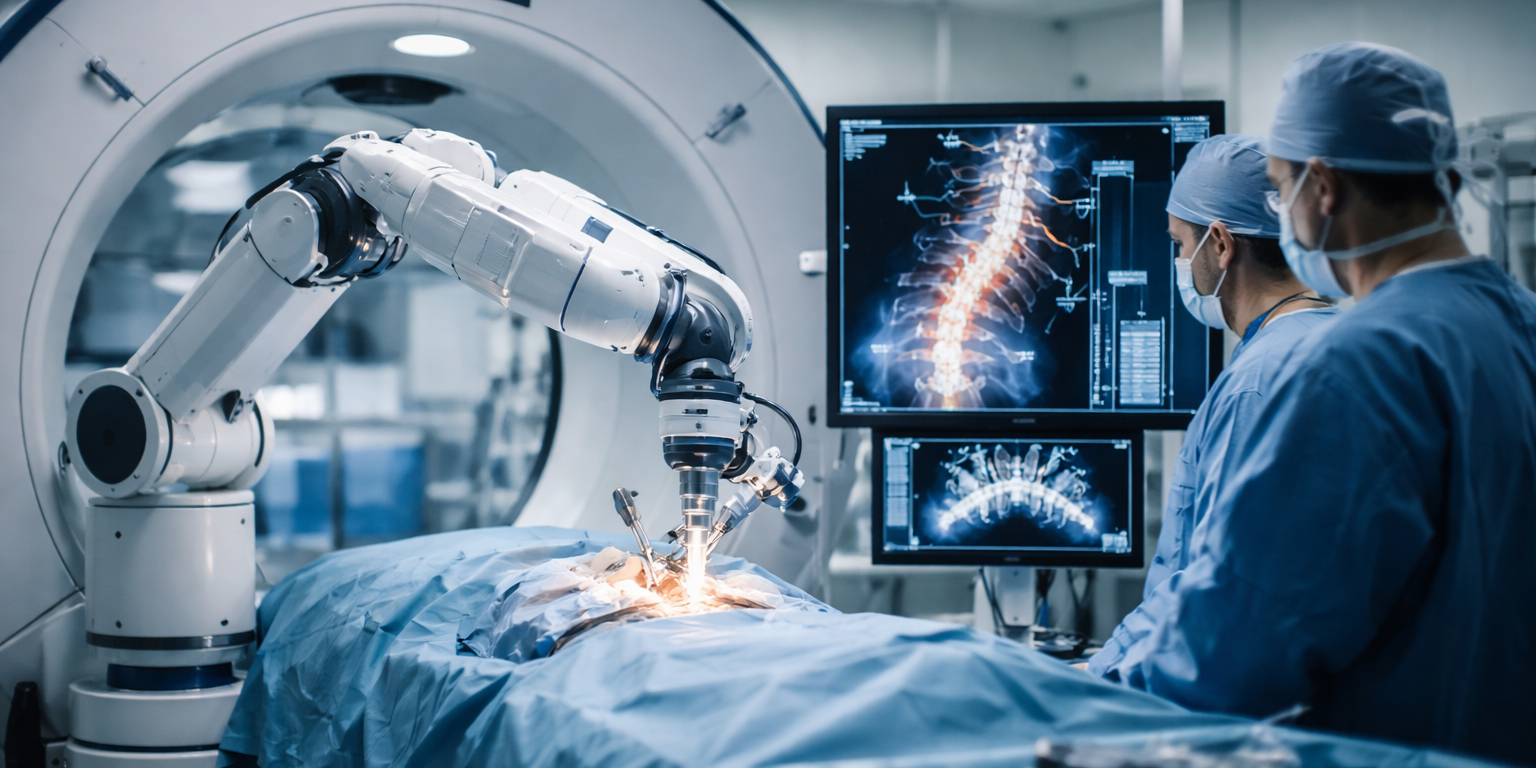
Enovis will pay $155 million to acquire eCential Robotics, a Paris-based developer of imaging-guided surgical robotics for spine procedures, the company disclosed in a binding offer made public this week. The transaction brings Enovis a platform already generating commercial revenue in European markets and marks the orthopedic device maker's first significant entry into autonomous surgical positioning systems. Matt Trerotola, Enovis CEO, framed the acquisition as essential infrastructure for the company's reconstructive division, which has relied on manual instrumentation and passive navigation tools while competitors deployed active robotics. The deal is expected to close in the fourth quarter of 2026, subject to French regulatory clearances and works council consultations required under European labor law.
eCential's core technology combines intraoperative computed tomography with a robotic arm that automates screw trajectory planning and instrument positioning during spinal fusion procedures. The system, marketed under the brand name eCential Assist, uses a compact CT scanner mounted on a motorized gantry to capture three-dimensional anatomy in real time, then calculates optimal screw paths and guides drilling with millimeter-level precision. Surgeons approve the planned trajectories on a touchscreen interface before the robotic arm executes the approach. Clinical data presented at the 2025 North American Spine Society annual meeting showed the platform reduced mean fluoroscopy time by 64 percent compared to freehand techniques in a cohort of 187 lumbar fusion cases performed at five French hospitals. Radiation exposure to surgical staff dropped by a corresponding margin. The system has European CE Mark clearance for thoracolumbar procedures and is installed in approximately two dozen European spine centers, primarily in France, Germany, and Switzerland. Enovis has not disclosed whether eCential holds U.S. Food and Drug Administration clearance or has initiated the 510(k) submission process required for American commercialization.
The orthopedic robotics market has consolidated rapidly over the past eighteen months as devicemakers race to match the imaging and automation capabilities Medtronic introduced with its Mazor X Stealth Edition platform. Globus Medical, which acquired Excelsius Surgical in 2019, now reports robotic-assisted cases account for nearly 40 percent of its U.S. spine implant revenue. Zimmer Biomet holds a minority stake in ROSA, the Zimmer-branded version of Medtech's robotic system, but has focused deployment on brain procedures rather than spine. Enovis, which separated from Colfax Corporation in 2022 and combines the legacy DJO Global rehabilitation business with Mathys orthopedic implants, has until now relied on partnerships for advanced visualization. The company's reconstructive segment posted $421 million in revenue for the first half of 2026, growing 7.8 percent organically, but lacks the double-digit expansion rates robotics-enabled competitors have reported. Industry analysts have noted that high-volume ambulatory surgery centers increasingly view robotic guidance as a prerequisite for spine case contracts, particularly as Medicare reimbursement models shift toward bundled payments that penalize revision procedures caused by misplaced hardware.
eCential Robotics was founded in 2009 by a team of engineers and neurosurgeons from the French Alternative Energies and Atomic Energy Commission and the University of Paris. The company has raised approximately €50 million across multiple venture rounds, with backing from Bpifrance, the French public investment bank, and the European Innovation Council. According to corporate filings, eCential employed 62 people as of December 2025, split between its Paris headquarters and a development facility in Grenoble. The $155 million acquisition price represents roughly 3.1 times estimated 2026 revenue, assuming eCential reaches the €50 million sales target management outlined in investor presentations earlier this year. That multiple sits below the 4-to-6 times revenue multiples surgical robotics assets commanded in 2024 and 2025 transactions, reflecting both eCential's early commercial stage and the absence of U.S. market access. Enovis will fund the purchase through a combination of cash on hand and an expansion of its existing revolving credit facility. The company carried $1.9 billion in total debt as of June 2026, with a leverage ratio of 3.2 times adjusted EBITDA.
Integration plans call for eCential to operate as a standalone unit within Enovis's reconstructive division, maintaining its French engineering team and European commercial operations while gaining access to Enovis's U.S. distribution network and regulatory affairs resources. Trerotola said the company will prioritize FDA clearance for the eCential platform and expects to begin limited U.S. market introduction in late 2027, starting with academic medical centers that perform high volumes of complex spine cases. Enovis has not disclosed capital expenditure plans for expanding eCential's manufacturing capacity or whether it will co-develop future versions of the platform with its existing implant engineering teams. The transaction includes earn-out provisions tied to U.S. regulatory milestones and 2027 revenue targets, though specific performance thresholds were not disclosed. Credit Suisse served as financial advisor to Enovis on the deal. eCential was advised by Bryan Garnier & Co.
What to Watch: FDA 510(k) submission timing will determine whether Enovis can begin U.S. commercialization before the end of 2027. Track whether Enovis integrates eCential's robotic platform with its existing MicroPort implant portfolio or maintains it as a platform-agnostic positioning system compatible with multiple implant vendors. Monitor competitive responses from Medtronic and Globus Medical, both of which have hinted at next-generation spine robotics launches scheduled for 2027. Finally, watch for updates on whether eCential expands beyond spine into robotics-assisted joint replacement, a considerably larger market but one requiring entirely new clinical validation.