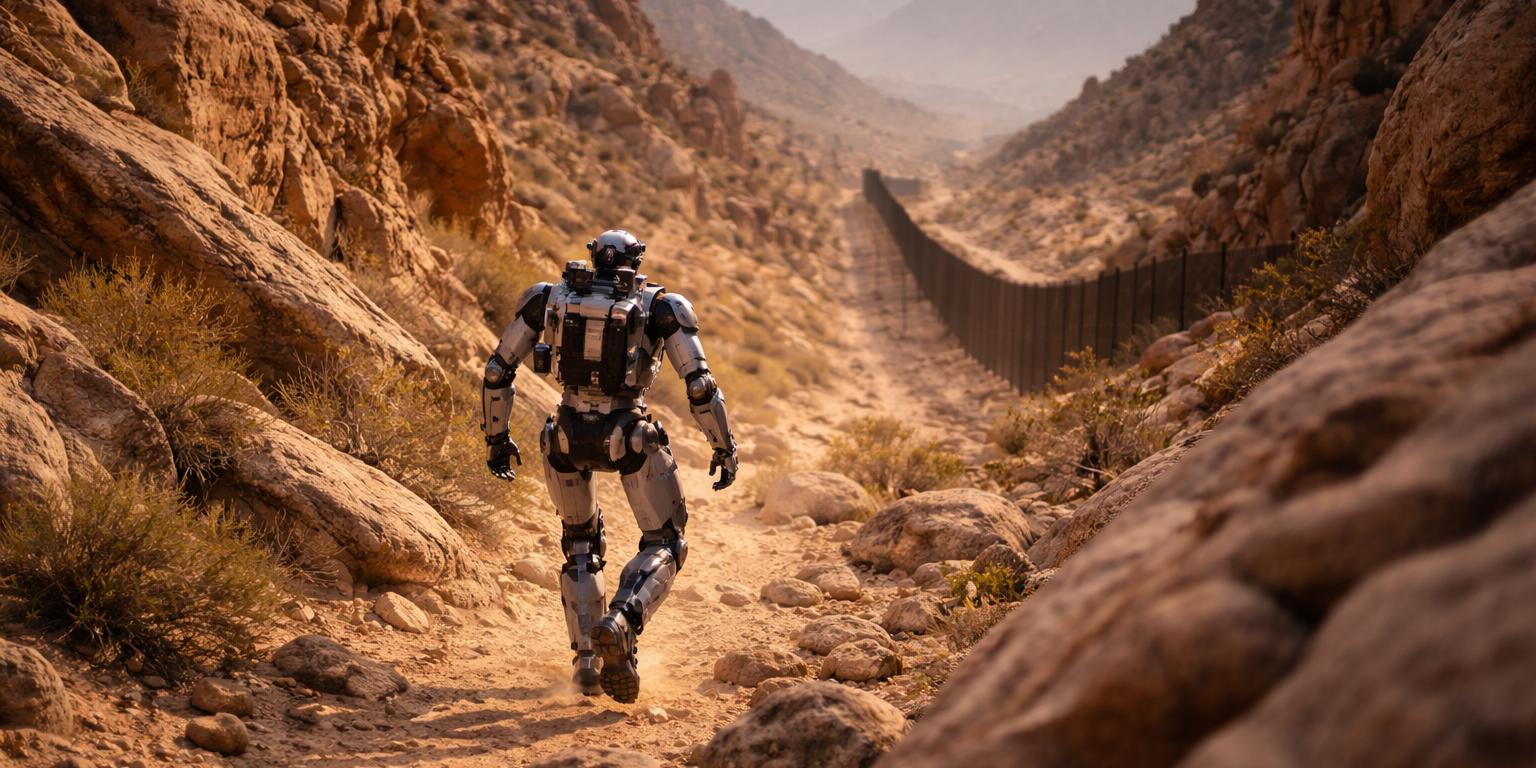
The Department of Homeland Security has issued a request for information seeking humanoid robots to augment personnel stationed along the southern border, marking the first formal effort by a federal law enforcement agency to deploy bipedal autonomous systems in field operations. The RFI, circulated to defense contractors and robotics manufacturers in late July 2026, asks for platforms capable of traversing rocky desert terrain, operating in extreme temperatures, and conducting multi-hour patrols without human supervision. A source familiar with the procurement noted that the request stems from operational gaps that neither aerial drones nor fixed sensor towers have successfully addressed, particularly in remote mountain passes and canyon networks where vehicle access remains limited and foot patrols prove resource-intensive. The initiative follows three years of pilot programs testing quadruped robots from Boston Dynamics and Ghost Robotics at select border checkpoints, deployments that demonstrated the utility of autonomous ground systems but revealed limitations in their ability to navigate vertical obstacles and interact with physical infrastructure designed for human operators. Those earlier trials informed the current requirements, which specify bipedal mobility as essential for climbing ladders, opening gates, and operating in built environments where migrants and smugglers exploit terrain that wheeled or quadruped platforms cannot reliably access.
The timing reflects broader momentum in federal adoption of humanoid systems. U.S. Customs and Border Protection, which operates under DHS, currently employs approximately 19,000 Border Patrol agents across 328 ports of entry and 8,000 miles of land and coastal borders. Budget documents reviewed by RoboticsIntl.com show the agency spent $871 million on technology and tactical infrastructure in fiscal year 2025, with surveillance systems accounting for the largest share. Yet a 2024 Government Accountability Office report found that sensor coverage remains incomplete across 47 percent of the southwest border, particularly in mountainous sectors where tower placement proves prohibitively expensive and terrain limits the effectiveness of ground-based radar. Aerial drones, widely deployed since 2021, provide broad area surveillance but lack the dwell time and close-range capability needed to assess whether detected movement involves people, animals, or vehicles. The gap has kept agent deployments high in areas where environmental conditions make sustained human presence difficult, driving interest in systems that combine mobility, endurance, and the ability to perform tasks currently requiring human judgment or dexterity.
The RFI does not name specific manufacturers, but industry analysts point to a short list of likely respondents. Agility Robotics, which has focused on logistics applications with its Digit platform, recently added ruggedized components and enhanced battery systems targeting outdoor use cases. Figure AI has conducted undisclosed trials with defense and public safety customers, though the company has not publicly detailed law enforcement applications. Apptronik, backed by investments from several aerospace primes, has emphasized modularity and payload capacity in its Apollo platform, characteristics relevant to carrying surveillance equipment or supplies during extended missions. Sanctuary AI and Tesla remain possibilities, though neither has demonstrated platforms optimized for unstructured outdoor terrain. The RFI explicitly requires robots capable of operating continuously for at least four hours, withstanding temperatures from 10 to 120 degrees Fahrenheit, and navigating slopes up to 35 degrees, specifications that exceed the published capabilities of most commercially available humanoids. It also asks vendors to address how their platforms would handle communication in areas with limited or no cellular connectivity, a technical challenge that has hindered other autonomous systems deployed along the border.
Beyond technical specifications, the procurement raises questions about operational doctrine and legal frameworks. Current DHS policy prohibits unmanned systems from carrying weapons, a restriction that would limit humanoid robots to surveillance, communication relay, and logistical support roles. But the RFI includes language asking vendors to describe how their platforms could be adapted for future capabilities, wording that defense attorneys and civil liberties organizations have flagged as potentially opening the door to armed variants. A DHS spokesperson declined to comment on whether armed humanoids are under consideration, stating only that any system deployment would comply with existing use-of-force policies and constitutional protections. The agency has committed to a public comment period before finalizing requirements, though no timeline has been announced. Meanwhile, contractors are watching closely. Northrop Grumman, L3Harris, and Anduril Industries, all of which hold existing border security contracts, are expected to respond either with proprietary platforms or as integrators partnering with humanoid developers. The structure of those partnerships, and whether established defense contractors will acquire humanoid startups outright, could reshape the competitive landscape for terrestrial autonomous systems across multiple government verticals.
What to Watch: DHS plans to release a formal request for proposals by the end of Q4 2026, with initial prototype evaluations likely in spring 2027. Monitor whether Figure AI or Agility Robotics announce defense-focused product variants or new partnerships with prime contractors in the coming months. Pay attention to congressional appropriations hearings this fall, where border technology spending typically faces scrutiny and where funding levels for autonomous systems will be set. Finally, track any policy updates from CBP regarding the operational scope of unmanned ground systems, as those rules will define how aggressively the agency can deploy humanoids once platforms are fielded.