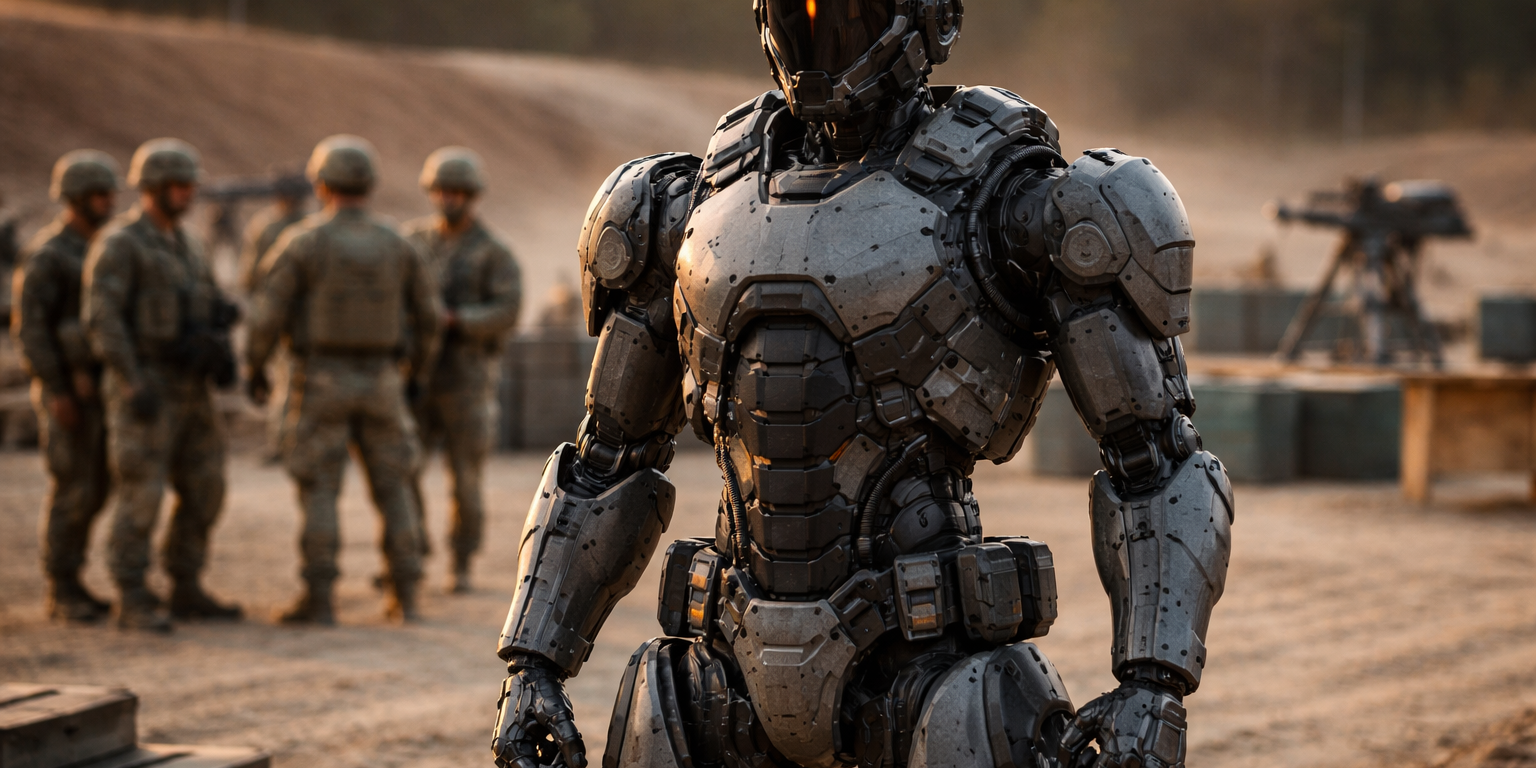
DARPA solicitations describe autonomous medical robots that would link together to drag wounded soldiers from contested terrain, administer injectable medications, and apply improvised splints to fractured limbs. The systems, termed "medicbots" in agency planning documents, would operate in scenarios where adversary fire or other hazards prevent human medics from reaching casualties within the critical minutes following injury. The agency envisions multi-robot teams coordinating physical tasks in real time, navigating obstacles, and adapting to terrain conditions while carrying wounded personnel who may weigh two hundred pounds or more in full kit. No budget figures or program milestones have been released, leaving industry observers to assess technical requirements from the solicitation language alone.
Casualty evacuation under fire has driven military doctrine for decades, with medical personnel accepting exceptional risk to reach wounded soldiers before blood loss or shock becomes irreversible. Current protocols depend on human medics closing distance to casualties within five to ten minutes, a timeline that compresses further when adversaries can direct accurate fire at rescue attempts. Combat in urban terrain or open ground with limited cover exacerbates the problem, creating zones where extraction attempts carry near-certain casualties among rescuers. Robotic systems promise to penetrate these environments without adding to the butcher's bill, but only if they can execute tasks that have so far required human judgment, strength, and dexterity. DARPA's program appears designed to push autonomous manipulation and mobility into regimes where existing commercial platforms fall short.
The technical challenges stack quickly. Coordinating multiple robots to drag a two-hundred-pound load across uneven ground demands real-time path planning algorithms that account for shifting terrain, obstacle detection, and dynamic load distribution among machines whose relative positions change continuously. Current disaster-response robots, including those deployed at Fukushima or in collapsed-building scenarios, typically operate under direct human teleoperation with latency measured in seconds. DARPA's medicbots would need to plan and execute maneuvers autonomously, likely using onboard sensor fusion and edge computing to avoid communication delays that could prove fatal in fluid combat conditions. Medical tasks add another layer of difficulty. Injecting medication requires locating anatomical landmarks, penetrating clothing or body armor, and delivering precise dosages, all while the robot and patient may be moving. Splinting broken limbs demands force sensing and control loops sophisticated enough to immobilize a fracture without causing additional tissue damage. Surgical robotics companies like Intuitive Surgical and CMR Surgical have demonstrated the required dexterity in sterile operating theaters, but packaging those capabilities for outdoor operation in dust, mud, temperature extremes, and electromagnetic interference from jamming systems represents an entirely different engineering problem. Companies working on modular robotic architectures and ruggedized actuators, including RE2 Robotics and Sarcos Technology and Robotics Corporation, may find the program offers a reference application that validates their approaches for military buyers.
DARPA has not specified whether medicbots would carry defensive weapons or operate exclusively in areas already secured by friendly forces. That decision will shape sensor suites, autonomy levels, and rules of engagement in ways that ripple through system design. Unarmed robots operating in unsecured areas would need reliable threat detection and evasion capabilities, possibly including smoke deployment, acoustic decoys, or high-speed retreat maneuvers. Armed systems would require targeting algorithms, fire-control integration, and policy frameworks that govern when a medical robot may engage threats. The agency's silence on this dimension leaves contractors to propose architectures that could accommodate either pathway, likely driving modular payload bays and software-defined mission profiles. Industry reaction has been muted so far, with no major defense primes issuing public statements. That pattern typically indicates companies are evaluating whether their existing robotics portfolios position them for credible bids or whether the program requires ground-up development that may not fit near-term revenue pipelines. Smaller firms specializing in autonomous ground vehicles or mobile manipulation may see an opportunity to leapfrog established players if they can demonstrate fieldable prototypes quickly.
What to Watch: Monitor DARPA contracting announcements over the next ninety days for Phase I awards, which will identify which firms are pursuing tethered multi-robot systems versus independent units. Track patent filings from RE2 Robotics, Sarcos, and Ghost Robotics related to load-sharing algorithms and field-hardened manipulation. Watch for any public clarification from DARPA on whether medicbots will carry weapons, as that decision will determine which companies can compete using existing platforms versus requiring clean-sheet designs.