
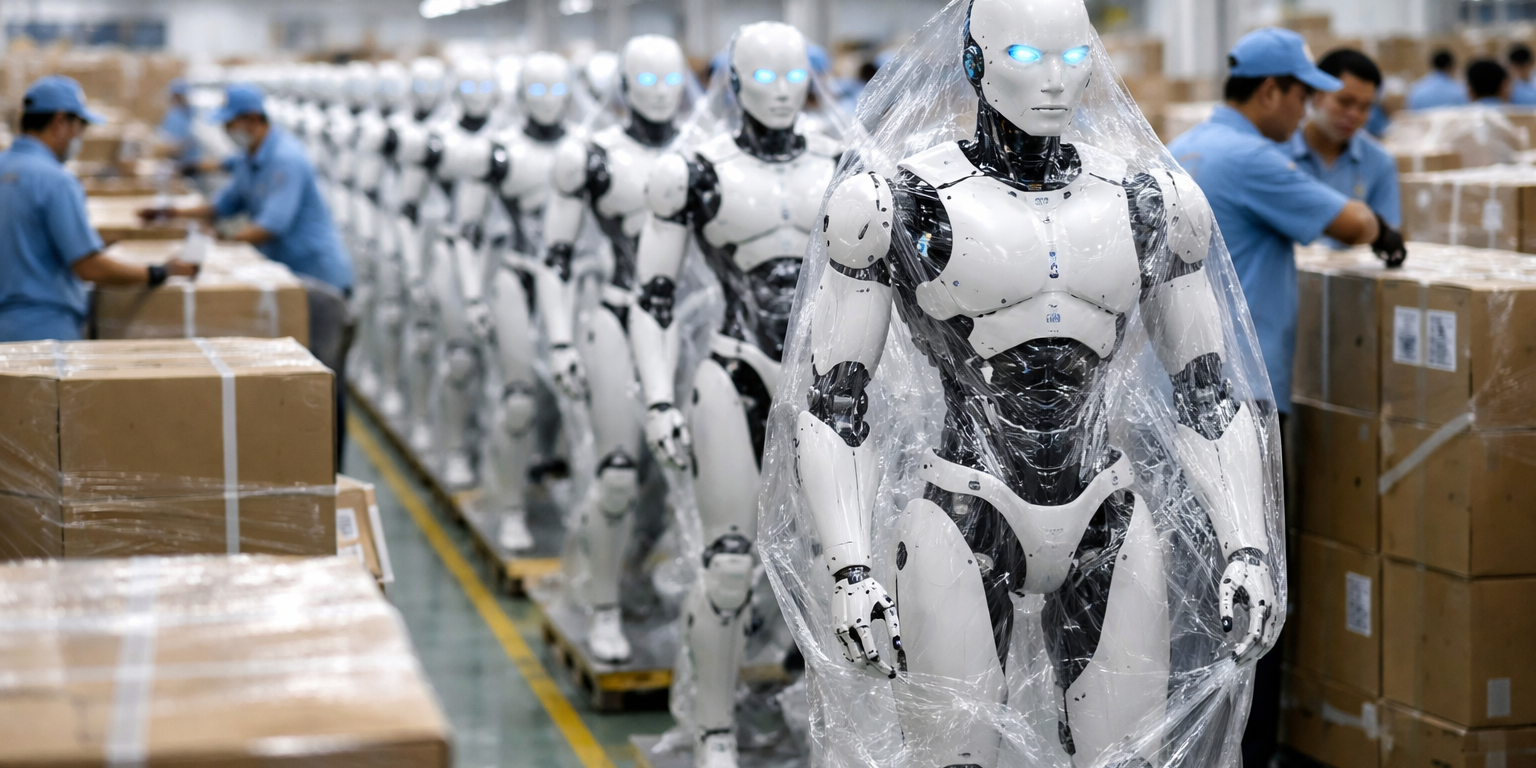
Global humanoid robot shipments hit 19,100 units in the first half of 2026, and Chinese manufacturers accounted for 18,500 of them. That 97% market share represents a level of dominance rarely seen in emerging robotics categories, surpassing even China's 52% share of traditional industrial robot installations. The numbers, which reflect a 275% increase from the 5,100 units shipped during the same period last year, mark the first time humanoid hardware has moved from prototype-scale production to something resembling volume manufacturing.
Two companies drove the majority of that growth. AgiBot, the Shenzhen-based firm backed by Zhongguancun Development Group, shipped approximately 8,400 units in the first six months of the year, capturing 44% of the global market. Unitree, better known for its quadruped robots before entering the humanoid space, followed with 5,900 units. The remaining Chinese manufacturers, a group that includes names like Fourier Intelligence, UBTech, and LEJU Robotics, collectively accounted for another 4,200 units. Non-Chinese producers shipped fewer than 600 units combined, a figure that includes ongoing pilot deployments from Figure AI, Tesla's limited Optimus shipments to internal facilities, and evaluation units from Sanctuary AI and Apptronik.
The shipment data reflects more than just manufacturing capacity. Chinese humanoid makers have converged on a business model that prioritizes affordability and immediate deployments over extended development cycles. AgiBot's Raise-A1, which began shipping in volume during the second quarter, carries a list price around $30,000 for industrial variants. Unitree's G1, available since late 2025, starts at approximately $16,000 for the base configuration. Those price points sit well below the estimated $150,000-plus cost structures cited by several U.S.-based humanoid developers, a gap that has allowed Chinese manufacturers to secure purchase orders from logistics firms, contract manufacturers, and automotive suppliers willing to deploy robots at scales that make economic sense. Several regional logistics operators in eastern China have placed orders exceeding 500 units, a volume unheard of in humanoid deployments just 18 months ago.
The industrial applications driving these shipments differ notably from the general-purpose ambitions often highlighted in venture-funded pitches. AgiBot's largest customer segments include electronics assembly, warehousing operations, and quality inspection roles where the form factor of a humanoid offers advantages in facilities designed for human workers. Unitree has found traction in educational institutions and research labs, where lower-cost hardware enables experimentation at scale, as well as in pilot programs with retailers testing humanoids for inventory management and shelf stocking. The robots shipping today typically operate in constrained environments with well-defined tasks, not the open-ended scenarios that dominate conference presentations. That pragmatism has translated into purchase orders.
The concentration of humanoid production in China carries implications beyond market share statistics. Supply chain advantages in electric motors, sensors, and power electronics have allowed Chinese manufacturers to iterate hardware faster and cheaper than competitors importing components. AgiBot and Unitree both rely on domestic suppliers for actuators and control boards, components that often require customization and close collaboration between robot makers and parts manufacturers. The resulting cost structures and production lead times create competitive moats that extend beyond simple labor cost differentials. Western humanoid developers, many of which remain focused on achieving technical milestones rather than shipping volume hardware, now face a market where price-performance expectations have shifted. A $150,000 humanoid must demonstrate capabilities that justify a 5x to 10x premium over Chinese alternatives, a difficult case to make when customers prioritize deployment scale over cutting-edge manipulation or navigation.
What to Watch: AgiBot plans to begin exports to Southeast Asian markets in the third quarter, with shipments expected to Thailand and Vietnam for electronics manufacturing customers. Unitree has announced a higher-payload variant of the G1 scheduled for release in September 2026, targeting automotive and heavy logistics applications. Tesla's shipment numbers for Optimus remain undisclosed, but analysts expect the first external customer deployments could begin in the fourth quarter. Chinese humanoid production capacity is projected to exceed 60,000 units annually by year-end, a figure that would require identifying applications beyond the current industrial base.