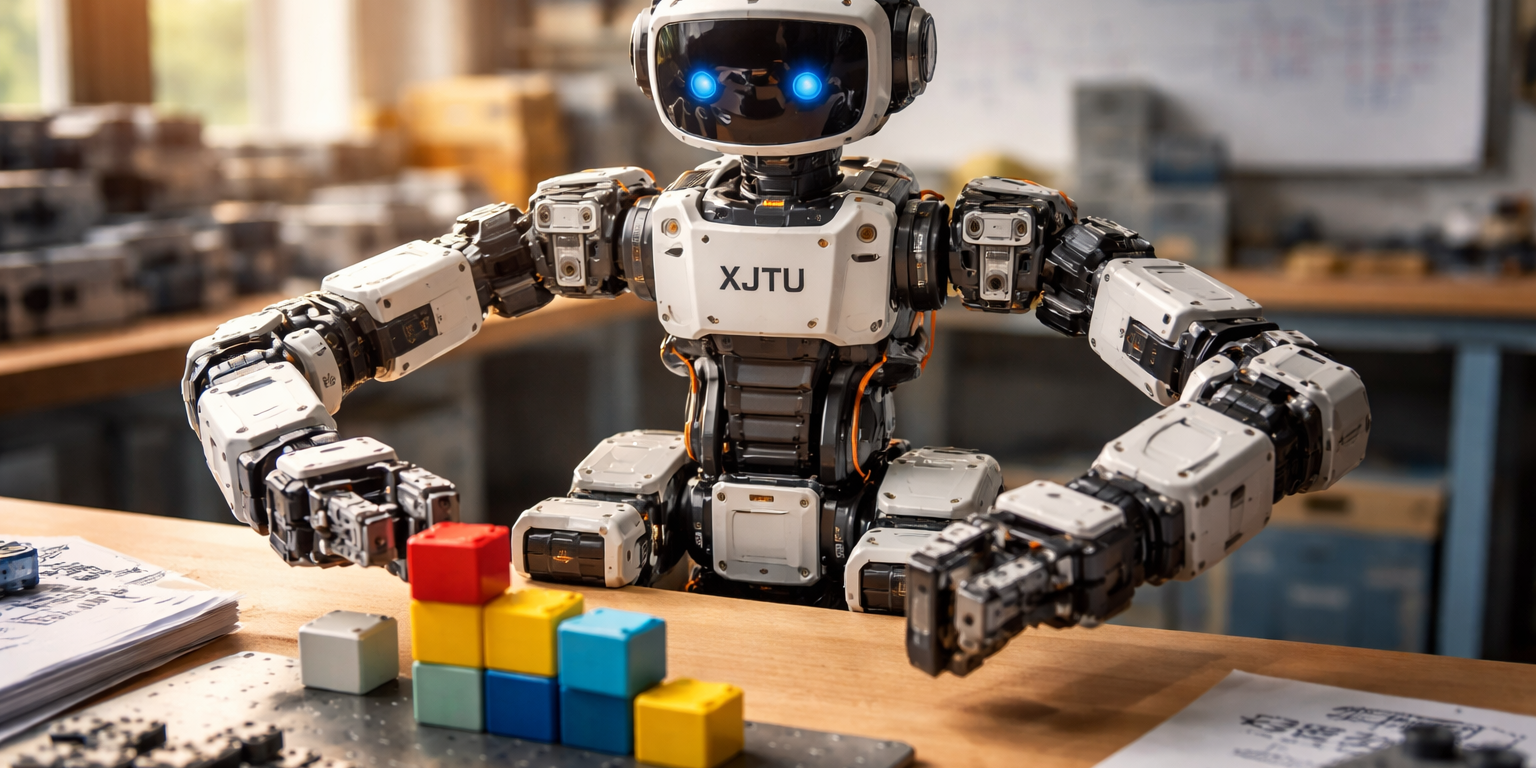
At RMB 9,800, Blue Insect Embodied's newly launched Mantis Standard humanoid robot costs about $1,350 at current exchange rates, positioning it well below the RMB 16,000 to RMB 30,000 range that Chinese competitors typically charge for research-grade humanoid platforms. The company, which operates as a technology-transfer entity from Xi'an Jiaotong University, designed the platform around standardized modules connected through quick-install interfaces, allowing users to swap or upgrade individual components without disassembling the entire system. The robot, marketed under the name Xiaobai in Chinese-speaking markets, ships with 22 degrees of freedom distributed across its chassis, dual arms, waist joint, and head assembly. A 663-millimeter arm span and 7-kilogram single-arm payload suggest the platform targets tabletop manipulation tasks rather than heavy industrial work, though those specifications position it competitively against similarly sized research platforms from established robotics labs.
The modular architecture represents a calculated bet on standardization as a path to volume production. Where previous humanoid designs from Chinese startups have relied on custom actuators and proprietary control boards, Blue Insect Embodied built the Mantis Standard around off-the-shelf servo motors and standardized mechanical interfaces that mirror patterns emerging in the open-source robotics community. Quick-install connectors mean a lab technician can replace a damaged arm module in minutes rather than hours, reducing downtime costs for research groups running multi-shift experiments. The approach also creates a natural upgrade path: users who start with the base configuration can add higher-torque actuators or extended arm segments as project requirements evolve, without scrapping the entire platform. Xi'an Jiaotong University has produced several successful robotics spinouts over the past decade, including companies focused on industrial vision systems and collaborative robot arms, giving Blue Insect Embodied access to both technical expertise and established supply chain relationships in China's manufacturing hub regions.
Pricing pressure in the humanoid robotics sector has intensified as Chinese manufacturers compete for university research budgets and early commercial adopters. Shenzhen-based LimX Dynamics charges RMB 29,900 for its P1 biped platform, while UBTech's Walker series starts above RMB 100,000 for commercial variants with advanced mobility features. Blue Insect Embodied's entry point undercuts those figures by focusing on upper-body manipulation rather than full locomotion, a trade-off that resonates with researchers studying object grasping, human-robot interaction, and telepresence applications where the robot remains stationary. The 7-kilogram payload per arm supports typical research loads: laboratory equipment, consumer products for retail studies, or assembly components in manufacturing research settings. The 663-millimeter arm span restricts the robot's workspace compared to larger humanoids, but matches the reach requirements for seated workstation tasks or countertop assembly scenarios that represent near-term commercial applications for humanoid manipulators. Universities and corporate research labs ordering multiple units can negotiate volume discounts, bringing per-unit costs down further.
Broader industry dynamics explain the pricing strategy. Chinese robotics companies raised approximately $2.8 billion across 147 funding rounds during the first half of 2026, according to data compiled by IT Juzi, with humanoid robotics attracting nearly one-quarter of that total. Investors have pushed companies to demonstrate product-market fit and recurring revenue rather than simply showcasing technical capabilities, creating pressure to ship commercial products even as core technologies continue maturing. The modularity of the Mantis Standard supports a recurring revenue model through component sales and periodic upgrades, similar to approaches taken by computer hardware manufacturers. Meanwhile, competition from international players has softened: Agility Robotics focuses on logistics applications with its Digit platform, while Figure AI targets automotive manufacturing partnerships, leaving gaps in the research and light manufacturing segments where Blue Insect Embodied aims to compete. The Xi'an Jiaotong University connection provides another advantage. Chinese government policies encourage technology transfer from leading universities, often providing subsidized manufacturing space and favorable lending terms to spinout companies that commercialize academic research. Those structural advantages help explain how Blue Insect Embodied can price aggressively while maintaining margins sufficient to support ongoing development.
What to Watch: Monitor whether Blue Insect Embodied announces partnerships with Chinese electronics manufacturers or research institutes before year-end 2026, which would validate demand for the sub-$1,500 price point. Track whether competitors like LimX Dynamics or Fourier Intelligence respond with lower-cost modular platforms of their own within the next 90 days. Watch for technical specifications on the Mantis Standard's control software and computing platform, particularly whether it supports ROS 2 or other standard middleware that would ease integration with existing research workflows. Pay attention to export availability, as sub-$2,000 humanoid platforms could find significant demand among robotics programs at universities in Southeast Asia and Latin America if regulatory approvals permit international shipments.