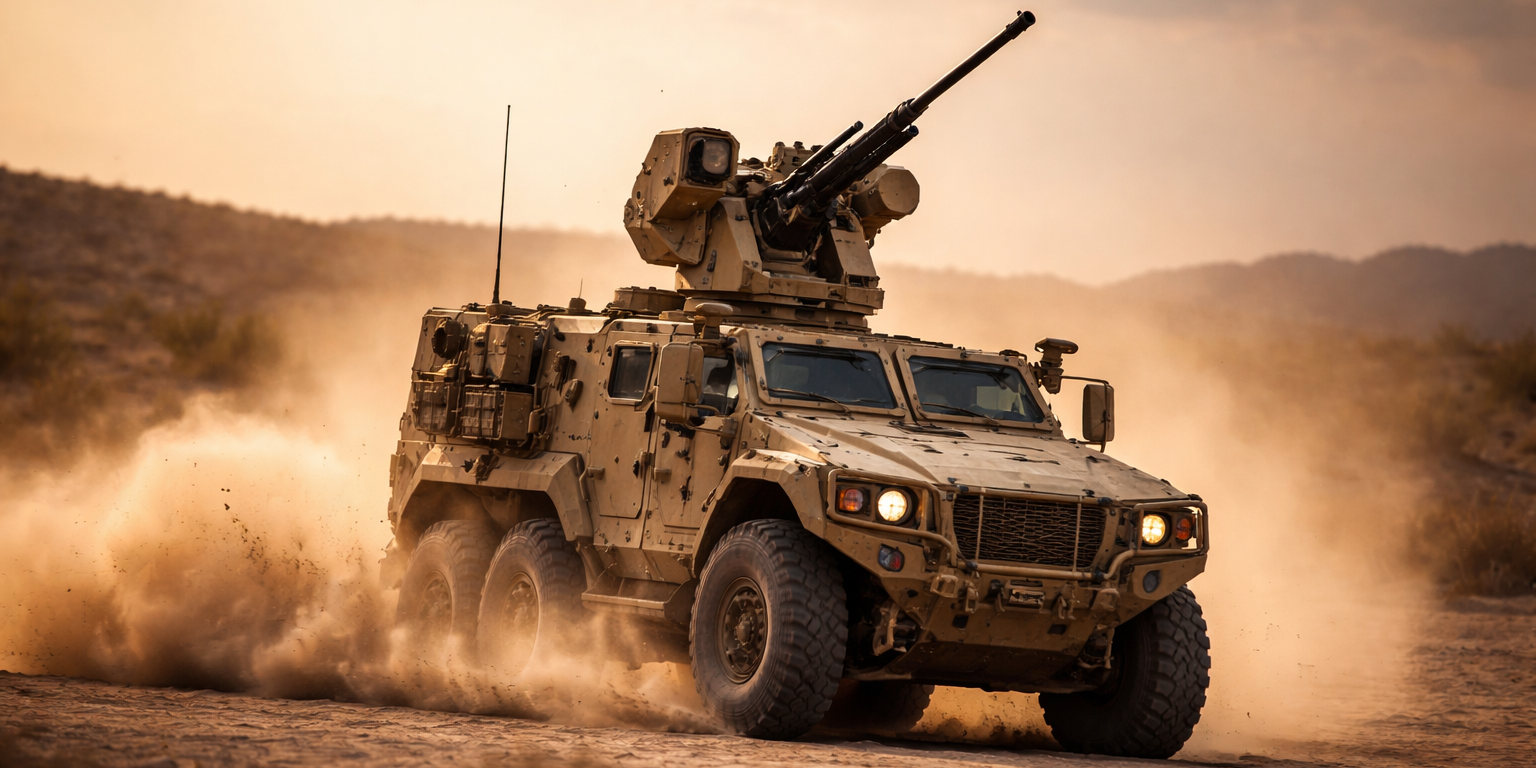
A vehicle traveling at tactical speed engaged and destroyed multiple unmanned aircraft in flight during recent Army evaluations of fire control software designed to solve one of the harder problems in counter-drone warfare: hitting a moving target from a moving platform. The tests, conducted at Army proving grounds with production-grade hardware, demonstrated repeatability across multiple engagement scenarios and weapon types, according to sources familiar with the trials.
The software addresses a persistent gap in vehicle-based counter-UAS capabilities. Existing systems perform adequately when stationary or when engaging hovering targets, but accuracy degrades sharply once both shooter and target are moving. The ballistic calculations required to lead a maneuvering drone while compensating for vehicle motion, weapon cant, and environmental factors demand processing capabilities and sensor fusion algorithms that most fielded systems lack. The Army has been funding development work in this area since 2023, when operational units reported multiple engagement failures during exercises where vehicles attempted to fire on the move. The service set a requirement that vehicles must maintain greater than seventy percent hit probability against Class 1 and Class 2 UAS while traveling at speeds up to forty kilometers per hour across uneven terrain.
The validated software integrates with the Common Remotely Operated Weapon Station (CROWS) and similar platforms already mounted on thousands of Army vehicles. It pulls data from multiple sensor feeds including radar, electro-optical trackers, and vehicle navigation systems to generate firing solutions in real time. The processing architecture uses predictive modeling to account for target acceleration and vehicle dynamics, recalculating aim points at rates exceeding one hundred hertz. During the tests, gunners engaged targets at ranges between three hundred and fifteen hundred meters while their vehicles traversed courses with elevation changes, turns, and obstacles designed to simulate tactical movement in contested environments. Hit rates exceeded Army thresholds across all scenarios, with particular success against small quadcopters performing evasive maneuvers.
Several defense contractors participated in the development and testing, though the Army has not disclosed which companies supplied the core algorithms or how the intellectual property will be managed for future procurements. Industry sources indicate that at least three firms submitted competing approaches during earlier evaluation phases, with the winning architecture selected based on performance in simulation before moving to live fire. The modular design allows the software to run on various hardware configurations, from dedicated fire control computers to vehicle-integrated processing units. This flexibility matters for rapid fielding across the Army's heterogeneous vehicle fleet, which includes platforms ranging from JLTVs to Strykers to Abrams tanks, each with different computing resources and weapon station types.
The urgency behind this capability stems from battlefield observations in Ukraine and the Middle East, where small commercial drones have proven devastatingly effective against armored vehicles that cannot shoot accurately while maneuvering. Stationary defensive positions allow crews to engage threats methodically, but vehicles caught in transit or during assault operations face far higher risk. The Army's existing counter-UAS doctrine emphasizes layered defense with electronic warfare and kinetic effectors, but gaps remain when vehicles operate beyond the protective umbrella of area-denial systems. Mobile hard-kill capability fills that gap, particularly for mechanized units operating in environments where GPS jamming renders many drone navigation systems ineffective but does not eliminate the threat entirely. The software's validation arrives as the Army accelerates procurement of counter-UAS equipment across brigade combat teams, with billions of dollars allocated through 2028 for systems that can deploy with expeditionary forces.
What to Watch: The Army will begin integrating this software into operational units during the third quarter of 2026, starting with select brigade combat teams scheduled for deployment rotations. Watch for procurement announcements identifying which contractors will supply production licenses and support services. Also track testing results from international partners, particularly European NATO members who have expressed interest in similar capabilities for their vehicle fleets. Finally, monitor whether the Marine Corps adopts the same software architecture for its lighter vehicles, or pursues a separate development path optimized for amphibious and expeditionary operations.