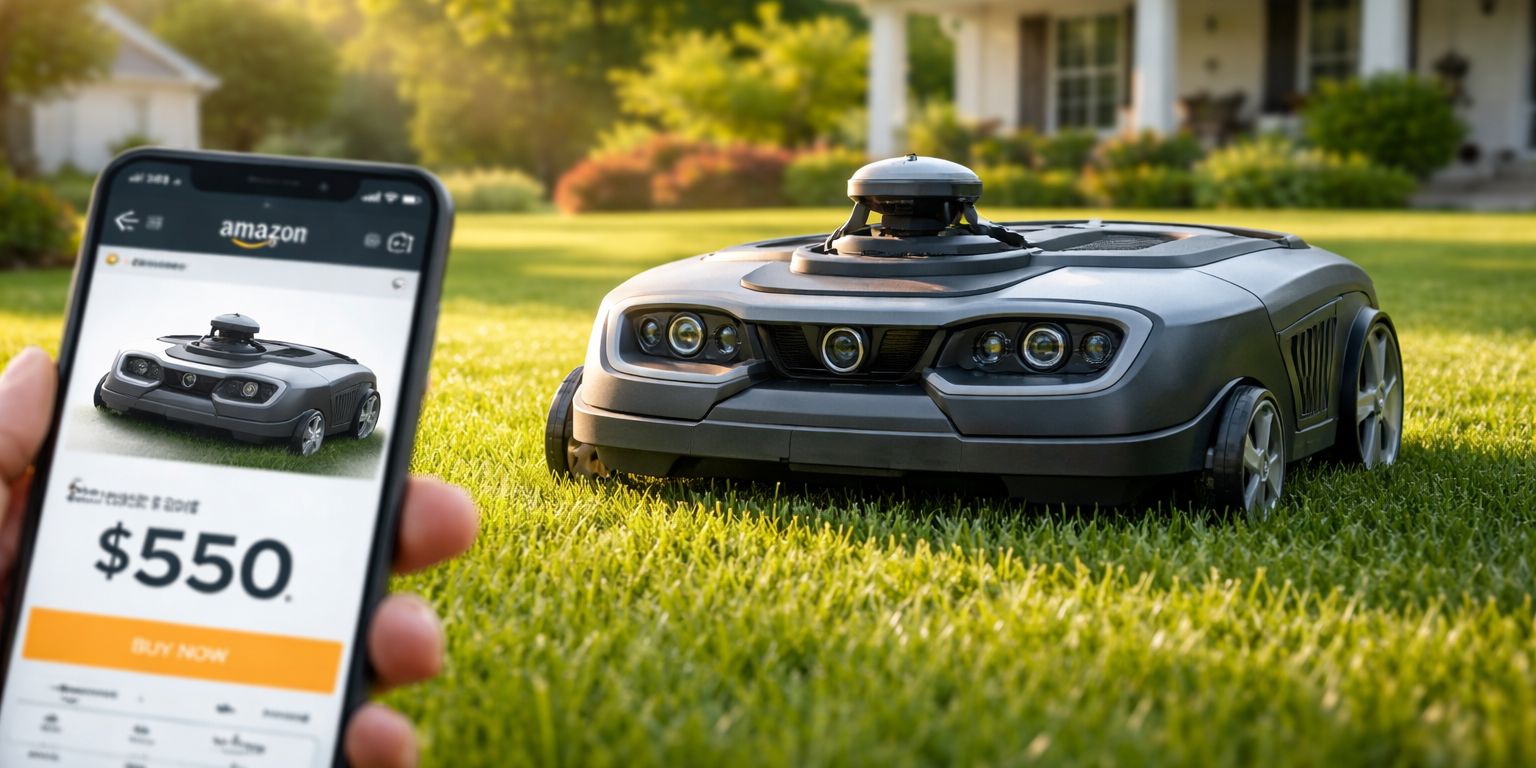
Anthbot trimmed $79 from its M5 autonomous lawn mower this week, bringing the machine to $550 with free shipping on Amazon for properties up to one-eighth acre. The discount arrives as established outdoor power equipment brands face sustained pressure from Chinese robotics manufacturers willing to sacrifice margin for market share in North America and Europe. Anthbot, a Shenzhen-based company that entered the robotic mower segment in late 2024, has now undercut Worx, Greenworks, and EcoFlow on price while matching or exceeding their navigation capabilities. The M5 uses full-band RTK satellite positioning paired with dual-vision cameras, a sensor suite that cost over $2,000 in commercial agricultural robots just three years ago.
The specifications tell the story of rapid component cost reduction across outdoor autonomous systems. Anthbot's 20-centimeter cutting width and five-blade rotary deck handle slopes up to 24 degrees, processing roughly 500 square meters per charge cycle. The dual-vision system uses stereo cameras for obstacle detection within three meters, while the RTK receiver pulls corrections from a base station to maintain centimeter-level accuracy during boundary mapping and mowing patterns. That combination of visual and satellite navigation eliminates the perimeter wire installation that plagued earlier robotic mowers and limited adoption among homeowners unwilling to spend weekends burying cable. Husqvarna and Worx both still sell wire-dependent models in the $400 to $600 range, creating an opening for companies like Anthbot that can deliver wireless boundary setting at comparable prices. The M5 stores up to five zone maps in onboard memory, allowing owners to manage front yards, side yards, and backyard sections as distinct mowing areas without physical barriers.
Anthbot competes directly with Mammotion, another Shenzhen manufacturer that raised $15 million in Series A funding in March 2025 and began U.S. distribution through Home Depot last fall. Mammotion's Luba 2 AWD, priced at $2,499 for one-acre coverage, dominated the wire-free category until Ecovacs and Anthbot entered with sub-$1,000 models in the first quarter of 2025. Yarbo, based in Hangzhou, launched a $1,799 snow-capable version in January 2025 targeting northern climates where single-function mowers sit idle for five months. The resulting price compression has pushed gross margins below 15 percent across the category, according to market research firm Robotics Business Review, compared to 35 percent margins on traditional walk-behind mowers. European manufacturers have responded by emphasizing durability and after-sales service rather than competing on upfront cost. Husqvarna's Automower 430X NERA, at $3,499, includes three-year cellular connectivity and over-the-air software updates, betting that commercial landscapers and affluent homeowners will pay a premium for proven reliability. Bosch exited the consumer robotic mower market entirely in October 2025, citing unsustainable economics.
The broader implications extend beyond lawn care into consumer robotics manufacturing and distribution. Anthbot and its peers benefit from the same Shenzhen supply chain that produces components for DJI drones, Roborock vacuums, and dozens of other autonomous devices. Brushless motors, lithium iron phosphate cells, and SLAM processors have become commodity inputs available from multiple suppliers at scale. RTK receivers that cost $800 in agricultural applications now appear in $550 consumer products because the same u-blox and Trimble chips serve both markets. Amazon's willingness to stock and ship these devices provides instant distribution that bypasses traditional outdoor power equipment dealers, who add 40 to 50 percent retail markup. The result is a pricing environment where Chinese manufacturers can profitably sell advanced autonomous systems for less than premium cordless string trimmers. That dynamic has already reshaped the robot vacuum category, where iRobot's North American market share dropped from 62 percent in 2019 to 29 percent in 2025 as Roborock, Ecovacs, and Dreame undercut Roomba pricing while delivering comparable or superior navigation.
What to Watch: Anthbot's planned quarter-acre model scheduled for August 2026 will test whether the company can scale battery capacity and cutting width without sacrificing the sub-$1,000 price point. Husqvarna reports second-quarter earnings in July with updated guidance on its Automower division facing the steepest price competition in the category's history. Mammotion's expected Series B round in the third quarter of 2026 will signal whether investors believe margin compression is temporary or permanent in autonomous outdoor equipment.