
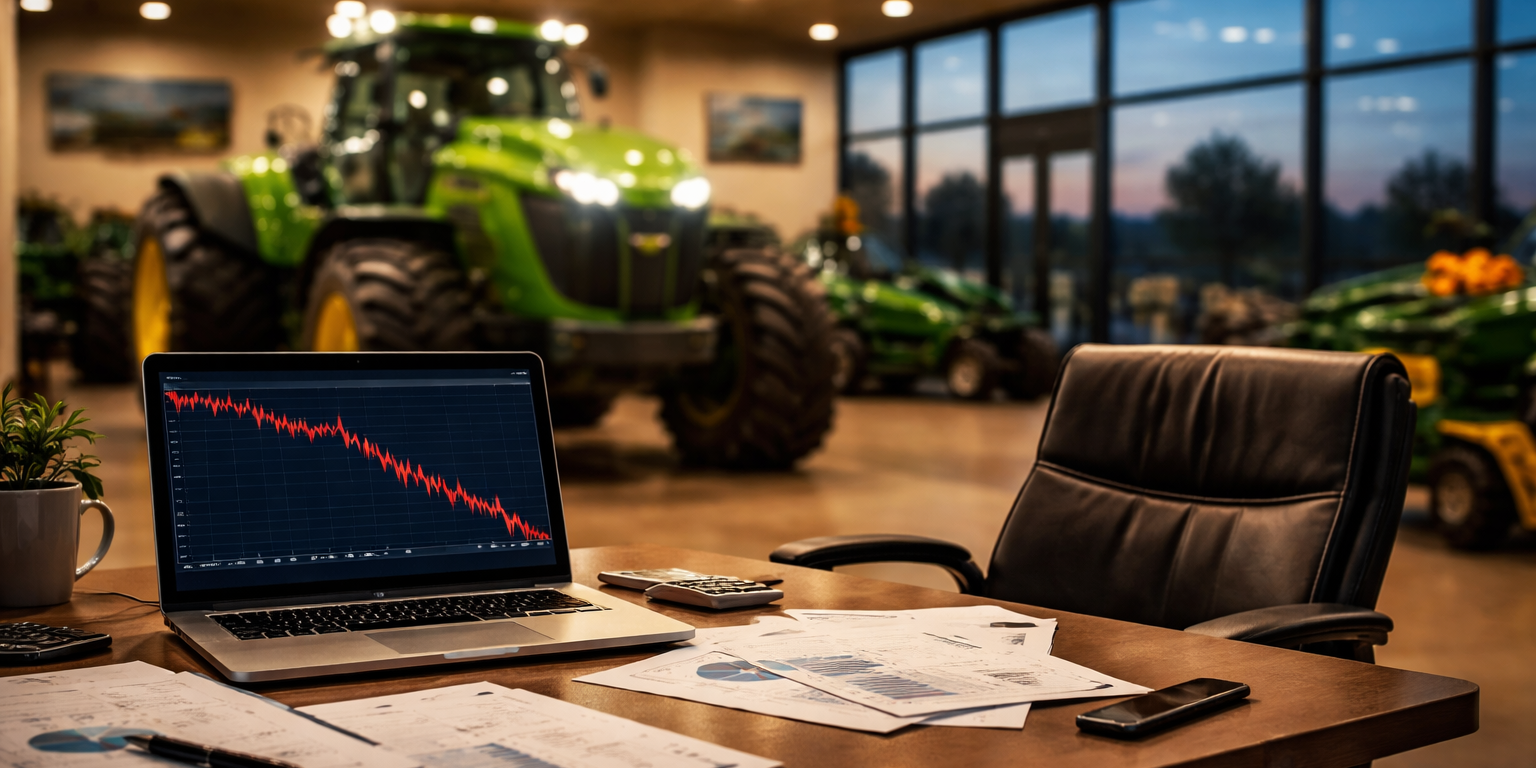
Deere & Co. shed 8% of its market value in the trading session following Oppenheimer's revised price target, a reminder that even leaders in agricultural robotics face cyclical pressures that can stall ambitious automation roadmaps. Analyst Kristen Owen lowered her target on May 27, pointing to softening demand in the North American farm equipment market where Deere generates the majority of its revenue. The downgrade arrives as Deere accelerates its push into autonomous tractors, computer vision-guided harvesters, and AI-powered crop management platforms that promise to redefine large-scale farming by the decade's end. For engineers and investors tracking the intersection of robotics and agriculture, the tension is clear: Deere possesses the technology and installed base to dominate precision farming, but equipment sales cycles tied to commodity prices create volatility that pure-play robotics firms avoid. The company still holds a spot among the ten best robotics and automation stocks, according to recent sector analysis, thanks to its extensive patent portfolio in machine vision, GPS-guided steering, and yield optimization algorithms that few competitors can match.
Deere's autonomy program centers on its 8R tractor line, which the company has equipped with six pairs of stereo cameras, embedded neural networks for obstacle detection, and bidirectional communication with a cloud-based operations center that monitors fleets in real time. Farmers can dispatch these machines to plow, plant, or spray without a driver, though regulatory frameworks in most U.S. states still require a human supervisor within line of sight. The company shipped roughly 300 fully autonomous units in the 2025 calendar year, a modest figure that reflects both the $500,000-plus price point and the cautious adoption curve among farm operators who worry about reliability during critical planting and harvest windows. Deere has publicly committed to scaling production to 2,000 units annually by 2028, contingent on achieving a mean time between failures above 400 hours and securing explicit approval from the USDA for unsupervised operation on parcels larger than 640 acres. Those milestones matter because they unlock demand from corporate farms and agricultural investment trusts that manage portfolios of 50,000 acres or more, where labor costs justify the capital outlay for autonomous fleets.
The broader agricultural robotics market reached $8.3 billion in 2025, according to figures from ABI Research, with Deere commanding an estimated 22% share when autonomous tractors, precision sprayers, and sensor-equipped combines are aggregated. CNH Industrial and AGCO trail at 14% and 11% respectively, while a cohort of venture-backed startups including Monarch Tractor, Bear Flag Robotics (acquired by Deere in 2021 for $250 million), and SwarmFarm Robotics target smaller acreage operators with sub-$150,000 platforms. Deere's competitive moat derives less from hardware and more from its proprietary Operations Center software, which ingests terabytes of soil composition data, weather patterns, and yield histories to generate planting prescriptions that farmers execute via API calls to the autonomous machines. The company charges a $15,000 annual subscription per connected machine, creating a recurring revenue stream that analysts value more highly than one-time equipment sales. Yet that strategy depends on a steady expansion of the autonomous installed base, and any prolonged downturn in new equipment purchases delays the inflection point where software revenue offsets margin pressure in the legacy tractor business.
Oppenheimer's price cut reflects concern that commodity price weakness will force farmers to extend replacement cycles, deferring purchases of high-end autonomous models in favor of refurbishing older equipment. Corn futures traded at $4.12 per bushel in late May, down 18% from the prior year peak, while soybean prices hovered near $10.80, a three-year low that squeezes margins for row crop operators across the Midwest. When revenue per acre drops, capital expenditure budgets contract first, and autonomous tractors remain discretionary for all but the largest operations. Deere's management has acknowledged this dynamic on recent earnings calls, noting that order backlogs for autonomous units fell 12% quarter-over-quarter in the period ending April 2026. The company still expects to deliver mid-single-digit revenue growth in its precision agriculture segment for the full fiscal year, buoyed by software subscriptions and aftermarket sensor upgrades, but the trajectory is flatter than the 20% compound annual growth rate Deere projected when it acquired Bear Flag five years ago. For investors evaluating the stock against pure-play robotics firms, the calculus hinges on whether Deere's embedded market position and service network justify the exposure to agricultural commodity cycles that can erase years of margin expansion in a single harvest season.
What to Watch: Monitor Deere's fiscal Q3 earnings in August 2026 for updated guidance on autonomous unit deliveries and any adjustments to the 2028 production target of 2,000 machines annually. Track USDA rule-making on unsupervised autonomous operation, expected by late 2026, which could accelerate adoption among large corporate farms. Watch for competitive moves from CNH Industrial, which has signaled plans to launch its own camera-based autonomy stack in early 2027. Commodity prices remain the leading indicator—corn above $4.50 per bushel historically correlates with increased capital spending on precision equipment.