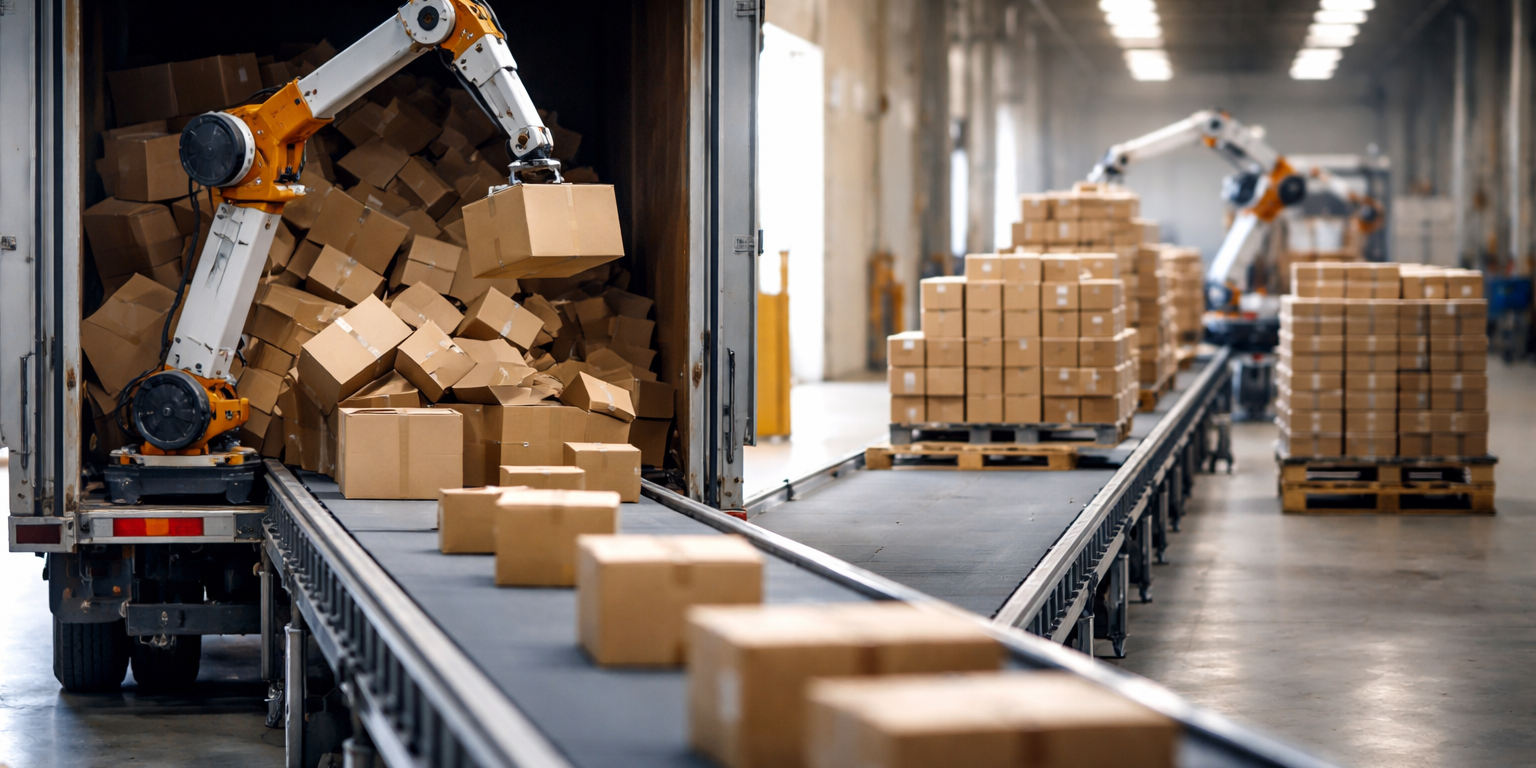
Ambi Robotics and Pickle Robot Company now operate as a single automated workflow inside warehouse loading docks, routing packages from the back of a trailer directly onto sorted pallets without human intervention between the two systems. The integration connects Pickle's Dill unloading robot to Ambi's AmbiSort parcel sorting platform through a shared conveyor interface and coordinated software layer. Both companies confirmed the technical milestone in recent customer deployments, though neither disclosed which facilities are currently running the combined setup. The move addresses one of the stickiest labor problems in logistics: the chaotic, high-turnover work of unloading trailers and building stable pallets at speeds that match modern fulfillment operations.
Pickle Robot emerged from the MIT robotics lab in 2019 with a focus on the trailer unloading problem, a task that defeated earlier automation attempts because of the variability inside trailers. Boxes arrive jumbled, stacked haphazardly, and mixed by size and weight. The Dill system uses a combination of vacuum grippers, 3D vision, and a telescoping arm to pull packages from trailers and deposit them onto outbound conveyors. Ambi Robotics, a UC Berkeley spin-out founded in 2018, built its business around high-speed parcel sortation using reinforcement learning-trained robotic arms. The AmbiSort system handles the downstream problem: taking a chaotic stream of packages and organizing them by destination onto specific pallets. Warehouses typically employ separate crews for each task. Linking the two systems means a package can travel from trailer to sorted pallet without a human touch, collapsing two labor-intensive steps into one automated flow.
The technical challenge was not trivial. Pickle's system outputs packages at variable rates depending on trailer density and box orientation. Ambi's sorters expect a relatively steady flow to maintain sorting speed and accuracy. The companies developed a buffering protocol that holds packages on intermediate conveyors when the sorter is busy and accelerates flow when capacity opens. The software integration also required aligning package identification: Pickle's vision system scans barcodes as it unloads, passing that data to Ambi's control layer so the sorting arms know each package's destination before it arrives. Both companies retained independent operation modes, meaning customers can run either system standalone if one unit goes offline. That redundancy matters in logistics facilities where downtime translates directly to missed delivery windows.
The timing reflects broader momentum in warehouse automation, particularly at loading docks where labor shortages remain acute. Third-party logistics providers reported average turnover rates above 40 percent for dock workers in 2025, and wage inflation has pushed starting pay past $20 per hour in many markets. Robotics deployments in warehouses have historically concentrated on picking and packing, leaving the dirtiest and most physical work to humans. Companies like Pickle and Ambi are now targeting those gaps. The integration also signals a shift in how automation vendors approach the market. Rather than competing to own the entire workflow, specialized providers are forming technical partnerships to offer end-to-end solutions. That modularity appeals to logistics operators who prefer best-of-breed components over monolithic systems from a single vendor. Ambi and Pickle join a growing list of robotics firms pursuing interoperability, though most partnerships remain at the pilot stage.
What to Watch: Monitor whether Ambi and Pickle formalize their integration with a joint go-to-market strategy or keep it as a customer-driven option. Watch for public deployment announcements from major third-party logistics providers, particularly those handling high parcel volumes for e-commerce clients. Track whether other dock automation vendors like Boston Dynamics or Locus Robotics pursue similar cross-platform integrations. Finally, pay attention to whether the combined system achieves cycle times competitive with manual crews, the key metric that will determine whether this approach scales beyond pilot facilities.