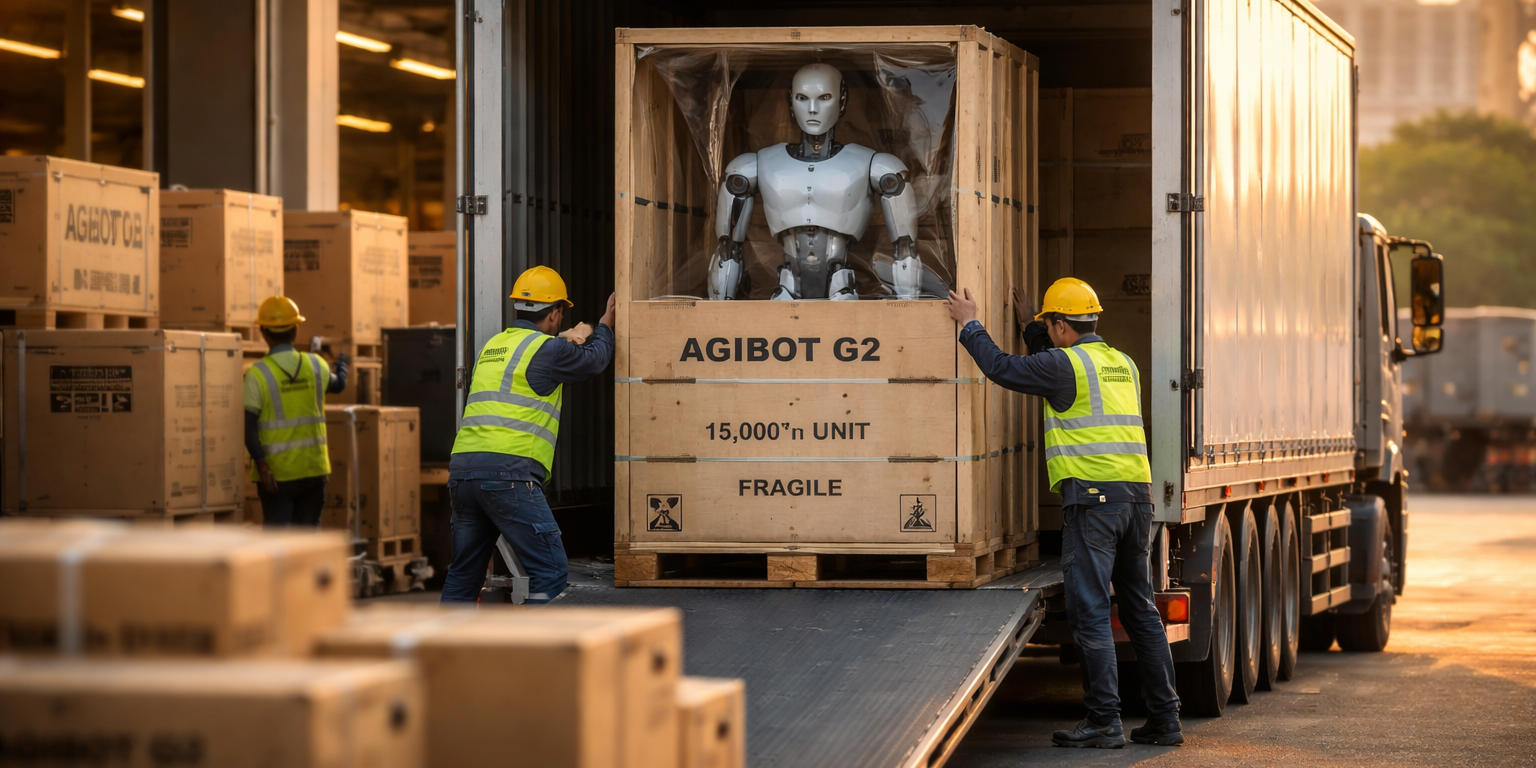
AGIBOT's 15,000th robot left its Shanghai production facility on June 28, a cumulative shipment figure that places the Chinese manufacturer in rare company among embodied AI platforms. The milestone unit is a G2, the company's industrial-grade humanoid designed for task automation in manufacturing and logistics environments. AGIBOT says it now has more than 1,000 robots deployed in commercial operations, though it declined to name specific customer facilities or provide a breakdown of where those systems are working. The gap between units shipped and units deployed suggests a substantial portion of AGIBOT's production serves research institutions, pilot programs, or remains in inventory.
The production volume claim matters because cumulative shipments remain the clearest proxy for manufacturing maturity in a sector where most players struggle to move beyond double-digit unit runs. Tesla reported approximately 2,000 Optimus units deployed internally as of March 2026. Figure AI has not disclosed total shipments but confirmed several hundred units operating at BMW's Spartanburg facility. Boston Dynamics, which began commercial Stretch shipments in late 2023, passed 1,500 units in early 2026 but focuses on a mobile manipulation platform rather than humanoid form factor. AGIBOT's 15,000-unit figure would represent the highest publicly disclosed cumulative shipment total for a humanoid platform, though the company's definition of "robot" may include earlier models and development units alongside commercial G2 deployments. Industry observers note that Chinese robotics manufacturers have historically reported cumulative production figures that blend pilot units, development hardware, and commercial deployments without clear delineation.
AGIBOT operates as part of China's broader push into embodied AI, a sector that has drawn significant government support and private investment since Beijing identified humanoid robotics as a strategic technology priority in 2024. The company competes domestically with Fourier Intelligence, UBTech Robotics, and Zhiyuan Robotics, each pursuing distinct approaches to humanoid design and deployment strategy. Fourier's GR-1 targets rehabilitation and eldercare applications. UBTech focuses on the consumer and education markets with its Walker series. Zhiyuan builds industrial humanoids for automotive and electronics manufacturing. AGIBOT positions the G2 as a general-purpose industrial platform capable of operating in environments designed for human workers, emphasizing dexterity and manipulation capabilities over specialized tooling. The G2 stands approximately 170 centimeters tall, weighs 65 kilograms, and features what AGIBOT describes as a modular joint architecture allowing field replacement of actuators without returning the unit to the factory. The company has not disclosed the robot's degrees of freedom, payload capacity, or battery runtime under typical operating conditions.
The Shanghai facility where the 15,000th unit was produced represents AGIBOT's primary manufacturing base, though the company has not specified the plant's current capacity or production rate. Reaching 15,000 cumulative units without disclosing the timeline over which those shipments occurred makes it difficult to assess manufacturing velocity. If AGIBOT began commercial production in 2024, the figure suggests an average monthly output exceeding 600 units, a rate that would require significant automation and supply chain maturity. Chinese media reports from late 2025 indicated AGIBOT had established partnerships with actuator suppliers in Shenzhen and vision system providers in Hangzhou, suggesting a domestic supply chain for critical components. The company's ability to scale production depends heavily on actuator availability, the primary bottleneck for humanoid manufacturers globally. Harmonic drive suppliers remain capacity-constrained, and lead times for high-torque actuators frequently exceed six months for new customers.
What to Watch: AGIBOT's customer disclosure will clarify whether the 15,000-unit figure represents genuine commercial traction or a mix of internal deployments and pilot programs. Watch for named partnerships with Chinese manufacturing giants like BYD, CATL, or Foxconn, which would signal validation beyond government-supported pilots. The company's monthly production rate will indicate whether it can sustain volume growth or if the 15,000 figure includes legacy models no longer in production. Quarterly shipment updates from competing Chinese humanoid manufacturers will provide context for AGIBOT's claimed market position.