
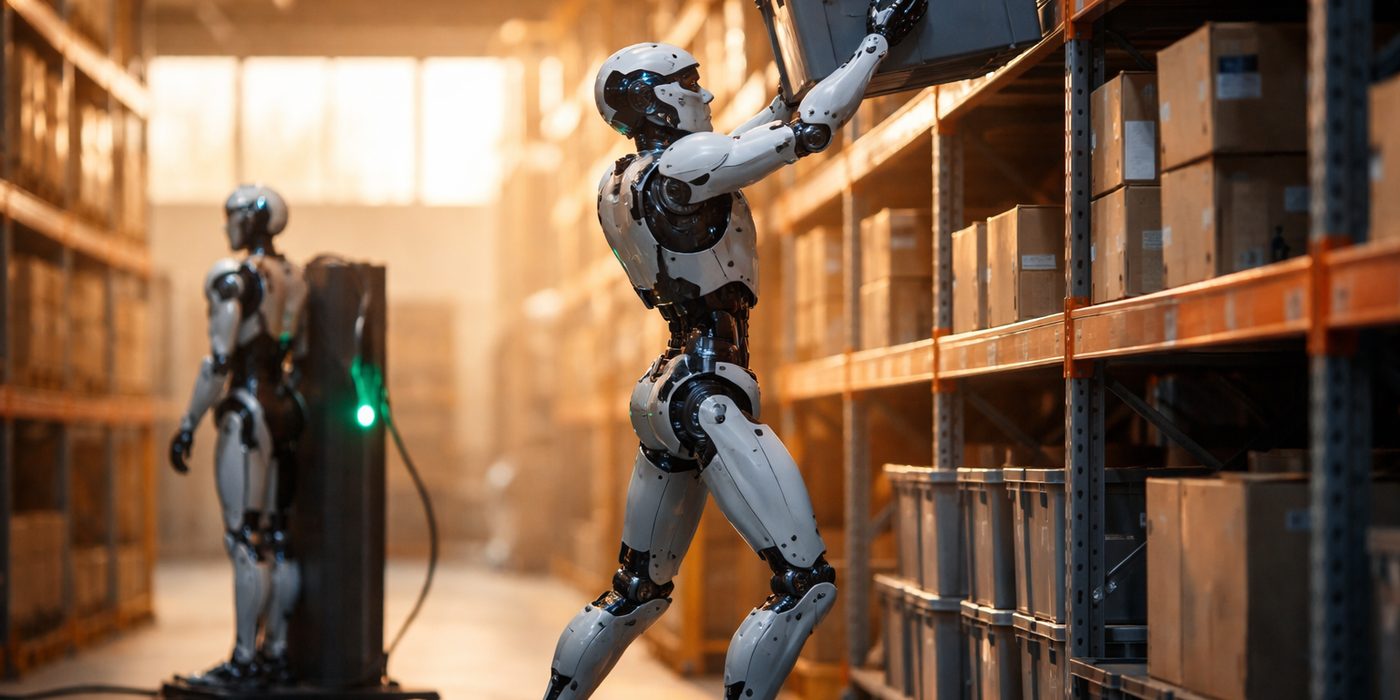
Nine minutes. That is how long Digit 5 needs on a charger to earn 90 minutes of work, a ratio that says more about Agility Robotics' priorities than any demo reel could. The company, spun out of Jonathan Hurst's lab at Oregon State University in 2015, has launched its fifth-generation humanoid with a headline payload of 23 kilograms, enough to hoist a full warehouse bin onto a high shelf. Hurst, writing in IEEE Spectrum under the title "The Robot I Didn't Expect to Build," describes the machine as the first humanoid engineered to do useful work safely and economically at scale, with a stated ambition of putting tens of thousands of units into the field.
The charging math matters because it reframes the central argument about humanoid economics. Most conversations about bipedal robots fixate on dexterity or AI. Operators fixate on uptime. A robot that runs 90 minutes and then needs an hour on a dock is a robot that requires a fleet three times larger to cover the same shift, plus the floor space and electrical infrastructure to charge it. Compress the charge to nine minutes and the duty cycle changes. Digit can slot recharging into natural breaks in a workflow, the way a forklift operator might top off a battery, rather than disappearing for long stretches. For anyone modeling cost per tote moved, that single specification moves the denominator.
Digit 5 arrives with a more credible commercial pedigree than most of its rivals can claim. Agility has spent years iterating through earlier Digit generations while others were still unveiling prototypes, and the company built a manufacturing facility in Salem, Oregon, called RoboFab, aimed at producing humanoids in volume rather than in handfuls. Hurst's essay is candid that the product he ended up building differs from the one he imagined when the company began. The pivot, as he tells it, was toward constraints: payload, safety, charge speed, and cost, rather than a general-purpose android that does everything adequately. That discipline separates Agility from competitors chasing broader capability at the expense of a defined job.
The competitive field has thickened considerably. Figure AI, Apptronik, Tesla's Optimus program, Boston Dynamics' production Atlas, and a crowd of Chinese manufacturers including Unitree and UBTech are all pursuing logistics and manufacturing floors, and several have announced pilots with automotive and retail partners. What Agility is betting on is that the winner will be decided less by who demonstrates the most impressive behavior and more by who can document safe operation alongside human coworkers and deliver a defensible return on investment. The 23-kilogram figure is a deliberate choice here: it targets the heavy end of routine tote and bin handling, the repetitive lifting that drives injury claims and turnover in fulfillment centers, rather than exotic tasks.
For investors and engineers, the harder questions sit behind the spec sheet. Safe operation without cages has been the unresolved regulatory and engineering problem for legged robots in shared spaces, since a falling 23-kilogram payload carried by a bipedal machine is a different risk profile than a wheeled cart. Standards bodies are still writing the rules for dynamically stable robots, and customers will want third-party validation before they let a humanoid work an aisle with people in it. Agility's claim that Digit 5 can scale to tens of thousands of units is ultimately a claim about reliability, serviceability, and unit cost, none of which a launch announcement can prove. The number to watch is not payload or charge time but mean time between interventions across a real fleet over a full year.
What to Watch Track whether Agility names new enterprise customers or expands existing deployments beyond its current logistics partners before the end of 2026, since signed volume commitments will say more than launch-day specifications. Watch for published safety certification progress, including any movement on standards for dynamically stable legged robots from ISO and ANSI working groups. Compare Digit 5's charge-time and payload claims against forthcoming spec disclosures from Apptronik's Apollo, Figure's next-generation platform, and Boston Dynamics' production Atlas through the fourth quarter. Finally, follow RoboFab's reported output in Salem, because a credible units-per-month figure would be the first hard evidence that the tens-of-thousands ambition has a manufacturing path.