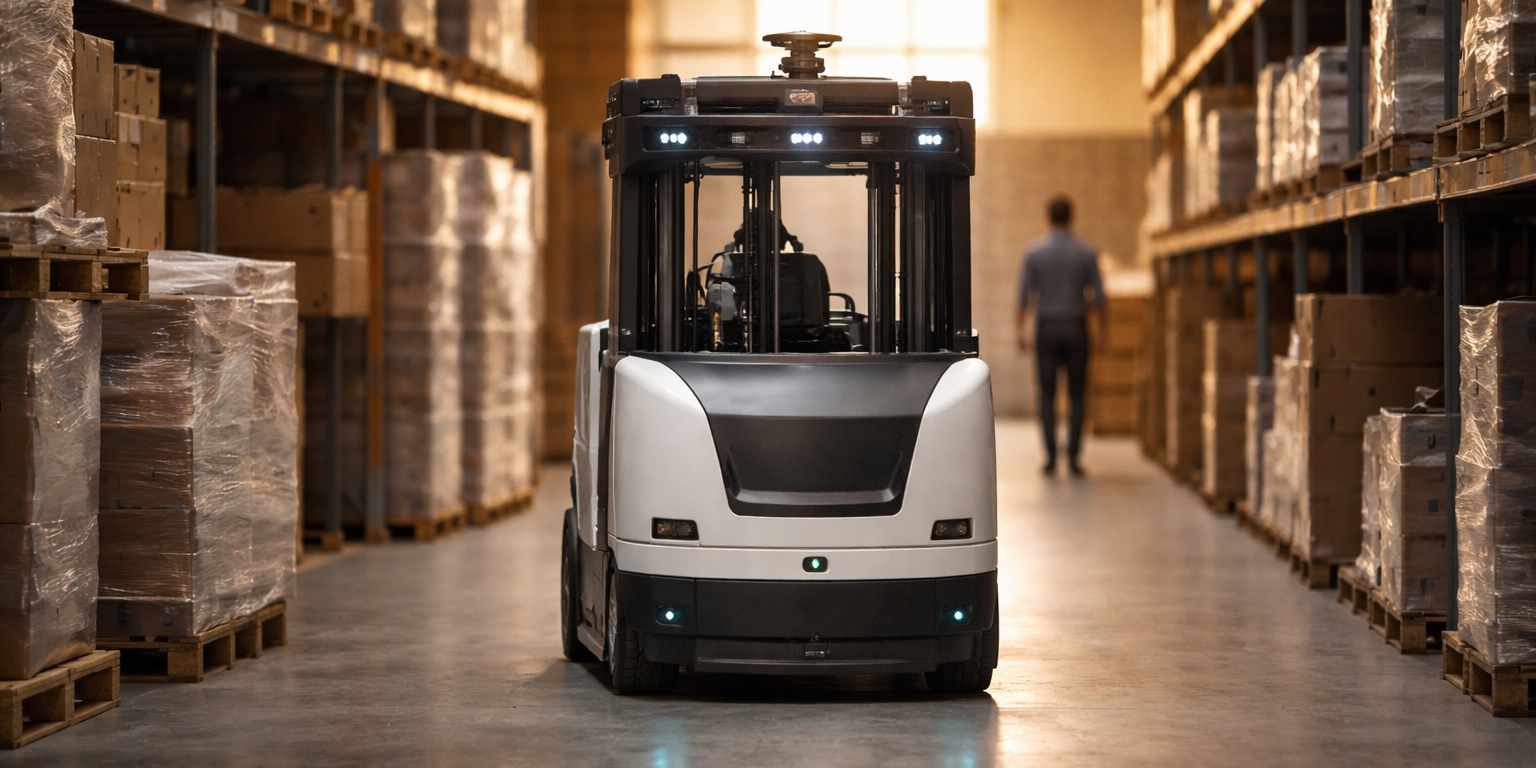
The Flexley Stacy F712 autonomous forklift now navigates warehouse floors using visual simultaneous localization and mapping, allowing the machine to build spatial understanding through cameras rather than relying on floor markers, magnetic tape, or reflective beacons. ABB Robotics integrated the vSLAM capability into what the company positions as a safety-compliant material handling platform designed to work alongside other autonomous systems in mixed environments where human workers and mobile robots share space.
ABB acquired the Flexley Stacy product line through its purchase of ASTI Mobile Robotics Group in 2021, gaining both the engineering team and existing customer deployments across Europe and North America. The F712 represents the evolution of that platform under ABB's industrial automation division, which has been working to standardize interfaces between autonomous mobile robots and fixed automation equipment like conveyors and palletizers. The vSLAM integration marks a deliberate shift away from infrastructure-dependent navigation methods that require warehouses to install and maintain physical reference systems. Vision-based navigation means the F712 can adapt to layout changes, work in facilities undergoing renovation, and deploy faster in new locations without installation teams spending days mapping spaces with reflectors or painting guide lines.
The technical implementation uses stereo cameras mounted on the forklift to capture depth information while proprietary algorithms process visual data to determine position and orientation within the facility. ABB has not disclosed the specific sensor hardware or whether the vSLAM system came from internal development or a third-party supplier, though the company confirmed the F712 meets VDI 2510 safety standards for automated guided vehicle systems. That certification matters because warehouses operating in Germany and other European markets face regulatory requirements around autonomous vehicle safety performance, and compliance determines whether equipment qualifies for insurance coverage in commercial deployments. The F712 also communicates with other autonomous mobile robots through what ABB describes as fleet management protocols, allowing multiple vehicles to coordinate path planning and avoid bottlenecks at charging stations or high-traffic intersections within the warehouse.
Warehouse operators have been pushing mobile robot suppliers to move beyond fixed infrastructure navigation for practical reasons beyond flexibility. Magnetic tape wears out under constant forklift traffic and requires regular replacement, adding to operating costs. Reflective beacons need clear sightlines and can create dead zones in facilities with dense racking or frequent layout changes. Vision-based systems theoretically eliminate those maintenance requirements, though they introduce different challenges around lighting conditions, floor surface variations, and the computational overhead of processing video streams in real time. ABB has positioned the F712 in the mid-capacity segment of the autonomous forklift market, targeting facilities moving between 2,000 and 15,000 pallets daily where the economics justify automation but budgets remain constrained compared to massive distribution centers operated by third-party logistics providers. The company has not released pricing for the vSLAM-equipped F712, though comparable autonomous forklifts from suppliers like Toyota Material Handling and KION Group typically range from $150,000 to $300,000 depending on lift capacity and sensor configurations.
The timing of ABB's vSLAM announcement reflects broader momentum in vision-based mobile robot navigation as component costs decline and computing power increases. Several autonomous mobile robot companies including Locus Robotics, Fetch Robotics, and Mobile Industrial Robots have already deployed vSLAM or related visual navigation technologies in warehouse environments, establishing a track record that helps validate the approach for conservative warehouse operators hesitant to bet on unproven methods. ABB brings different advantages to that market, primarily its existing relationships with industrial customers through its motion control and factory automation businesses. A warehouse already running ABB robots on assembly lines or using ABB inverters on conveyor systems may find integration simpler when adding autonomous forklifts from the same supplier, particularly for enterprise customers managing standardized equipment specifications across multiple facilities. Whether that channel advantage translates to market share gains against autonomous forklift specialists remains the question ABB must answer through actual deployments over the next 12 to 18 months.
What to Watch: Look for ABB to announce reference customers deploying the vSLAM-equipped F712 before the end of Q3 2026, likely in automotive or consumer packaged goods sectors where the company already has strong relationships. Monitor whether ABB begins offering retrofit vSLAM packages for existing Flexley Stacy forklifts in the field, which would indicate confidence in the technology's reliability. Watch for competitive responses from Jungheinrich and Crown Equipment, both of which have autonomous forklift programs but have not yet committed publicly to vision-based navigation over laser-based systems.