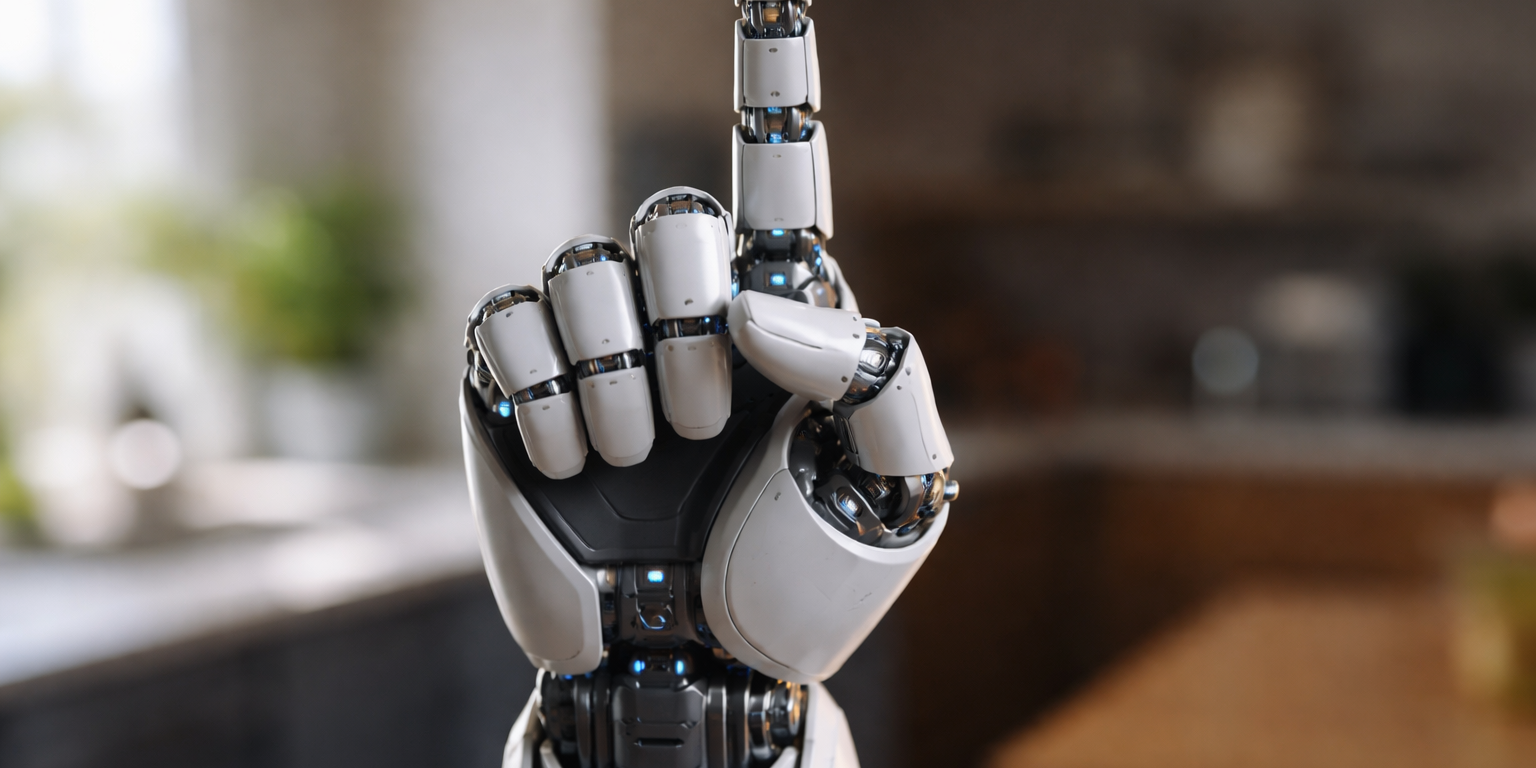
The hands attached to 1X's NEO humanoid can now sign the alphabet in American Sign Language, a capability that requires individual finger articulation across 26 distinct poses and transitions between them. Dar Sleeper, the company's product head, describes this as evidence that 1X has solved what he calls one of robotics' most enduring technical problems: building hands that match human dexterity without requiring the complexity that typically comes with it. The claim arrives as competition intensifies among companies racing to deliver household robots that can manipulate everyday objects without constant human intervention or specialized tooling.
NEO debuted in late 2025 as 1X's second humanoid platform, following the wheeled EVE model deployed in security patrol roles. The Oslo-based company has positioned NEO specifically for residential environments, where manipulation tasks demand far more nuanced control than navigation or surveillance applications. Previous humanoid hand designs have struggled with a fundamental trade-off: increase the number of actuators and sensors to improve dexterity, and you add weight, cost, and failure points that make the system impractical outside laboratories. Reduce complexity to hit consumer price targets, and you sacrifice the fine motor control needed for tasks like threading a needle, buttoning a shirt, or handling fragile stemware. 1X has not disclosed the actuator count, sensing architecture, or control algorithms behind the new hands, but company materials show them pouring liquid from a teapot without spillage and inserting USB-C connectors into laptop ports, both tasks that require force modulation and spatial precision.
The tea-pouring demonstration carries particular weight in the robotics engineering community because it combines several challenge areas simultaneously. The hand must grip an irregularly shaped object with a shifting center of gravity as liquid drains from it, maintain that grip while moving through space, then control the pour rate by adjusting wrist angle in real time based on visual or force feedback. Boston Dynamics, Tesla, Sanctuary AI, and Figure have all published videos of their humanoids manipulating kitchen items, but public demonstrations rarely include transparent performance metrics like success rates across repeated trials or the amount of training data required. 1X has not released such figures for the NEO hands either, which means independent validation remains pending. The company does claim the hands can handle objects ranging from delicate electronics to heavy tools, suggesting a grip force range that spans at least two orders of magnitude.
Sign language capability, meanwhile, points to control bandwidth that extends beyond gross motor tasks. American Sign Language relies on hand shape, orientation, location, and movement to encode meaning, with subtle differences in finger position changing entire words. A system that can reliably produce ASL letters must track and actuate individual digits through precise trajectories, then hold those positions without drift while the signer transitions to the next letter. This requires not just hardware capable of fine articulation, but also control software that can translate high-level commands into coordinated motor outputs across multiple joints while compensating for dynamics like momentum and backlash. If 1X has genuinely achieved this without exotic materials or prohibitively expensive components, it would represent a meaningful step toward humanoids that can perform care tasks for elderly or disabled users, a market application that multiple research groups and startups have targeted for over a decade. The company has not announced partnerships with assisted living providers or healthcare systems, but such collaborations would be a logical next move if the technology performs as described.
The broader context here involves a shift in how robotics companies approach the dexterity problem. Earlier generations of research hands, like the Shadow Dexterous Hand or the DLR Hand II, prioritized matching human anatomy with high actuator counts and complex tendon routing. Those designs achieved impressive laboratory results but never scaled to commercial deployment because of cost and reliability constraints. More recent efforts from Tesla's Optimus team and Sanctuary's Phoenix platform have emphasized simpler mechanical designs paired with sophisticated learning algorithms that compensate for hardware limitations through software. 1X appears to be betting on a middle path: enough mechanical capability to handle diverse tasks without relying entirely on AI to paper over hardware gaps, but not so much complexity that the hands become maintenance nightmares or price themselves out of consumer reach. Whether that balance proves viable depends on factors the company has not yet disclosed, including unit cost, mean time between failures, and how much task-specific training the system requires before a customer can deploy it in an unstructured home environment.
What to Watch: Look for 1X to publish technical specifications or white papers detailing the NEO hand architecture by late third quarter 2026, likely timed around a major robotics conference. Monitor whether the company announces pilot deployments with healthcare or eldercare partners before year-end, which would signal confidence in real-world reliability. Track competing announcements from Figure, Sanctuary AI, and Apptronik, all of which have humanoid platforms in various stages of commercial testing and could respond with their own dexterity claims. Watch for independent testing results from academic labs or industry standards bodies, which would provide the first third-party validation of Sleeper's assertions.