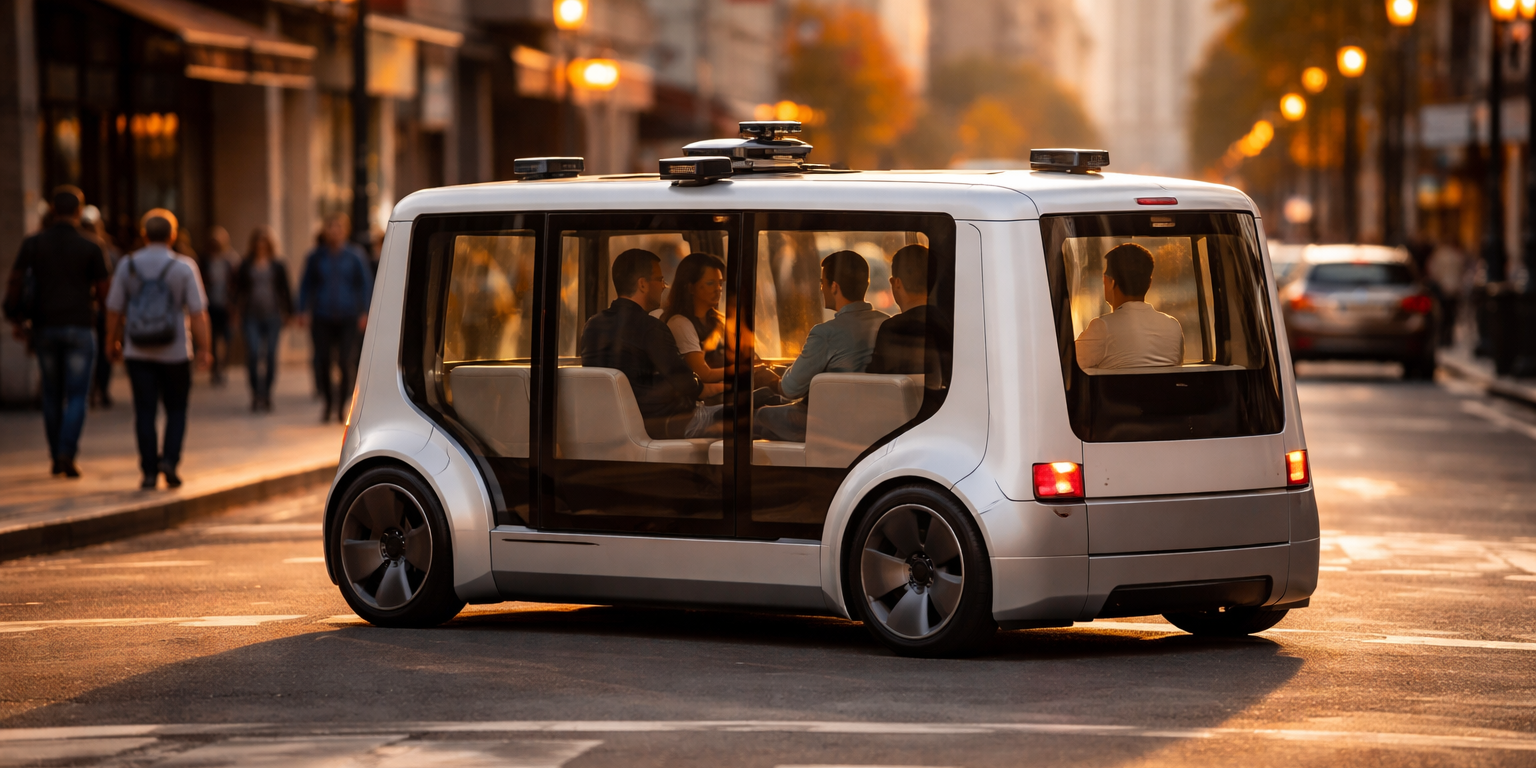
Zoox disclosed a redesigned exterior for its boxy, symmetrical robotaxi this week, describing the changes as the "next evolution" of a vehicle now engineered for volume manufacturing. The company currently operates unpaid passenger services in San Francisco, Las Vegas, Austin, and Miami as it awaits National Highway Traffic Safety Administration clearance to charge fares and expand beyond test corridors. The announcement arrives more than five years after Amazon acquired Zoox for $1.2 billion in 2020, and nearly two years after the vehicle first carried passengers on public roads in California.
The updated design represents a departure from the concept aesthetic Zoox first showed in 2020. While the vehicle retains its defining characteristics—no front or back, four-wheel steering, seating for four passengers facing each other—the exterior surfacing has been simplified for manufacturing efficiency. Zoox declined to specify which assembly partner will build the vehicles or provide a target production volume for 2026, citing competitive sensitivity. The company has previously stated it intends to manufacture tens of thousands of units annually, though it has not committed to a timeline. Amazon has been notably quiet about how Zoox fits into its broader logistics strategy, never publicly confirming whether the robotaxis will eventually serve package delivery or remain purely a mobility play.
The regulatory pathway remains the critical bottleneck. NHTSA must grant Zoox an exemption to deploy vehicles without traditional controls—no steering wheel, no pedals, no driver's seat oriented toward a windshield. The agency has been slow-walking such approvals. General Motors' Cruise division applied for a similar exemption in 2022 for its Origin vehicle and has yet to receive authorization. Waymo, by contrast, operates commercially in multiple cities but uses modified Jaguar I-Pace SUVs with conventional controls still installed, sidestepping the exemption process entirely. Zoox's application has been pending since late 2023. Industry observers expect NHTSA will approve at least one exemption in 2026, potentially setting precedent for purpose-built autonomous vehicles, but the agency has given no public indication of timing. Without that clearance, Zoox cannot charge passengers or deploy beyond its current test zones.
The free pilot programs offer a preview of the service model. Riders in San Francisco and Las Vegas can request trips within geofenced areas during daytime hours, though availability remains limited and waitlists are common. Zoox has not disclosed how many vehicles are active in each city or how many rides it completes daily. The company employs remote operators who can take control if the autonomy stack encounters an edge case, a setup similar to Waymo's approach during its early expansion. Competitors have taken divergent paths. Waymo now operates commercially in Phoenix, San Francisco, and Los Angeles without significant geographic restrictions, logging more than 100,000 paid trips per week as of early 2026. Tesla continues to promise a robotaxi service based on its Full Self-Driving software but has yet to demonstrate a vehicle without a human behind the wheel. Chinese robotaxi operators including Baidu's Apollo Go and Pony.ai have deployed at larger scale within China, with Apollo Go alone claiming over 6 million cumulative rides, though the regulatory environment there differs substantially from the U.S. market.
What to Watch: NHTSA exemption decisions are expected in the second half of 2026, which could finally allow Zoox to monetize its service and expand its operating zones. Watch for announcements from Zoox about manufacturing partnerships or production timelines, particularly any mention of Amazon's own logistics network as a deployment channel. Competitor Waymo is expected to announce its next city expansion by late summer. Track how many vehicles Zoox actually puts on the road once it secures regulatory approval—that will reveal whether Amazon is serious about scaling this as a standalone business or keeping it confined to pilots.