
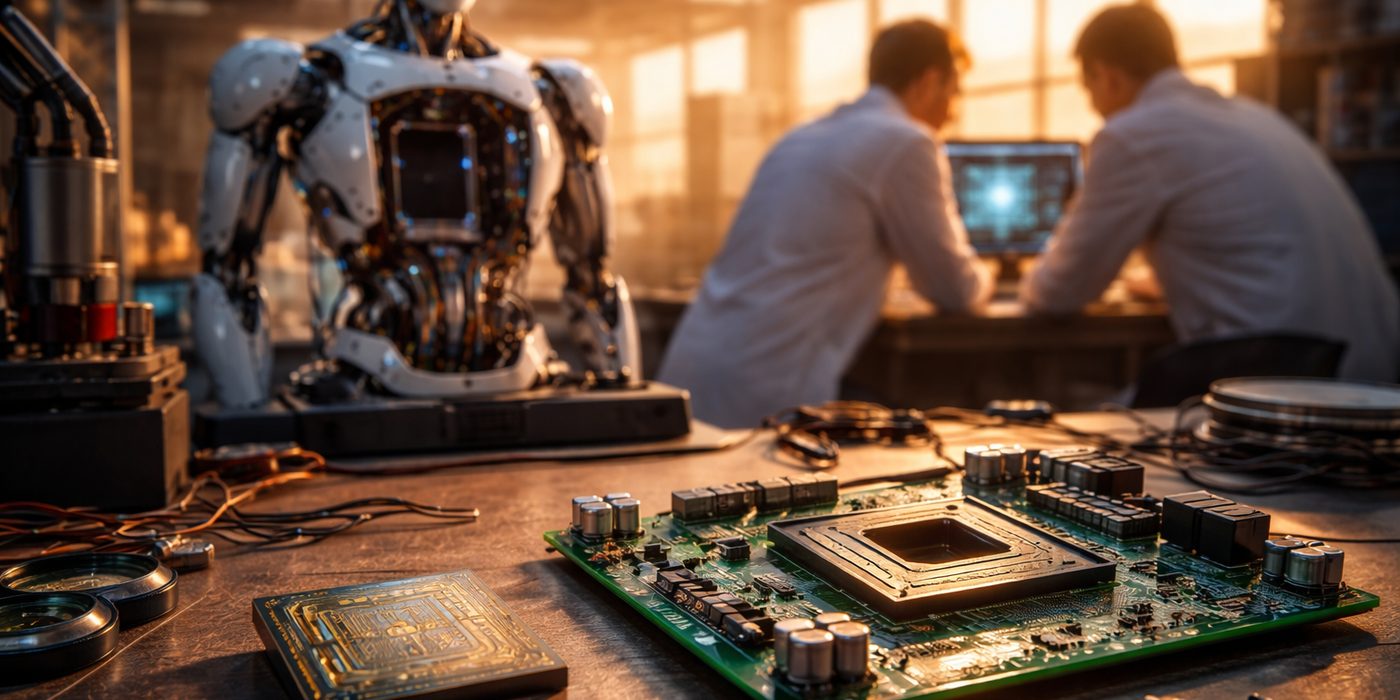
Half a billion yuan is a large angel round by any standard. It is an unusual one when the company has no product, no tape-out announced, and a founding cap table that reads like a supply chain diagram. Xilect, a robotics chip startup founded jointly by Chinese GPU maker MetaX and humanoid robot manufacturer UBTech Robotics, has raised RMB 500 million, roughly $70 million at current exchange rates, to build its first chip and the software stack around it. The funding will also pay for engineering hires and for putting the platform in front of robot makers early. The structure matters as much as the sum. A chip designer and a customer with shipping humanoids sit on the same side of the table.
The logic behind that pairing is not hard to reconstruct. Humanoid robots stress compute in ways that data center accelerators and phone-class application processors were never designed to handle. A bipedal machine must run perception, whole-body control, and increasingly large vision-language models at the same time, within a tight power and thermal envelope, with latency budgets measured in milliseconds for the balance loop. Most of today's humanoids cope by stitching together general-purpose parts: an NVIDIA Jetson-class module for heavy inference, a separate microcontroller or industrial PC for real-time control. It works. It is also expensive, power-hungry, and awkward to scale across production runs of thousands of units.
MetaX brings the silicon pedigree. The Shanghai-based company designs general-purpose GPUs, part of a cohort of Chinese chipmakers racing to build domestic alternatives as U.S. export controls restrict access to leading-edge Nvidia and AMD parts. UBTech brings what most chip startups spend years trying to acquire: a hardware customer. The Shenzhen company has pushed its Walker series of humanoids into factory pilots and has been among the more aggressive Chinese players in announcing industrial orders. Having a robot maker as a co-founder means Xilect can design against real workloads from day one rather than guessing at them, and it gives the startup a reference platform for validation. The risk runs the other way. A chip tuned too tightly to one company's robots may struggle to win the rest of the market.
The broader context is a land rush in embodied AI silicon. Nvidia has moved aggressively to own the robotics compute layer with its Jetson Thor module and the Isaac software stack. Qualcomm has signaled its own ambitions in the space. Chinese firms, meanwhile, face an added incentive that has little to do with benchmarks: supply security. A humanoid maker that depends on imported accelerators is exposed to policy shifts it cannot control, and Beijing's industrial policy has made domestic robotics and domestic chips twin priorities. Xilect sits where those two priorities overlap. For investors, the angel round is a bet that the overlap is large enough to support a standalone silicon company, and that the humanoid market grows into volumes that justify custom chips rather than repurposed ones.
The harder questions are technical and commercial, and the round does not answer them. Designing a competitive processor is a multi-year, capital-intensive undertaking, and RMB 500 million buys meaningful progress but not necessarily a full product cycle, especially if advanced-node fabrication access remains constrained. Software may prove the steeper climb. Nvidia's moat in robotics is less about its silicon than about CUDA, its simulation tools, and the developer ecosystem that has formed around them. Xilect's decision to fund supporting software alongside the chip suggests its founders understand this. Convincing third-party robot makers to port their control and perception pipelines to an unproven architecture is a different task from serving a sister company, and it is where many chip startups stall.
What to Watch The first signal to track is any disclosure of Xilect's architecture and target process node, which would show how realistic its path to silicon is under current export restrictions. Watch whether robot makers other than UBTech, such as Unitree, AgiBot, or Fourier, are named as test partners, since third-party validation will determine whether this is a merchant chip or a captive one. Follow MetaX's own financial disclosures and listing progress, as the parent's health shapes Xilect's runway. Finally, monitor whether a follow-on funding round arrives within the next several months, which would indicate that early engineering milestones are landing on schedule.