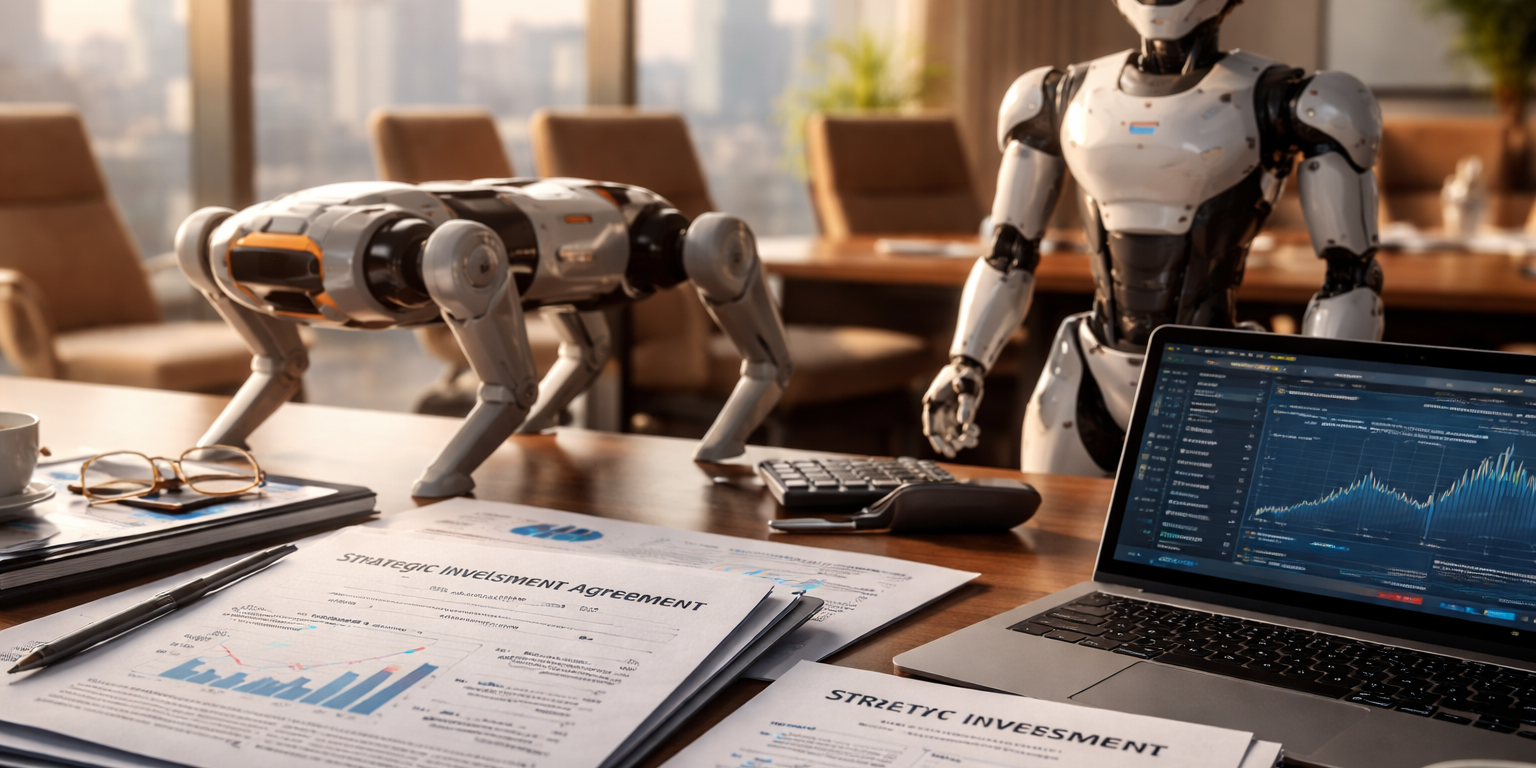
Unitree Robotics has filed preliminary documents for a $904 million initial public offering on the Shenzhen Stock Exchange, positioning itself to become the first publicly traded company focused exclusively on humanoid robots. The offering, expected to price in late fourth quarter 2026 according to sources familiar with the filing, would value the company at approximately $4.2 billion post-money, roughly half the valuation Figure AI commanded in its most recent private funding round but significantly higher than Agility Robotics' $2.7 billion mark set in early 2025.
The timing reflects calculated opportunism in a market where humanoid robotics has moved from speculative prototype to industrial deployment faster than most analysts predicted three years ago. Unitree shipped 847 G1 humanoid units in the first half of 2026, according to company disclosures embedded in the prospectus, putting it on track to deliver roughly 1,800 units for the full year. That figure trails Agility's estimated 2,400 Digit robots deployed in warehouse settings but exceeds the 1,200 units Figure AI has placed across automotive and logistics customers. More striking is the price point: Unitree's G1 retails at $16,000 per unit, roughly one-fifth the cost of competing platforms from Figure and Apptronik. Volume economics at that price require either unsustainable subsidies or manufacturing efficiencies Western competitors have yet to match. The prospectus indicates gross margins of 34 percent on hardware sales, suggesting the latter.
What Unitree brings to public markets is not technological superiority but proven volume production and a go-to-market strategy rooted in price compression rather than performance maximization. The company emerged from Zhejiang University's robotics lab in 2016, initially focused on quadruped platforms that undercut Boston Dynamics' Spot by 80 percent on price while delivering roughly 60 percent of the functionality. That approach—acceptable performance at radically lower cost—now extends to humanoids. The G1 walks at 1.6 meters per second, slower than Figure's 02 model but fast enough for warehouse traversal. Its 50-kilogram payload capacity falls short of Tesla's Optimus Gen 3 specifications but exceeds requirements for most picking and packing tasks. Investors evaluating the IPO will weigh whether "good enough at scale" beats "exceptional at premium pricing" in a market where total cost of ownership, not peak capability, drives procurement decisions at Amazon, DHL, and Foxconn.
The broader strategic calculus involves China's ambition to dominate the physical AI stack the same way it dominates solar panel and EV battery production. Unitree's prospectus reveals that 63 percent of component costs come from domestic suppliers, a figure that has climbed from 41 percent in 2023 as semiconductor sanctions pushed the company toward indigenization of motion controllers, sensor arrays, and actuator assemblies. The IPO proceeds will fund a 280,000 square meter manufacturing facility in Hangzhou capable of producing 15,000 humanoid units annually by late 2027, plus expanded R&D headcount focused on vision-language-action models that close the gap with OpenAI's robotics foundation work. Goldman Sachs and CICC are lead underwriters. Institutional allocation is expected to favor state-backed funds and insurance companies seeking exposure to strategic industries Beijing has prioritized in its 15th Five-Year Plan. Retail participation will be capped at 20 percent of the offering, standard for Shenzhen tech listings but a constraint that limits price discovery compared to Western IPOs.
For the robotics industry, Unitree's IPO creates a public comparable that will influence how private companies get valued and how quickly venture-stage players feel pressure to demonstrate path to profitability rather than pure technology leadership. Figure AI, which raised $675 million in Series B funding at $3.2 billion valuation in March 2025, now faces questions about when it will access public markets and whether waiting allows Unitree to establish the category's valuation benchmarks. Agility Robotics, backed by Amazon's Climate Pledge Fund and DCVC, has reportedly engaged Morgan Stanley for IPO advisory work targeting mid-2027. Tesla's Optimus program remains internal to the automaker, but Elon Musk's repeated statements about spinning out a robotics subsidiary take on new relevance if public markets assign Unitree an enterprise value exceeding $4 billion. The dynamics mirror solar in 2008, when Chinese manufacturers like Suntech Power and Trina Solar went public at valuations that forced Western competitors to either match their cost structures or exit the hardware business entirely. A decade later, eight of the top ten solar manufacturers were Chinese. Humanoid robotics may follow a similar trajectory, with Unitree's IPO marking the inflection point where manufacturing scale begins to matter more than research pedigree. The question is whether investors will reward that thesis or demand the margin profiles and defensibility that come with proprietary AI models and vertical integration.
What to Watch: Monitor the final prospectus when Unitree's roadshow begins, likely in late October 2026, for updated unit shipment figures and any disclosed enterprise customers beyond the manufacturing partners already public. Track how Figure AI and Agility Robotics respond in their own fundraising narratives, particularly whether they accelerate IPO timelines or emphasize technology moats to justify premium valuations. Watch for any U.S. or EU trade policy response if Unitree begins exporting volume into Western markets at current price points, as dumping concerns could trigger tariffs similar to those imposed on Chinese EVs in 2024.