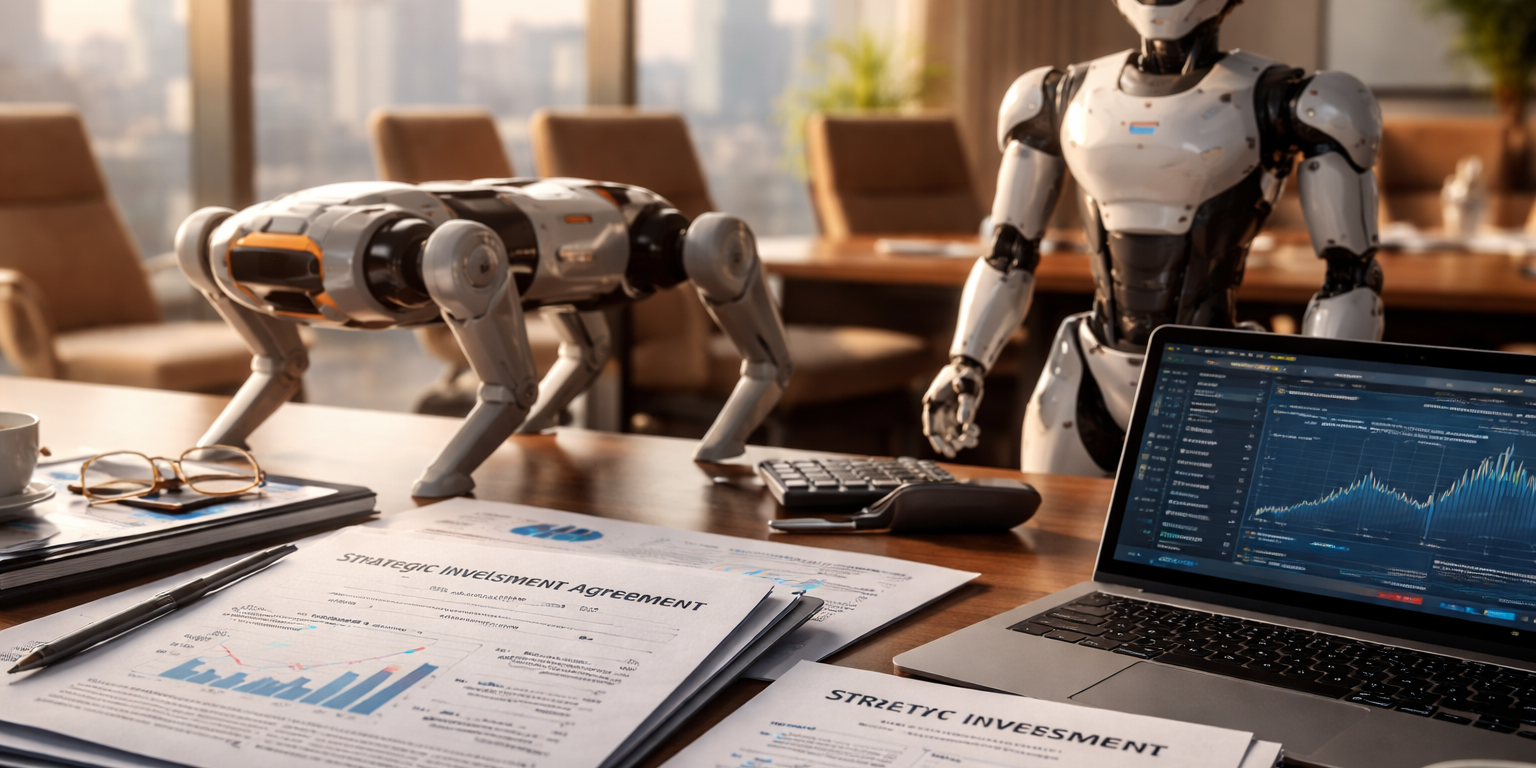
DeepSeek paid 140.8 million yuan for 933,399 shares in Unitree Robotics' Shanghai initial public offering, landing the AI research lab a 2.31% allocation of the strategic placement portion disclosed in exchange filings this week. The investment comes packaged with a procurement and joint development agreement that binds DeepSeek's large language models to Unitree's humanoid robot hardware, creating what both companies describe as an integrated development path for embodied AI systems. The filing marks DeepSeek's first direct equity stake in a robotics manufacturer and Unitree's most significant AI partnership since the Hangzhou-based company began shipping quadruped robots commercially in 2020.
Unitree has built its business on low-cost quadruped platforms, selling the Go2 model for under $1,600 and undercutting Boston Dynamics' Spot by roughly 90% on price. The company shipped an estimated 8,000 quadruped units in 2025, according to industry analysts, primarily to universities and research institutions in China and Southeast Asia. Its humanoid offering, the G1, launched in pilot production in March 2026 at a retail price of $16,000, positioning it as the least expensive electric humanoid with articulated hands on the market. DeepSeek's models, particularly its V3 architecture released in December 2025, have demonstrated strong performance on robotics-specific benchmarks including RT-2 manipulation tasks and embodied question answering, making the pairing a natural technical fit for companies aiming to ship consumer-grade humanoid products before 2028.
The procurement component of the agreement obligates DeepSeek to purchase Unitree hardware for internal research and commits Unitree to integrating DeepSeek's inference engines as the default AI stack on future humanoid models. Financial terms of the procurement deal were not disclosed, but the filing indicates multi-year commitments on both sides with minimum purchase volumes tied to production milestones. Unitree plans to scale G1 production to 500 units per month by the fourth quarter of 2026 and 2,000 units monthly by mid-2027, according to the IPO prospectus. DeepSeek operates roughly 40,000 H800 GPUs in its Hangzhou data center, a scale that positions it among the top five AI labs in China by compute capacity, though well behind Alibaba and Baidu. The company has consistently prioritized efficiency over raw parameter count, achieving GPT-4-class performance on several benchmarks while using a fraction of the training compute reported by OpenAI and Anthropic.
The strategic investment places DeepSeek alongside Tencent, Xiaomi, and an undisclosed Shenzhen-based venture fund in Unitree's cornerstone investor group. Together, strategic investors took 40.2% of the IPO's total allocation, with the remainder distributed to institutional buyers through the Shanghai exchange's standard book-building process. Unitree's valuation at the close of the IPO reached 6.1 billion yuan, or roughly $850 million, giving the company a market capitalization comparable to Agility Robotics following its Series C round in January 2026. The robotics manufacturer reported revenue of 520 million yuan in 2025, up from 180 million yuan the prior year, driven primarily by quadruped sales to education and research customers. The company has not disclosed profitability figures but indicated in the prospectus that it expects to reach positive EBITDA by the second quarter of 2027 if humanoid sales meet internal forecasts.
Broader adoption of integrated AI-robotics partnerships follows similar moves by Figure AI, which brought Microsoft and OpenAI onto its cap table in early 2024, and Tesla, which has developed its humanoid AI stack entirely in-house using the same foundation models that power its Full Self-Driving system. The capital-intensive nature of humanoid development has pushed most startups toward vertical integration or deep partnerships that align model training with hardware iteration cycles. Boston Dynamics, now owned by Hyundai, announced in May 2026 that it would begin integrating Google DeepMind's RT-X models into Atlas for warehouse manipulation tasks, ending years of resistance to third-party AI dependencies. Sanctuary AI, based in Vancouver, maintains proprietary control over both its Phoenix humanoid platform and its Carbon AI control system but has raised over $140 million to sustain parallel development. DeepSeek's equity position in Unitree suggests the Hangzhou lab sees faster commercial traction by tying its models to a hardware partner already shipping physical products at scale, rather than developing its own robotics division or licensing models broadly across manufacturers.
What to Watch: Unitree's production ramp on the G1 humanoid through the fourth quarter of 2026 will test whether the company can maintain its cost advantage while scaling assembly operations beyond pilot volumes. DeepSeek's next model release, expected in the first quarter of 2027 based on prior release cadence, will likely include robotics-specific benchmarks and deployment case studies from the Unitree partnership. Monitor strategic placement allocations in other Chinese robotics IPOs over the next six months, as Tencent and Xiaomi have both signaled interest in taking minority stakes in hardware manufacturers as routes to exclusive AI integration agreements.