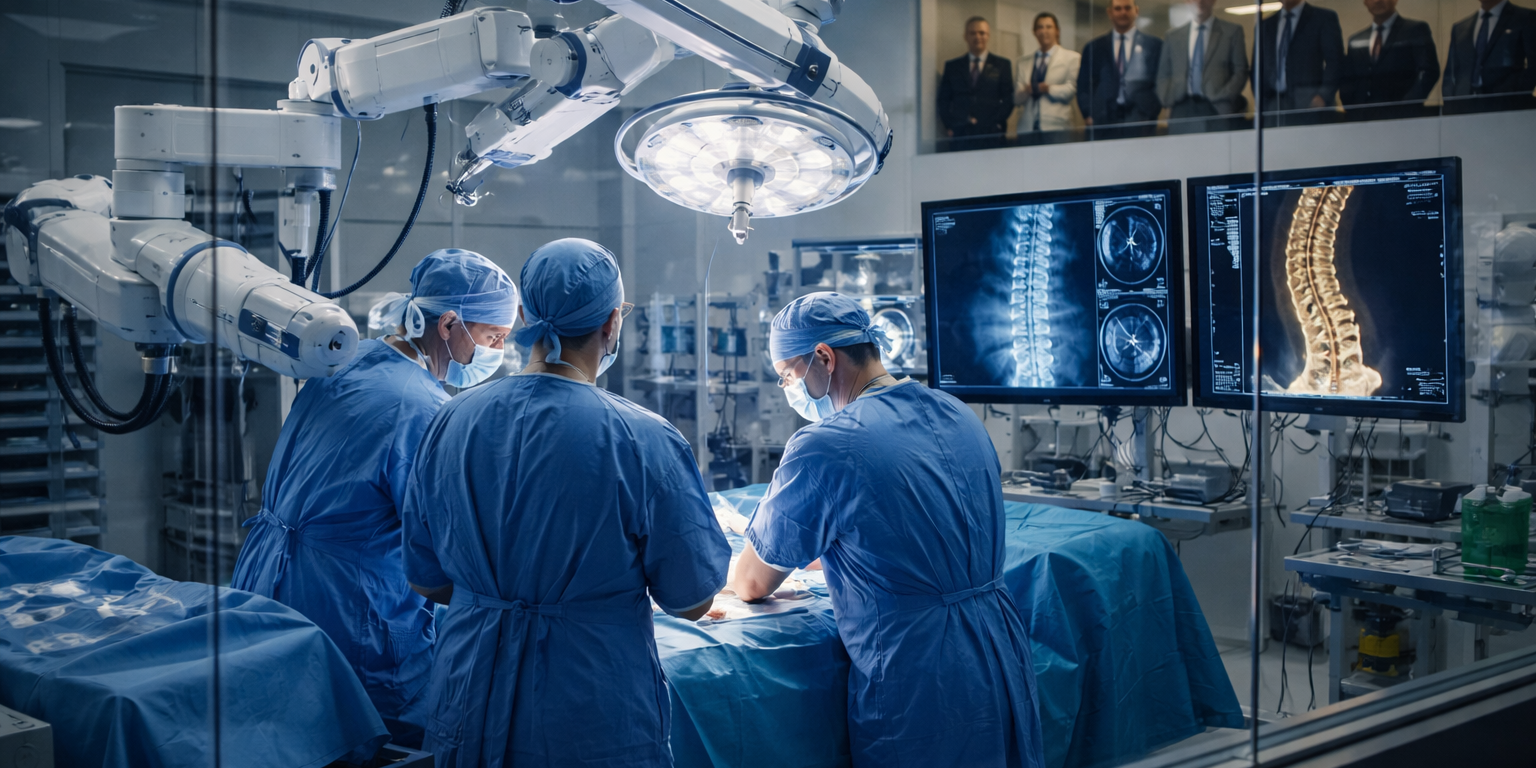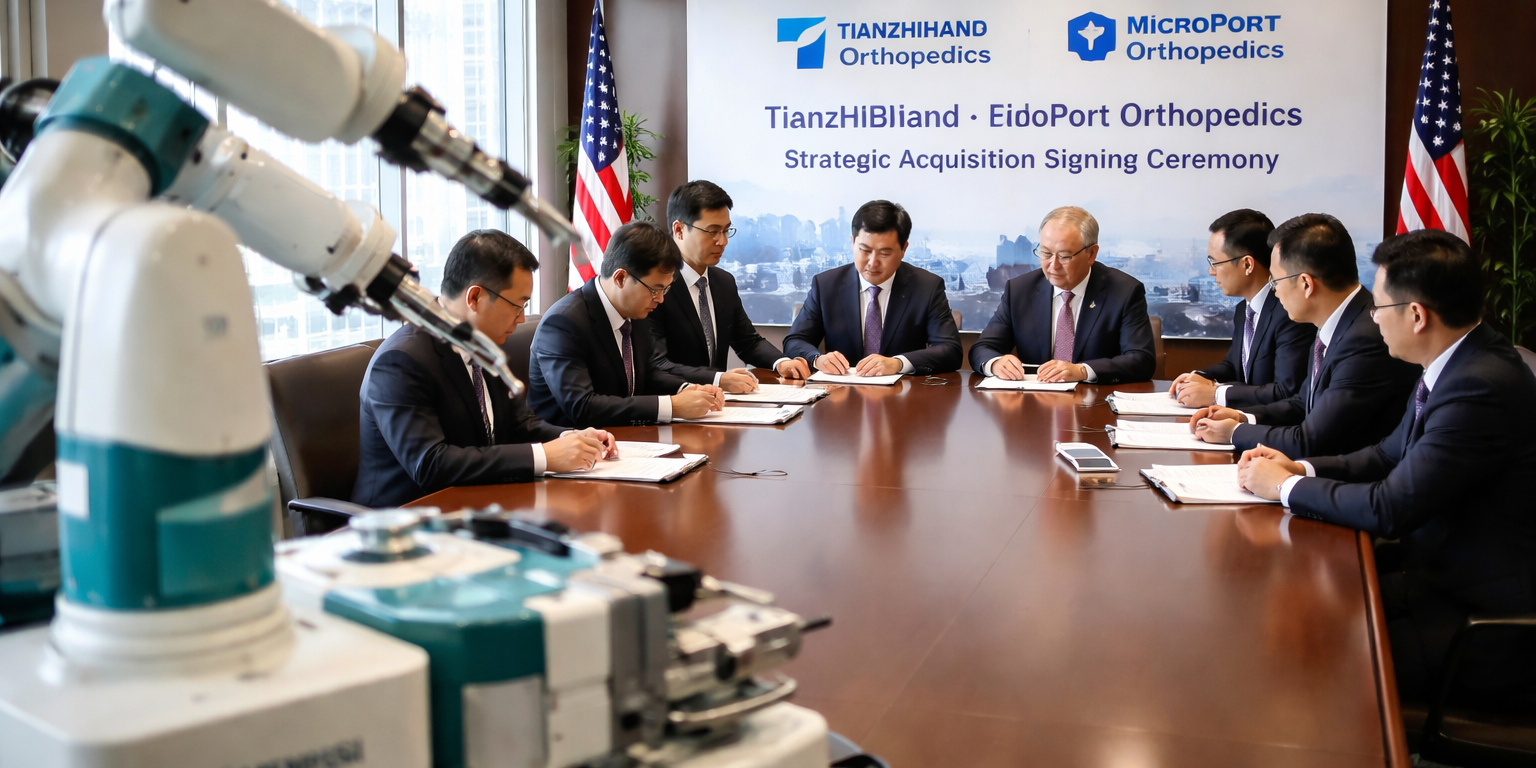
TIANZHIHANG, a Beijing-based manufacturer of orthopedic surgical robots, has entered into a definitive agreement to acquire MicroPort Orthopedics, an implant manufacturer with U.S. Food and Drug Administration clearances and established distribution in North American hospitals. The transaction, financial terms of which were not disclosed, marks the first instance of a Chinese robotics company acquiring a Western medical device incumbent to compress regulatory approval timelines and clinical adoption cycles. Rather than spending years navigating FDA 510(k) pathways and building surgeon relationships from scratch, TIANZHIHANG is purchasing both the credentials and the customer base outright. The deal is expected to close in the fourth quarter of 2026, subject to Committee on Foreign Investment in the United States review.
MicroPort Orthopedics, headquartered in Memphis, Tennessee, has been manufacturing hip and knee implants since its spin-off from Wright Medical Technology in 2014. The company holds FDA clearances for more than thirty implant product lines and maintains contracts with over two hundred hospitals across the United States, including seven of the top twenty orthopedic centers by surgical volume. TIANZHIHANG manufactures the TZH-OR1, a robotic arm platform for total knee arthroplasty that received China National Medical Products Administration approval in 2024 and has been deployed in forty-three Chinese hospitals as of mid-2026. The system uses preoperative CT imaging to generate patient-specific cutting guides, a workflow similar to platforms from Stryker's Mako and Zimmer Biomet's ROSA. TIANZHIHANG's robotics revenue reached approximately 180 million yuan in 2025, derived entirely from domestic sales. The company has no current FDA submissions and no U.S. commercial presence.
The acquisition inverts the typical integration path in surgical robotics, where implant manufacturers like Stryker, Zimmer Biomet, and Johnson & Johnson acquired robotic platform companies to enhance device portfolios. Those deals—Stryker's $1.65 billion purchase of Mako Surgical in 2013, Zimmer Biomet's acquisition of Medtech SA in 2016, Johnson & Johnson's $3.4 billion deal for Auris Health in 2019—moved from commodity hardware into software-enabled precision. TIANZHIHANG is executing the opposite strategy: starting with the robotics platform and acquiring the commodity implants, along with the regulatory clearances, surgeon training programs, and hospital contracts that represent the real barriers to entry in the U.S. market. The approach reflects a calculation that Chinese robotics engineering has closed the capability gap with Western platforms, but market access remains a decade-long grind. By acquiring MicroPort Orthopedics, TIANZHIHANG gains not just implants but also the institutional relationships that determine surgical robot adoption. Orthopedic robots do not succeed in isolation; they require integration into existing surgical workflows, vendor-neutral data systems, and hospital capital budgets already dominated by Stryker, Zimmer, and Smith+Nephew.
The transaction arrives as Chinese robotics companies face growing scrutiny in Western markets, particularly in defense-adjacent sectors, but also in healthcare where data security and supply chain resilience have become procurement criteria. TIANZHIHANG's path through CFIUS review will test whether surgical robotics, which processes patient imaging data and integrates with hospital information systems, triggers the same national security concerns that have blocked Chinese acquisitions in semiconductor and telecommunications sectors. MicroPort Orthopedics itself is a subsidiary of Shanghai-based MicroPort Scientific, a publicly traded medical device conglomerate with cardiovascular, orthopedic, and surgical robot divisions. MicroPort Scientific has been divesting non-core assets since 2024 to focus on higher-margin segments. The orthopedics unit generated approximately $120 million in revenue in 2025, down from $145 million in 2023, as competition from larger incumbents eroded pricing power. For MicroPort Scientific, the sale converts a declining implant business into cash. For TIANZHIHANG, it converts cash into a decade of market development compressed into a single deal.
What to Watch: CFIUS will issue its preliminary review determination by late September 2026; any extended review or mitigation requirements will signal regulatory appetite for Chinese ownership of U.S. healthcare robotics infrastructure. Monitor whether TIANZHIHANG pursues FDA clearance for the TZH-OR1 platform using MicroPort Orthopedics' established regulatory pathways, or whether it keeps the robotics and implant businesses operationally separate to minimize integration complexity. Track whether other Chinese robotics manufacturers—particularly those in endoscopy, neurosurgery, and interventional cardiology—pursue similar reverse integration strategies in the second half of 2026.