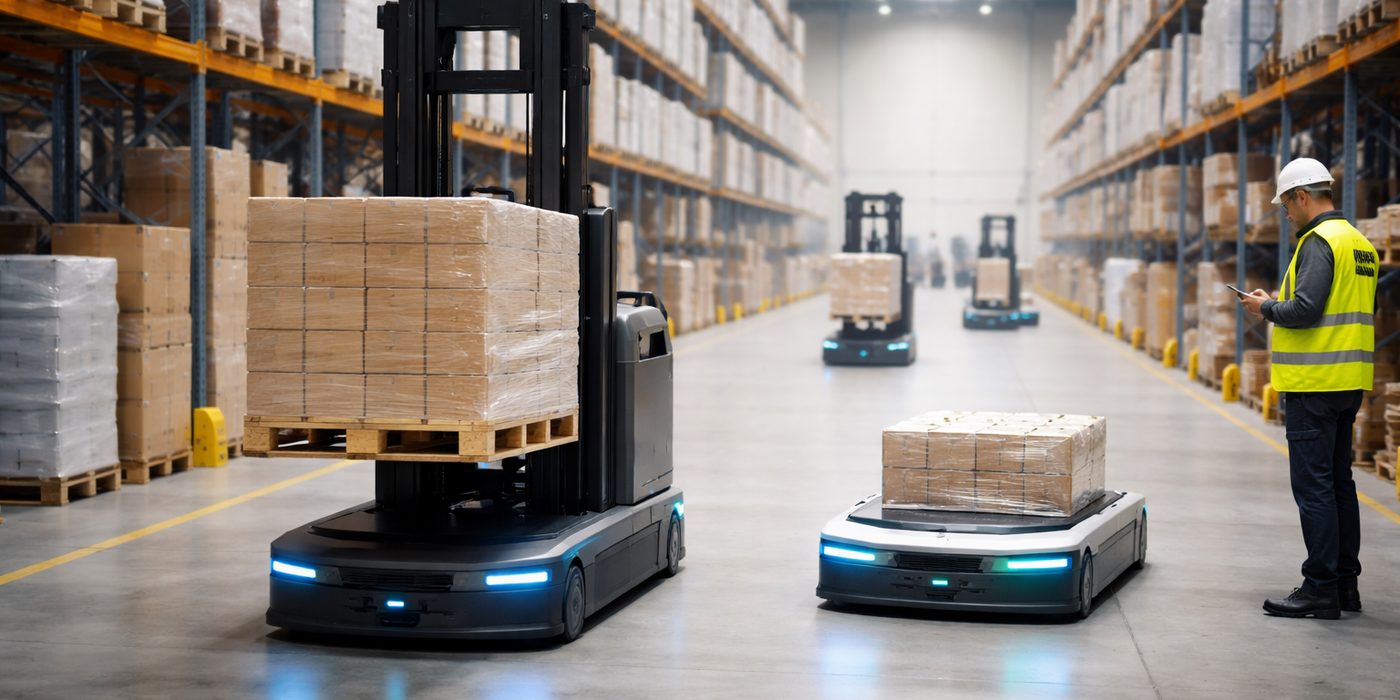
AGILOX's robots don't wait for instructions from a server. Each unit in the Austrian company's fleet carries its own AI-driven navigation and negotiates traffic with its neighbors directly, a swarm approach that removes the central controller most competing AMR systems depend on. On November 18, 2026, Rockwell Automation signed a definitive agreement to acquire the company, folding that architecture and AGILOX's forklift-style AMR portfolio into a robotics business that until now has been built largely around OTTO by Rockwell Automation's flatbed vehicles. Financial terms were not part of the initial disclosure. The stated goal is plain enough: expand Rockwell's autonomous material-movement capabilities and accelerate its physical AI strategy.
Rockwell has been assembling this position piece by piece. Its 2023 acquisition of Clearpath Robotics and OTTO Motors gave it a credible AMR franchise and a foothold in automotive and manufacturing intralogistics. But flatbed and cart-tugging platforms cover only part of the pallet-handling problem. Forklift-class AMRs, which lift, stack, and place loads at height, address a different slice of warehouse and plant-floor work, and it is a slice where customers have increasingly asked for a single vendor. AGILOX arrives with that product category already in production, along with AI developed in-house rather than licensed, which matters to any buyer thinking about long-term control of the software roadmap.
The swarm design is the detail that separates this from a routine catalog expansion. Conventional AMR deployments typically route every robot through a fleet manager that assigns missions, resolves conflicts, and keeps a shared map. That model scales well in tidy, well-instrumented facilities and less gracefully in cluttered ones, where a single server or network dropout can stall a floor. AGILOX's peer-to-peer coordination spreads that decision-making across the vehicles themselves. For engineers evaluating uptime and commissioning time, the appeal is fewer single points of failure and, in principle, simpler expansion: add a robot, and it joins the swarm. The trade-off is that decentralized systems can be harder to audit and to tune for throughput across a whole site.
For the wider market, the deal reads as another sign that the AMR sector is consolidating around automation incumbents with deep controls and software footprints. Rockwell's advantage is the installed base. Its programmable controllers, plant-floor software, and manufacturing customers already sit at the other end of the integration problem AMR vendors struggle with: connecting mobile robots to MES, WMS, and production schedules. Standalone AMR makers, even technically strong ones, must build or buy those connections. Rockwell owns many of them. That makes AGILOX less a stand-alone bet than a component in a larger pitch about orchestrating humans, machines, and data across a facility.
The open question for Rockwell is architectural. OTTO's fleet software and AGILOX's swarm logic represent two philosophies about where intelligence should live, and customers running mixed fleets will expect them to coexist without drama. Whether Rockwell unifies the stacks, keeps them parallel, or exposes both through a common orchestration layer will determine how much of the promised synergy shows up in customer deployments. Regulatory approval and closing conditions also remain ahead. Rockwell has framed the acquisition as complementary rather than overlapping, pairing forklift AMRs with flatbed AMRs, but pairing two product lines on a slide is easier than pairing them on a shop floor.
What to Watch Track the closing timeline and any regulatory filings in Austria and the EU through early 2027, along with whether Rockwell discloses deal value in its next quarterly earnings materials. Watch for a combined product roadmap or integration announcement showing how AGILOX forklift AMRs and OTTO flatbed vehicles share fleet software, ideally ahead of major automation trade events in the first half of 2027. Pay attention to AGILOX's existing customer base in European intralogistics and whether Rockwell commits to continued support of the swarm architecture. Finally, monitor competitor responses from other automation majors and AMR specialists, since a bundled forklift-plus-flatbed offer from Rockwell will pressure rivals to match breadth through partnerships or acquisitions of their own.