
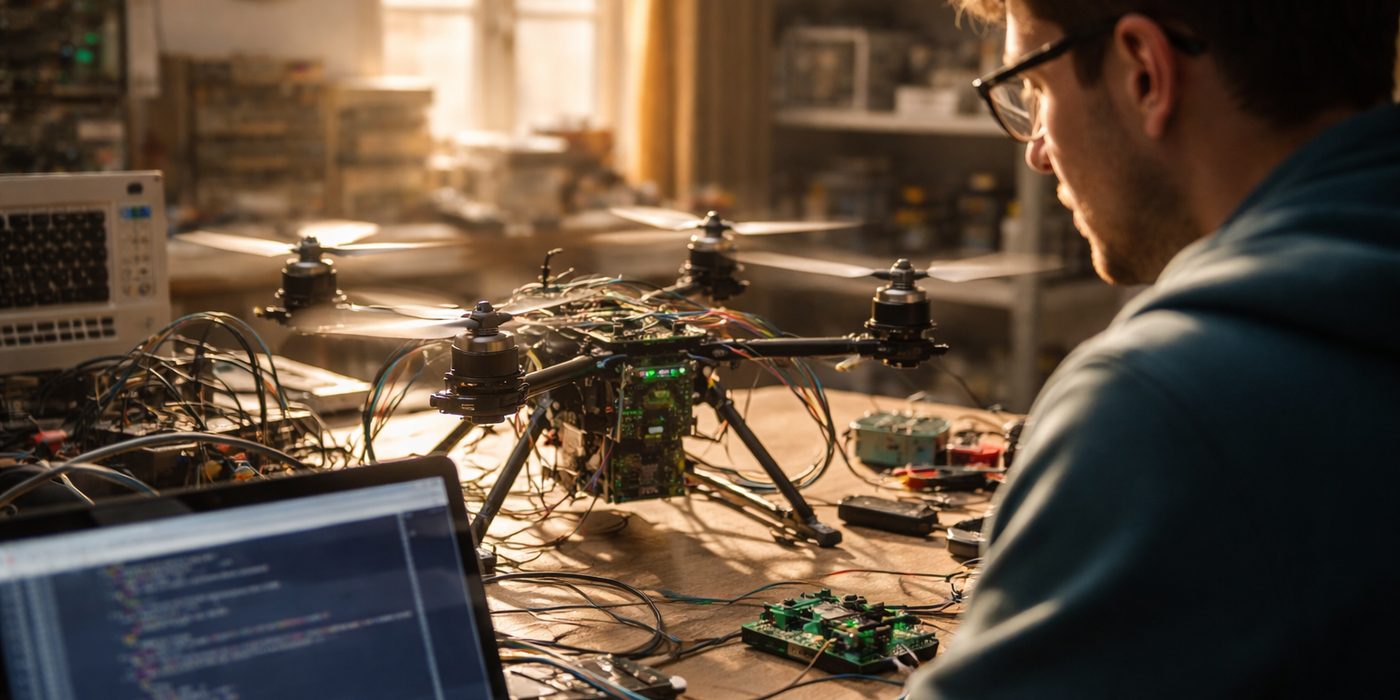
Thirty minutes. That is how long NXP Semiconductors says a developer needs to get initial drone functionality running on its new modular robotics platform, announced November 9, 2026. The claim is aggressive, and it is aimed squarely at a pain point that anyone who has built a robot knows well: the months lost not to inventing algorithms but to making motor controllers, vision pipelines, sensor stacks, and compute modules talk to one another reliably. NXP's answer is a unified package of processors, open-source software, and reference designs, with pre-integrated software and validated subsystem interoperability that the company says compresses integration and validation from months to days or weeks.
The pitch lands at a moment when the physical AI conversation has been dominated by models and humanoid demos, while the unglamorous middle layer of embedded engineering quietly determines which prototypes ever reach production. Robotics teams routinely discover that the gap between a convincing lab demonstration and a certifiable, repeatable product is paved with integration debt: mismatched drivers, timing conflicts between sensor feeds and control loops, and safety validation that has to be redone whenever a component changes. Silicon vendors have long supplied the chips and left that debt to customers. NXP is now trying to absorb some of it into the platform itself.
Underpinning the offering is the company's Neural Axis Architecture, which NXP positions as the foundation connecting its processors to the software and reference designs layered on top. The modular framing matters. Rather than selling a monolithic robot brain, NXP is offering validated building blocks that developers can swap and recombine, which in theory lets a team prototype a drone today and repurpose the same subsystems for a ground vehicle or industrial manipulator tomorrow. The open-source emphasis is equally deliberate. Developers wary of lock-in tend to gravitate toward stacks they can inspect and modify, and open software lowers the barrier for the university labs and startups that often seed the next wave of commercial designs.
For the broader industry, the strategic read is about where value accrues. Nvidia has spent years building a software-and-simulation moat around its Jetson and Isaac ecosystem, and Qualcomm has been courting robotics developers with its own edge-AI silicon. NXP's differentiation is its deep footprint in automotive, industrial, and edge applications, markets where functional safety, long product lifecycles, and deterministic real-time behavior are non-negotiable. A platform that trims validation time speaks directly to those buyers. The open question is whether a 30-minute out-of-the-box drone translates into the harder metric that matters to engineers: how much of that pre-validated work survives contact with a custom payload, a proprietary sensor, and a regulator's checklist.
The sharper observation sits beneath the headline number. A drone that flies in 30 minutes is a demonstration of integration discipline, not of intelligence, and that is precisely the point. As physical AI models grow more capable and more commoditized, the scarce resource shifts from algorithms to the engineering hours required to deploy them on real hardware. By selling time saved rather than raw compute, NXP is competing on the cost structure of building robots, a framing that appeals to executives and investors who have watched development budgets balloon while product launches slip.
What to Watch Track whether NXP names launch customers or ecosystem partners in the coming weeks, since a platform's credibility rests on third-party adoption beyond reference designs. Watch for independent benchmarks or developer reports testing the 30-minute and days-to-weeks claims on non-trivial hardware configurations. Monitor competitive responses from Nvidia and Qualcomm as year-end developer events approach, particularly any moves toward pre-validated, modular subsystem bundles. Finally, follow how NXP extends the Neural Axis Architecture beyond drones into ground and industrial platforms, which will show whether the modularity claim holds up outside its showcase use case.