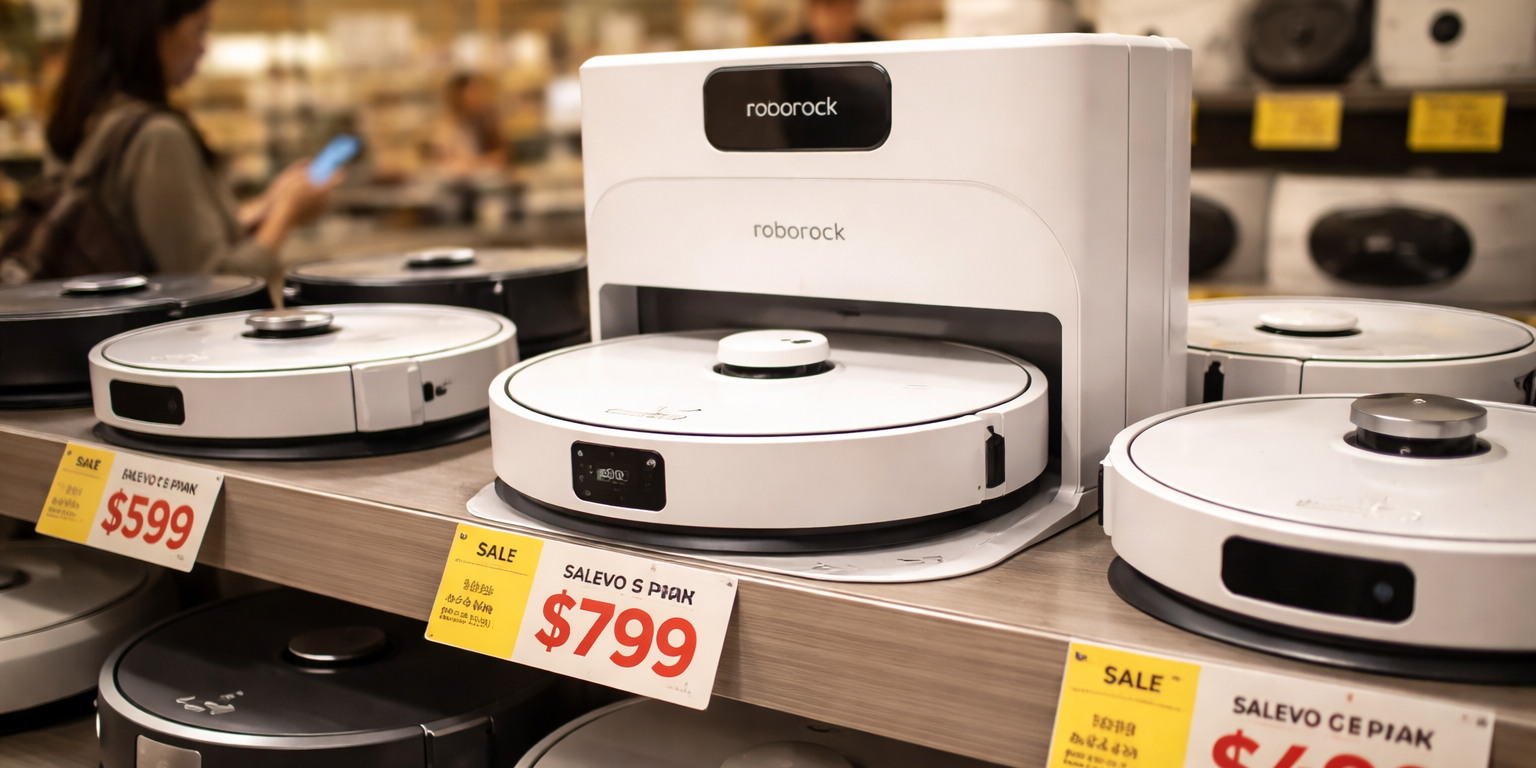
Roborock's Qrevo S Pro, a combination vacuum-mop unit launched at $1,399 in late 2025, is currently retailing for $799 through multiple channels—a 43 percent markdown that signals intensifying price competition in the home robotics segment. The discount lands as at least six Chinese competitors have released functionally similar models in the $600-$900 range since January 2026, forcing established brands to reassess their pricing architecture or risk inventory accumulation.
The Qrevo S Pro features dual spinning mop heads with 100-minute runtime, obstacle avoidance using RGB camera and structured light sensors, and a docking station that automatically empties dustbins, refills water tanks, and washes mop pads. Those specifications matched flagship offerings from iRobot and Ecovacs when Roborock introduced the model eight months ago. Today, brands including Dreame, Yeedi, and Narwal ship units with nearly identical sensor suites and dock capabilities at launch prices below Roborock's current discounted rate. The gap between premium and mid-tier consumer robotics hardware has narrowed to the point where differentiation hinges almost entirely on software refinement and brand loyalty rather than mechanical capability. For robotics component suppliers, this commoditization presents both risk and opportunity. LIDAR modules that cost manufacturers $45 per unit in 2024 now trade at $22 in volume orders, according to supply chain data from Yole Intelligence. Computer vision processors from Ambarella and Novatek have seen similar deflation. Companies betting on hardware margins in consumer robotics are watching those economics erode in real time, while software and services businesses are positioning themselves as the durable value layer. iRobot's Roomba Combo j9+, still priced at $1,399 with minimal discounting, relies heavily on its Genius Home Intelligence platform and integration with Amazon Alexa as justification for the premium over functionally comparable Chinese models.
The timing of Roborock's pricing adjustment aligns with broader inventory concerns across the sector. Import data from U.S. Customs and Border Protection shows a 34 percent year-over-year increase in robotic vacuum shipments from China during the first quarter of 2026, even as unit sales growth in North America slowed to 11 percent over the same period. That mismatch suggests channel stuffing or overproduction, conditions that typically precede aggressive discounting. Retailers including Amazon, Best Buy, and Target have expanded robotic vacuum shelf space by an average of 22 percent since 2024, but the number of brands competing for that space has grown faster—from 14 major labels in early 2024 to 27 as of June 2026. The result is a classic margin squeeze where incremental market share gains require pricing below sustainable levels. For investors evaluating robotics companies with consumer exposure, the Roborock discount serves as a reminder that hardware alone offers limited defensibility. Companies that control proprietary navigation algorithms, own large datasets of home floor plans, or bundle their devices with subscription services are better positioned to weather pricing pressure. Roborock itself has introduced a $4.99 monthly Roborock Care plan offering extended warranties and priority customer support, though uptake figures remain undisclosed.
The consumer robotics pricing environment also reflects maturation in underlying technologies. SLAM algorithms that required PhD-level expertise to implement five years ago are now available as open-source libraries or turnkey modules from suppliers like Slamtec and NVIDIA. Brushless motors, lithium polymer batteries, and injection-molded chassis components have become standardized inputs with multiple qualified sources. Even the docking stations—once a differentiator for premium models—now share common designs across brands, often manufactured by the same Shenzhen-based contract producers. What remains proprietary is the edge case handling: how a vacuum responds when it encounters pet waste, how it prioritizes room cleaning when battery is low, how it adapts suction power based on detected floor types. Those software behaviors take years to refine through field data collection, giving established players a narrow but real advantage. Whether that advantage justifies a 75 percent price premium is the question Roborock and its peers are now answering in the marketplace. Early evidence suggests consumers see incremental software polish as worth perhaps a 20-30 percent premium, not the 100 percent-plus gaps that prevailed in 2023 and 2024.
What to Watch: Monitor whether Roborock maintains the $799 price point through the back-to-school shopping season in August and September 2026, or if further cuts follow. Track iRobot's quarterly earnings report in late July for commentary on pricing strategy and whether the company will defend its premium positioning or match Chinese competitors. Watch for consolidation activity—smaller brands like Yeedi and Eufy may struggle to remain viable as margins compress, making them acquisition targets for larger players seeking market share or technology tuck-ins. Finally, observe subscription service attach rates across brands; if monthly service revenue exceeds 15 percent of hardware revenue by year-end 2026, it could validate a pathway to sustainable business models even as device prices continue falling.