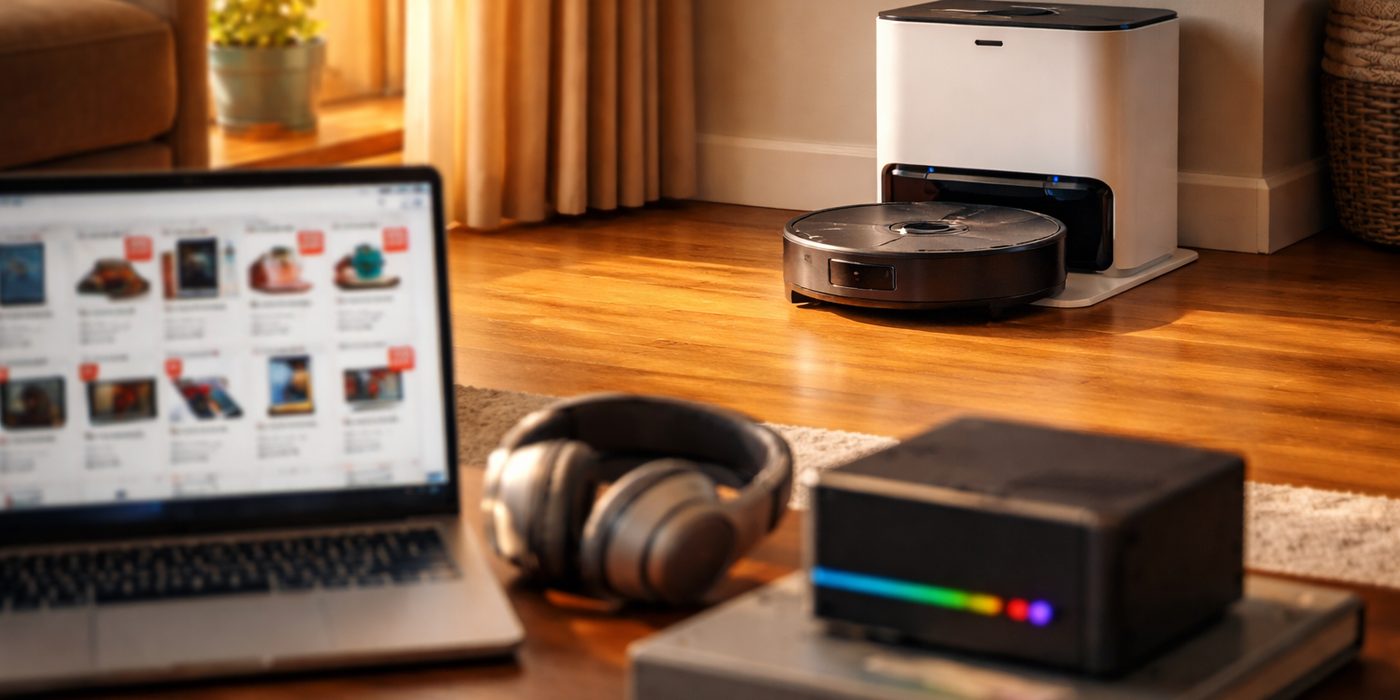
A robot that vacuums, mops, washes its own mop pads, and empties its own dustbin now shows up in a deals roundup between a JBL headphone markdown and a gaming desktop. That is the quiet significance of the Roborock Qrevo 2 Pro appearing in the November 15, 2026 daily deals post from Geeks Are Sexy, a consumer site that earns affiliate commissions on qualifying purchases. The listing itself is routine retail fare. It sits alongside an MSI Codex Z2 gaming desktop, a Lenovo Slim 7i Aura laptop, and JBL's Tune 530BT wireless headphones. But for anyone tracking the economics of domestic robotics, the placement tells a story that press releases rarely admit: the category's flagship hardware is now sold the way commodity electronics are sold.
The Qrevo line occupies the upper-middle tier of Roborock's catalog, the company's bid to make an all-in-one dock the default expectation rather than a luxury add-on. A single base station handles dust evacuation, clean-water supply, dirty-water collection, and mop-pad washing and drying, which removes the two chores that historically made robot vacuums feel like half-solutions: emptying bins and scrubbing pads by hand. That dock architecture was a differentiator three years ago. Today nearly every major vendor, including Ecovacs, Dreame, Eufy, and iRobot, ships a comparable station. When a feature set becomes table stakes, price becomes the lever, and seasonal discounting ahead of the holiday shopping window is how vendors move volume while protecting list-price positioning.
The competitive map behind those discounts has shifted sharply. Chinese manufacturers, led by Roborock, Dreame, and Ecovacs, have taken a growing share of global robot vacuum shipments, while iRobot, the category's original brand, spent the last two years navigating financial strain after its planned Amazon acquisition collapsed in early 2024. The result is a market where engineering iteration cycles run in months, not years, and where each new generation adds incremental features: stronger suction ratings, obstacle-avoidance cameras, mop lift mechanisms for carpet, and edge-reaching mop arms. Individually these upgrades are modest. Collectively they compress the shelf life of any single model, which explains why a product like the Qrevo 2 Pro can be promoted aggressively while its maker preps successors.
Here is the observation the headline price obscures: the dock, not the robot, is where the real engineering and the real margin now live. A vacuum is a mobile sensor platform with a brush; a dock is a plumbing, filtration, heating, and fluid-management system that must operate unattended in a kitchen or hallway for years. Failure rates, odor control, and water-handling reliability determine whether customers buy a second unit or leave a bad review. For robotics engineers, that is a useful reminder that consumer robot success depends less on autonomy headlines than on mundane subsystems executing flawlessly thousands of times. It also explains why vendors with strong manufacturing discipline can sustain promotional pricing that would sink a hardware-light competitor.
For investors and executives watching adjacent segments, the commoditization curve of the robot vacuum is a template worth studying. Humanoid and general-purpose home robot developers are courting the same households with far higher price points and far less proven reliability, and they will face the same compression once volumes scale. Robot vacuum makers are already probing the next step, with models that add articulated arms to pick up socks and small objects, blurring the line between a cleaning appliance and a manipulation platform. If that capability becomes a standard feature rather than a premium one, today's mop-and-dock discounting will look like an early chapter in a much longer race to bring dexterity into the home at mass-market prices.
What to Watch Track Black Friday and Cyber Monday pricing in late November 2026 on Roborock, Dreame, and Ecovacs flagship docks, since depth of discount will signal inventory position and demand elasticity. Watch for CES 2027 in early January, where vendors are expected to show arm-equipped vacuums and next-generation dock designs. Monitor iRobot's quarterly results for evidence of share recovery or further erosion against Chinese competitors. Finally, follow regulatory and tariff developments affecting imported consumer robots in the first quarter of 2027, which could reshape landed costs and promotional headroom.