Roborock's Qrevo CurvX is shipping at $850, a price point that signals how quickly advanced navigation and multi-surface cleaning capabilities are moving downstream in the consumer robotics market. The unit combines simultaneous vacuuming and mopping with a self-emptying base station and automatic mop-lift functionality that allows it to transition between hard floors and carpet without manual intervention. That feature set would have commanded a four-figure price two years ago. Now it sits firmly in the middle of a consumer robotics category where pricing pressure and commoditization are forcing every manufacturer to make hard calls about sensor suites, compute power, and margin.
The Qrevo CurvX represents Roborock's latest attempt to hold market share in a segment where iRobot still commands brand recognition but has struggled with profitability, and where Chinese manufacturers like Ecovacs, Dreame, and Narwal have compressed pricing on nearly every feature tier. Roborock itself is a Beijing-based company that went public on the Shanghai Stock Exchange in 2020 and has built its growth on aggressive feature development and competitive pricing. The company shipped approximately 2.3 million units globally in 2025, according to its most recent earnings disclosure, with North American sales accounting for roughly 18 percent of volume. That makes it a significant but not dominant player in a market where Ecovacs leads in unit volume and iRobot leads in brand equity but trails in innovation velocity. The Qrevo CurvX launch comes as Roborock prepares its 2026 product roadmap, which industry sources say will include at least two additional hybrid models and a potential entry into the standalone mopping category where Braava and Narwal currently compete.
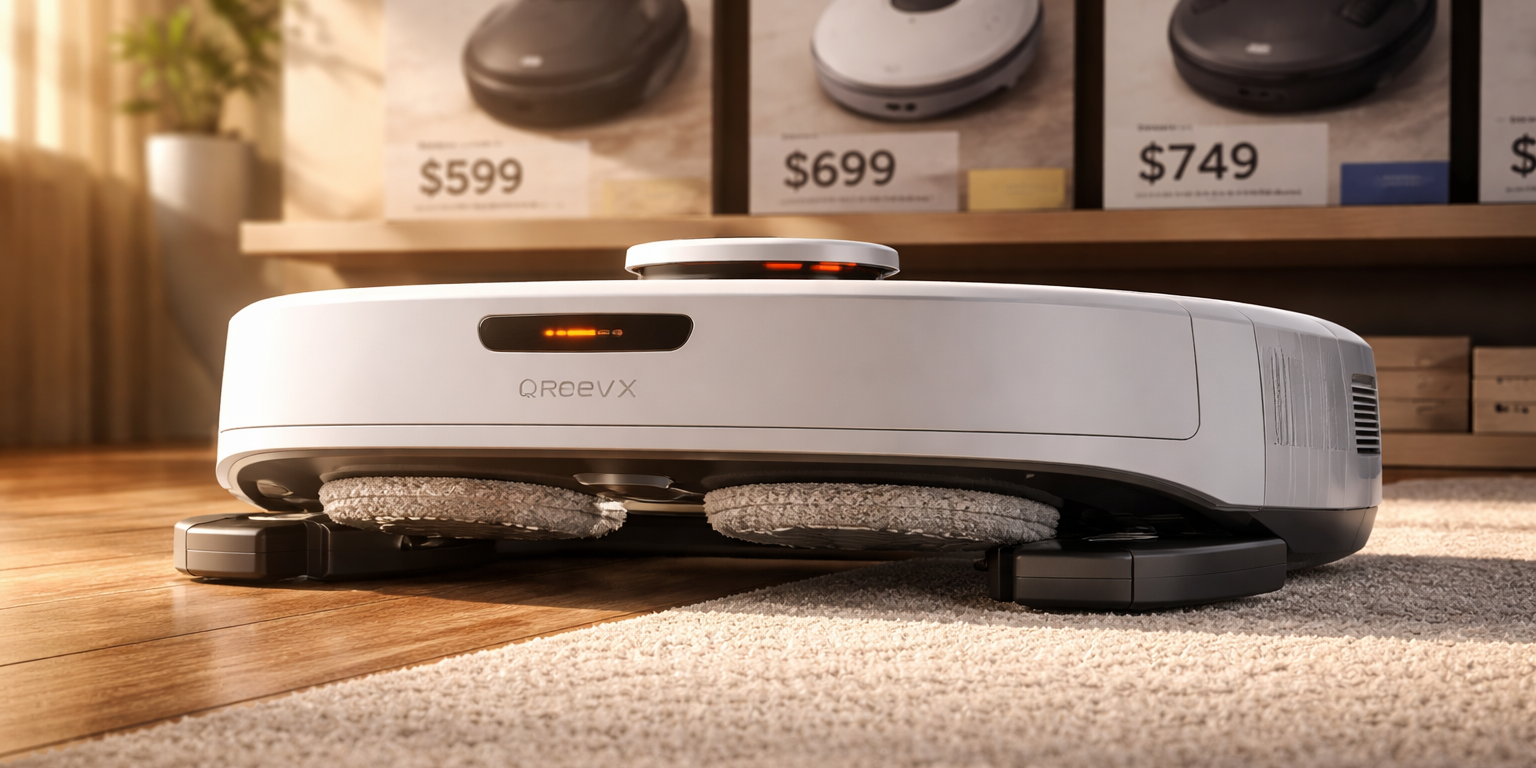
The engineering challenge in a unit like the CurvX is not in any single subsystem but in the integration overhead required to make simultaneous vacuuming and mopping work reliably across surface types without creating cross-contamination or navigation errors. The auto-lift mop feature uses a mechanical actuator to raise the mop pad approximately 10 millimeters when the unit detects carpet, which prevents the pad from dampening fibers or creating drag that degrades suction performance. That detection relies on a combination of acoustic sensors that identify carpet texture and load sensors on the drive motors that measure resistance changes. It is a simpler approach than vision-based carpet detection, which some competitors have deployed, but it also introduces latency and occasional misclassification when transitioning between low-pile rugs and hard floors. The self-emptying base is a standard cyclonic design that uses a 2.5-liter dust bag and claims to hold debris from up to 60 cleaning cycles, though that figure assumes a median household floor area and does not account for homes with pets or high traffic. The mopping subsystem uses a 200-milliliter onboard water tank and relies on gravity feed rather than active pumping, which limits its ability to handle dried or sticky residues but keeps component cost and complexity low.
What the $850 price point exposes is the margin compression happening across the entire category. Roborock's gross margin on consumer floor care products was approximately 34 percent in its most recent fiscal year, down from 39 percent two years prior, according to company filings. That decline reflects both component cost increases, particularly for LiDAR modules and brushless motors, and pricing pressure from competitors who are willing to sacrifice near-term profitability for volume growth. iRobot, by contrast, has tried to hold pricing on its Roomba Combo j9+ at $1,399, betting that brand loyalty and a superior software experience will justify the premium. Early sales data suggests that strategy is not working. Amazon sales rank data from Q1 2026 showed the Roomba Combo j9+ ranked 14th in the robot vacuum category, while Roborock's previous-generation Q Revo Pro held the number three position at $699. The gap between those two units in feature set is narrower than the gap in price, which suggests consumers are increasingly willing to trade brand for capability when the delta exceeds $500. For engineers and investors watching this space, the question is not whether hybrid vacuum-mop units will continue to gain share they will but whether any manufacturer can maintain differentiation that justifies a premium as sensor costs fall and Chinese competitors continue to iterate.
What to Watch: Roborock is expected to launch at least one additional Qrevo variant before the 2026 holiday season, likely with upgraded obstacle avoidance or voice assistant integration. iRobot's next earnings call in late August will reveal whether the company plans to cut pricing on its Combo line to remain competitive. Ecovacs and Dreame are both rumored to be preparing sub-$700 hybrid models with self-emptying for release in Q4 2026, which would further compress the middle of the market. Amazon Prime Day data in October will show whether consumer demand for robot vacuums is growing or whether the category is saturating in developed markets.