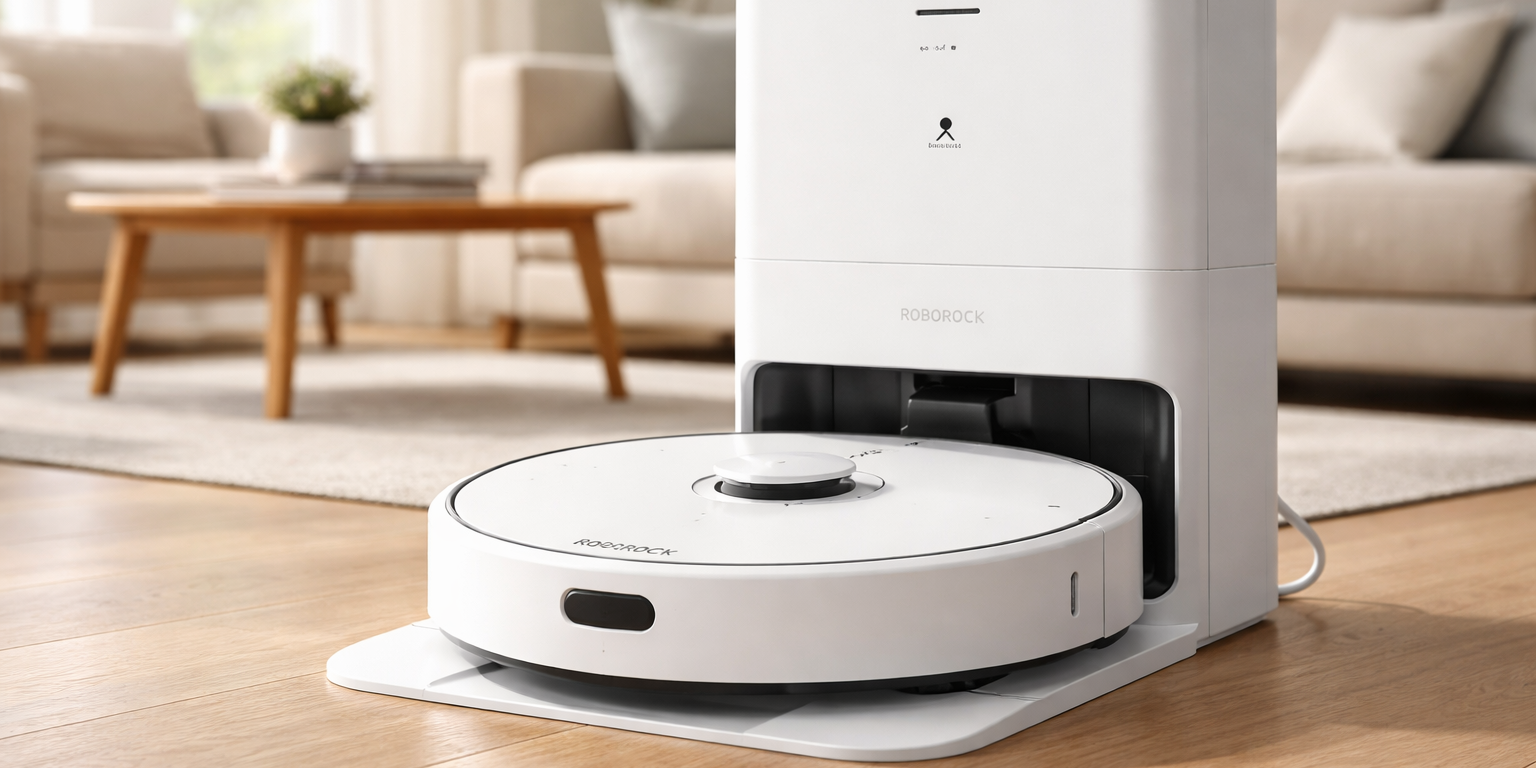
Roborock shipped the Q7 M5+ with an auto-empty dock and full SLAM navigation for a retail price well below the $500 mark, compressing the feature set that commanded premium pricing as recently as two years ago into a volume-market product. The unit uses visual simultaneous localization and mapping to build persistent floor plans, stores them across cleaning sessions, and returns to a base station that evacuates the onboard dustbin into a 2.5-liter disposable bag. That combination, standard on flagship models from iRobot and Ecovacs priced above $900, now defines the middle of Roborock's consumer lineup. The company declined to specify which SLAM algorithm variant the Q7 M5+ runs, but engineers familiar with the platform say it likely uses a cost-reduced version of the PSD sensor array deployed in the S7 series, trading absolute positional accuracy for adequate room segmentation at a bill-of-materials saving estimated near $40 per unit.
The pricing strategy reflects broader economics in the consumer robotics sector, where Shenzhen-based manufacturers have driven rapid feature diffusion downmarket by leveraging shared component ecosystems and high-volume production runs. Roborock, which manufactures in Changsha and sources motors, batteries, and sensor modules from the same Guangdong suppliers serving competitors, benefits from scale efficiencies that independent Western brands cannot match. The Q7 M5+ uses a brushless motor rated at 2700 pascals of suction, a figure that sits between entry-level units at 1800 pascals and flagship models exceeding 4000 pascals. That positioning is deliberate: enough power to satisfy the majority of residential cleaning tasks without the acoustic penalties or energy draw of maximum-performance systems. The auto-empty dock cycles at roughly 75 decibels during the ten-second evacuation sequence, comparable to other mid-tier implementations and tolerable for most households willing to accept brief noise bursts in exchange for reduced manual intervention.
Mapping performance determines usability in multi-room environments, and the Q7 M5+ handles the fundamentals without the refinement of Roborock's S-series flagships. The unit generates floor plans after an initial exploratory run, segments rooms based on spatial boundaries, and allows users to assign cleaning schedules or no-go zones through the companion mobile application. It does not offer the object recognition capabilities rolling out in premium models from iRobot and Roborock's own S8 line, meaning users must still clear charging cables, pet toys, and other floor clutter before initiating cleaning cycles. That limitation matters less in the target demographic of cost-conscious buyers willing to perform minimal preparation tasks in exchange for substantial savings over flagship alternatives. The Q7 M5+ also lacks mopping functionality, a feature Roborock reserves for higher-tier SKUs and one that adds mechanical complexity, weight, and roughly $60 to manufacturing costs according to industry teardown analyses.
The competitive landscape shows similar compression across manufacturers. iRobot's Roomba j7 series introduced visual obstacle avoidance at $799 in late 2024, but the company now faces margin pressure from Chinese competitors delivering comparable navigation at 40 percent lower retail prices. Ecovacs positioned its Deebot N10 Plus with auto-empty capability at $449 earlier in 2026, directly targeting the segment Roborock now addresses with the Q7 M5+. Market data from NPD Group indicates the $400-$600 price band grew 34 percent year-over-year in North American unit sales during the first half of 2026, outpacing both budget and premium segments as consumers gravitate toward products offering automated dustbin evacuation without flagship pricing. That trend benefits Chinese manufacturers with flexible supply chains and willingness to accept lower per-unit margins in pursuit of volume, while pressuring Western brands built around premium positioning and higher operational costs. Roborock reported 8.2 million unit shipments globally in 2025, with North America representing approximately 18 percent of volume, and the company has signaled intentions to grow that share through aggressive mid-tier product launches including the Q7 M5+.
What to Watch: Roborock plans additional Q-series SKU launches before the 2026 holiday shopping season, likely including mopping variants and potentially a Q8 model bridging the gap to S-series pricing. Track iRobot's response in the September-October timeframe, as the company faces pressure to introduce auto-empty functionality below the $600 threshold or risk further market share erosion to Chinese competitors. Monitor component pricing for brushless motors and SLAM sensor modules through Q4 2026, as any further cost reductions could enable sub-$400 auto-empty units by early 2027.