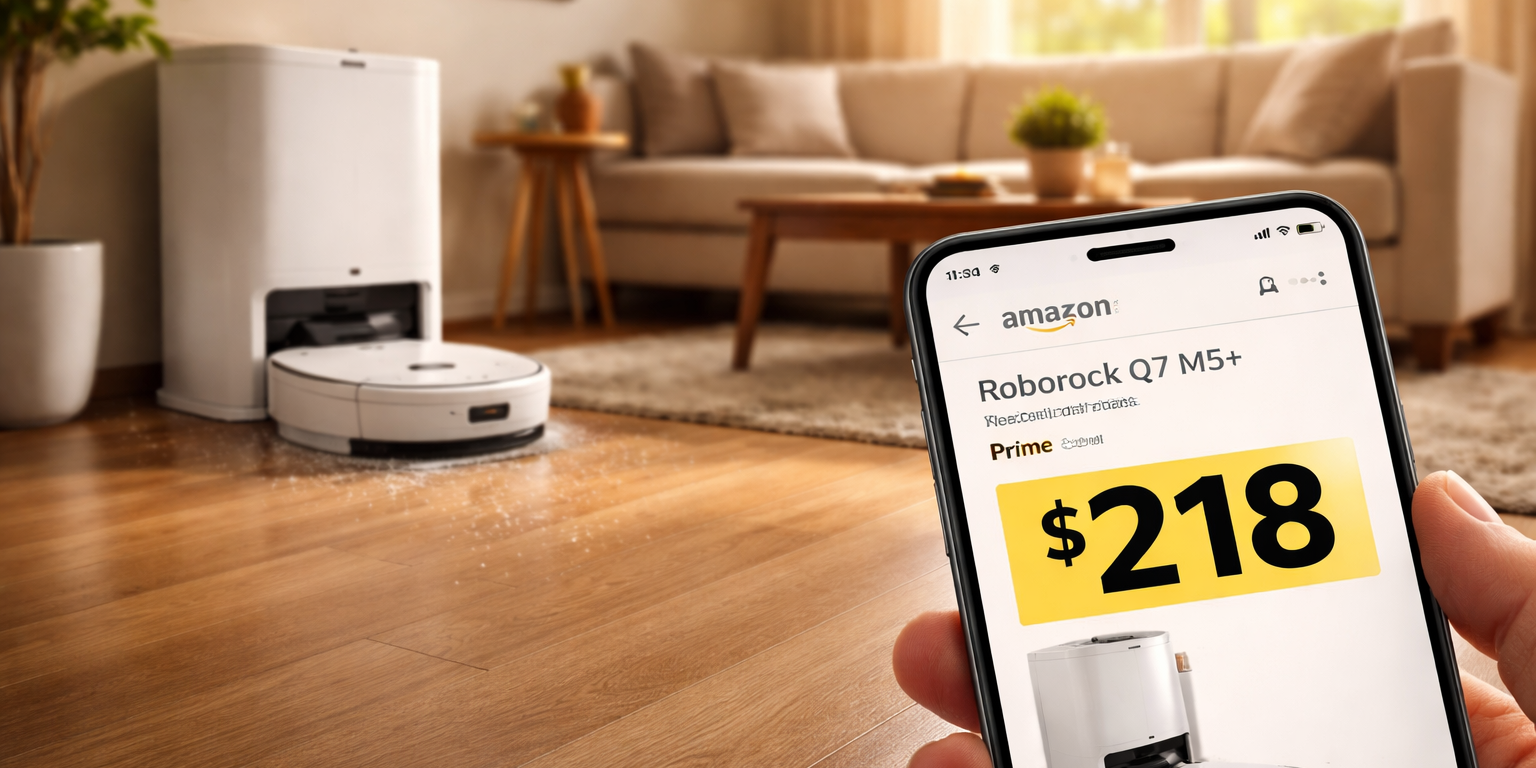
Roborock's Q7 M5+ vacuum-mop combination unit now sells for $218 through Amazon Prime, down from a $360 list price and representing a 39% discount on hardware that includes autonomous navigation, dual-function cleaning, and a self-emptying base station. The pricing move arrives as consumer robotics manufacturers face margin compression across multiple product tiers, with brands from Shenzhen-based startups to established Boston firms cutting street prices to maintain unit volume. The Q7 M5+ offers 10,000Pa suction power, a specification that places it in the mid-performance tier of residential vacuum robots currently available in North America.
The unit combines vacuuming and mopping functions in a single chassis, eliminating the need for separate appliances or manual intervention between cleaning modes. Its self-emptying base station stores debris for seven to nine weeks under typical usage conditions, addressing one of the persistent friction points in consumer robot adoption. Roborock, which began as a Xiaomi subsidiary before spinning out as an independent entity, has steadily increased its North American market share since 2022 by targeting the vacuum-mop hybrid segment where iRobot's Roomba Combo line and Ecovacs' Deebot series compete. The company manufactures primarily in China and distributes through Amazon as its dominant channel in the United States, leveraging Prime's logistics network to reduce delivery times and customer acquisition costs.
Pricing dynamics in the consumer robotics vacuum category have shifted substantially over the past eighteen months. Mid-tier units with self-emptying docks routinely commanded $400 to $600 retail in early 2025, but aggressive competition from Chinese manufacturers and Amazon's private-label Eufie brand has driven street prices downward. The Q7 M5+ at $218 undercuts iRobot's comparable Roomba j7+ by approximately $280 at current Amazon pricing, while offering similar navigation capabilities and dual cleaning modes. Component costs for LiDAR sensors, brushless motors, and lithium battery packs have declined roughly 15% year-over-year according to supply chain data, enabling manufacturers to maintain gross margins even as retail prices fall. Roborock's vertical integration, including in-house development of motor controllers and navigation algorithms, provides additional cost advantages relative to brands sourcing these subsystems externally.
The consumer robotics vacuum market generated $4.8 billion in global revenue during 2025, with North America accounting for 31% of unit sales. Penetration rates remain below 18% in U.S. households, leaving substantial headroom for category growth, but customer acquisition costs have risen as competing brands increase advertising spend. Amazon's dominance as a distribution channel concentrates pricing power, with the platform capturing an estimated 64% of online robot vacuum sales in the United States. Manufacturers face a strategic tension between maintaining brand equity through premium pricing and achieving the volume necessary to amortize R&D investments in navigation software, obstacle avoidance, and battery management systems. Roborock's decision to discount the Q7 M5+ by $141 suggests the company prioritizes market share growth over short-term margin preservation, a strategy that aligns with its publicly stated goal of expanding its installed base before competitors establish stronger network effects through app ecosystems and consumable sales.
What to Watch: Monitor whether iRobot responds with comparable price cuts on the Roomba j7+ or Combo series by mid-July 2026, which would signal broader margin pressure across the category. Track Roborock's quarterly earnings through Q3 2026 for insights into whether discounted pricing drives sufficient volume to offset reduced per-unit revenue. Watch for Amazon Prime Day in mid-July 2026, where further promotional pricing could establish new baseline expectations for mid-tier vacuum-mop units. Observe whether Ecovacs or Shark introduce competing models below $250 with self-emptying docks before the holiday selling season begins in October 2026.