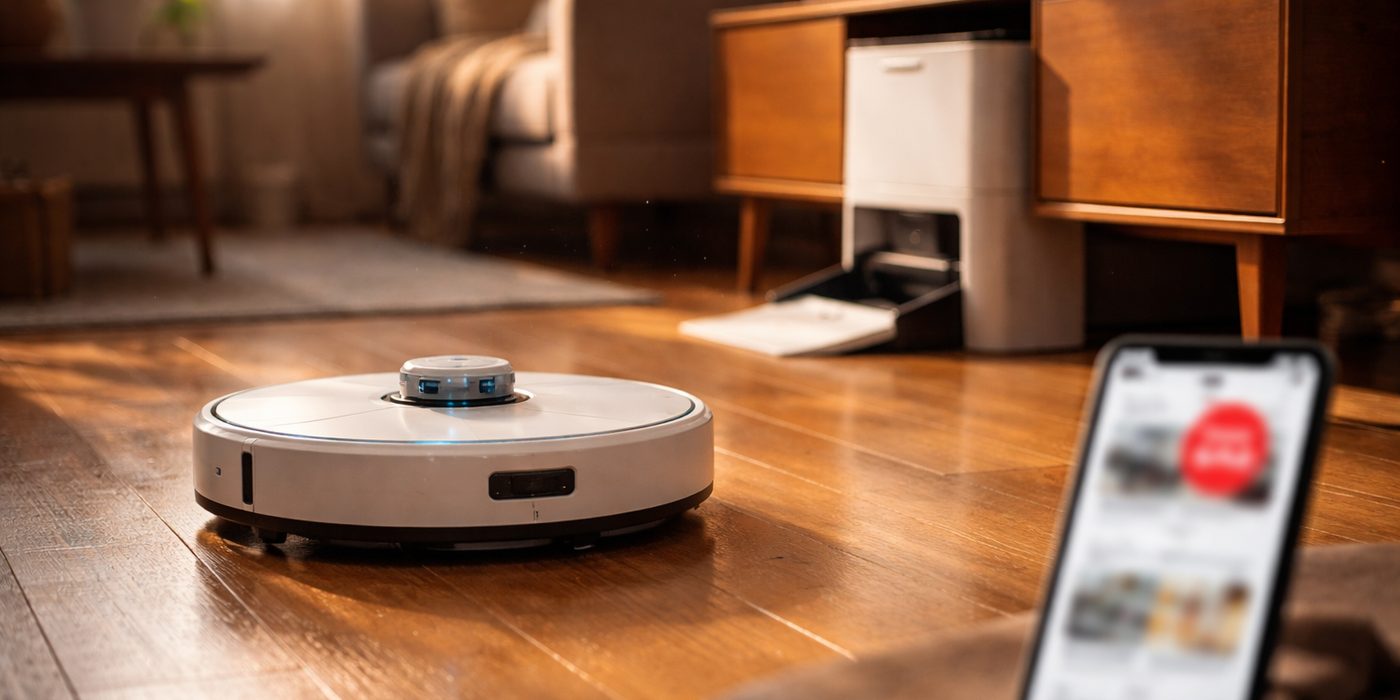
A robot vacuum with a spinning laser rangefinder, a self-emptying dock and a vibrating mop pad is now selling for less than many people spend on a single month of grocery delivery. That is the practical meaning of Amazon's 31% cut on the Roborock Q7 M5+, which takes more than $100 off the list price of a machine that, three years ago, would have been priced as a flagship. The headline discount is a retail event. The underlying fact is a hardware one: LiDAR, once a differentiator reserved for $600-plus units, has become a commodity component in the mid-tier, and the dock that empties the dustbin has followed it down the price curve.
The path to this price runs through a decade of component deflation and a fiercely competitive Chinese manufacturing base. Roborock, based in Beijing and listed on Shanghai's STAR Market, built its reputation on LiDAR-first navigation when rivals were still leaning on cheaper gyroscope-and-bumper systems that wandered rooms in unpredictable patterns. Laser distance sensors that cost tens of dollars in the mid-2010s now cost a fraction of that at volume, and the economies of scale from shipping millions of units annually have let Roborock, Ecovacs, Dreame and others pass those savings through while still hitting target margins. The Q7 M5+ sits in the middle of Roborock's lineup, below the company's premium S-series, yet it inherits the core mapping approach that made those models popular.
The specifics matter for anyone benchmarking the category. The Q7 M5+ pairs LiDAR-based simultaneous localization and mapping with a suction rating Roborock quotes at 10,000 Pa, a figure that has become a marketing shorthand across the industry even though real-world pickup depends far more on brush design and airflow geometry than on a peak pressure number. The bundled auto-empty dock evacuates the onboard bin into a sealed bag, which is the feature that actually changes user behavior: owners go from emptying a dustbin daily to swapping a bag every several weeks. The mopping function uses a vibrating pad that Roborock markets as scrubbing at a high pulse rate, a step up from the passive drag pads on older models, though it still lacks the lifting mop mechanism found on pricier siblings.
For robotics professionals, the interesting signal is less the vacuum than the pricing power it reveals, or fails to reveal. When a company can run a 31% promotion on a current-generation product and still move volume profitably, it suggests either fat list-price margins or very aggressive cost engineering, and likely both. Retailers use these discounts to anchor perceived value, which means the sale price increasingly resembles the true market price while the list price becomes a reference fiction. That dynamic pressures Western incumbents such as iRobot, which has struggled financially as lower-cost competitors matched its navigation capability at a fraction of the cost. It also raises the bar for any startup hoping to enter home robotics: the baseline user expectation of reliable mapping, app control and self-maintenance is now set at a price point that leaves little room for new entrants to charge a premium for basic autonomy.
There is a broader lesson for those building the next wave of domestic machines, from window cleaners to lawn mowers to the humanoids that investors keep promising will fold laundry. The robot vacuum is the proof case that a home robot can cross from novelty to appliance, and it did so by relentlessly driving down the cost of perception and by solving a narrow task extremely well. Each step in that journey, from random-walk bumpers to camera navigation to LiDAR mapping to self-emptying docks, was a feature that first appeared at the premium tier and then compressed into the budget tier within a few product cycles. Anyone modeling the adoption curve for more ambitious household robots would do well to study how long that compression actually took, and how little of the value ended up captured by the earliest movers.
What to Watch Holiday-season pricing is the near-term tell: watch whether Roborock, Dreame and Ecovacs hold or deepen discounts on LiDAR-equipped, self-emptying models through Black Friday and Cyber Monday in late November 2026, since sustained cuts would confirm that margins on this tier are thinner than list prices imply. Track iRobot's next quarterly earnings for any sign that its Roomba line is stabilizing or continuing to cede share to Chinese rivals. Keep an eye on whether Roborock extends its lifting-mop and robotic-arm features, now confined to premium models, into mid-tier products over the next two quarters. Finally, monitor U.S. tariff and import-duty developments affecting Chinese-made consumer robots, which could erase promotional discounts like this one almost overnight.